CyberArk Course Syllabus
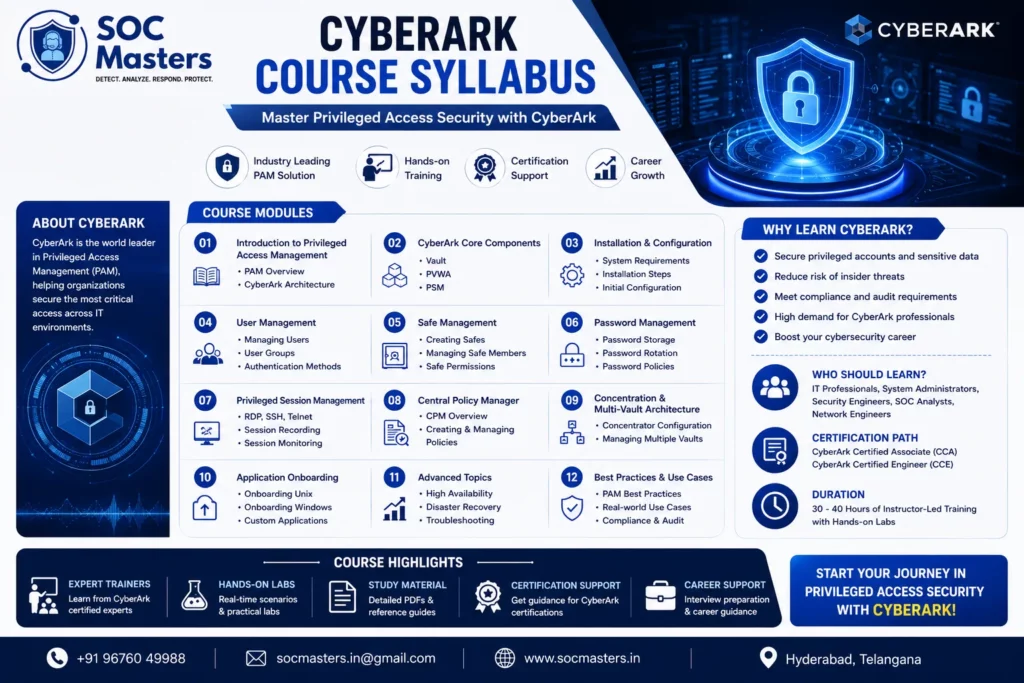
A CyberArk Course Syllabus typically covers PAM fundamentals, CyberArk architecture and component communication, the Digital Vault, PVWA, CPM and PSM, Safes and safe permissions, privileged account onboarding, access policies and least privilege, session monitoring, auditing and reporting, troubleshooting, and API-based automation. Most structured programmes close with real-time implementation projects and certification-oriented revision aligned to the Defender and Sentry exam tracks.
Introduction
CyberArk is the platform most large enterprises use to control who can log in as an administrator — and to prove it afterwards. It vaults privileged credentials, rotates them on a schedule, brokers the login so the human never sees the password, and records the session for audit.
Privileged Access Management (PAM) matters because administrator accounts are the shortest path from a phishing email to a domain compromise. Credential theft and abuse remain among the most reliably exploited attacker behaviours in the MITRE ATT&CK Enterprise matrix, which is why the BFSI, pharma and healthcare GCCs around HITEC City and Gachibowli treat PAM as a control they must evidence, not just deploy.
That is why learners look for a structured CyberArk Course Syllabus before enrolling anywhere. PAM is a narrow, deep skill you cannot bluff in an interview or learn from documentation alone, because the hard parts only appear when a CPM plugin fails to reconcile.
This guide sets out what a complete syllabus should contain, module by module, and what to check when comparing options for CyberArk Training in Hyderabad — including what most course pages have not updated: CyberArk is now part of Palo Alto Networks, and the portfolio was rebranded in May 2026.
What is CyberArk?
CyberArk is an identity security platform built around Privileged Access Management. Founded in 1999, it became the reference implementation for credential vaulting in large enterprises. It does four things:
- Stores privileged credentials — domain admin, root, service accounts, database sysadmin, network device passwords — in a hardened, encrypted Digital Vault.
- Rotates them automatically, so a leaked password has a short useful life.
- Brokers access, so an administrator reaches a target server without ever handling the password.
- Records the privileged session, producing the evidence auditors ask for.
Typical use cases: isolating domain administrator access, managing service account passwords hard-coded into applications, giving vendors time-boxed access without VPN credentials, and satisfying audit requirements under SOX, PCI DSS and RBI cybersecurity guidance.
What changed in 2026: Palo Alto Networks completed its acquisition of CyberArk in February 2026 and, on 12 May 2026, launched Idira, a rebranded platform covering human, machine and AI agent identities. For learners the practical impact is limited: Vault, PVWA, CPM and PSM remain the components you install and troubleshoot, and the Defender, Sentry and Guardian certification names remain current. A current CyberArk Training Course should mention the transition rather than ignore it.
What is CyberArk Privileged Access Management?
Privileged Access Management is the practice of controlling, monitoring and recording the accounts that can change a system rather than merely use it. A normal user account can read a file; a privileged account can delete the file server. That difference is the whole discipline.
CyberArk Privileged Access Management works through a small number of ideas:
- Privileged accounts — administrator, root, service, application and "break-glass" accounts are inventoried and brought under management.
- Credential custody — the password lives in the Vault, not a spreadsheet, a script, or someone's memory.
- Password security — credentials rotate automatically on a policy schedule, and after every use if configured that way.
- Access control — Safe permissions and platform policy decide who may request which account, not informal trust.
- Session monitoring — privileged sessions are proxied, recorded and searchable.
- Least privilege — access is granted narrowly and only for the window it is needed.
- Threat reduction — a stolen credential is already rotated, or the session is recorded and flagged.
Understanding these ideas before touching the console separates candidates who pass a technical interview from those who can only list component names.
CyberArk Course Syllabus Overview
A complete CyberArk Course Syllabus moves from concepts to components to operations to projects:
- Cybersecurity and PAM fundamentals
- CyberArk architecture and component communication
- Digital Vault
- Safes and safe permissions
- Password management and rotation policy
- PVWA (Password Vault Web Access)
- CPM (Central Policy Manager)
- PSM (Privileged Session Manager)
- Privileged account discovery and onboarding
- Access policies and least privilege
- Monitoring, auditing and reporting
- Troubleshooting
- Automation, APIs and integrations
- Real-time implementation projects
- Certification and interview preparation
Most instructor-led programmes cover this in roughly 40 to 60 hours. Anything materially shorter is a demo, not training.
CyberArk Course Syllabus – Complete Module Breakdown
Module 1: Cybersecurity and PAM Fundamentals
Groundwork: the CIA triad, authentication versus authorisation, and where PAM sits within identity security. You classify privileged account types — interactive admin, service, application, domain, local, break-glass — and study why each is exploited differently, then cover least privilege and the shift from standing privilege to just-in-time access.
Module 2: CyberArk Architecture
The component map and, more importantly, the traffic between components: Vault, PVWA, CPM, PSM, PSMP and PTA. You learn which ports each uses, why the Vault is isolated behind its own hardened firewall, and how a request flows from browser to Vault to target. Self-hosted, Privilege Cloud and hybrid deployment models are compared here.
Module 3: CyberArk Digital Vault
The Vault is the trust anchor. Covers the layered encryption model, server and recovery keys, its authentication methods, and Disaster Recovery replication and clustering — nobody runs a single Vault in production.
Module 4: Safes and Account Management
Safes are the access control boundary. Covers naming conventions that survive an audit, the permission matrix — use, retrieve, list, add, update, delete, manage members, initiate CPM operations — and how these combine with platform policy. Poor Safe design is the most common cause of a failed PAM rollout.
Module 5: PVWA — Password Vault Web Access
The interface most users experience. Covers account search and retrieval, show/copy/connect actions, dual control and request workflows, ticketing integration so a request must reference a change ticket, and exclusive access with check-out/check-in.
Module 6: CPM — Central Policy Manager
The engine that rotates credentials. Covers platform policies, verify/change/reconcile operations and the difference between them, and CPM plugins for Windows, Unix, databases, network devices and cloud targets. Most production incidents originate here, so this module is heavily hands-on.
Module 7: PSM — Privileged Session Manager
Session isolation and recording. Covers the PSM RDS server, connection components, how RemoteApp isolates the target from the user's endpoint, recording storage and retention, live monitoring and termination, and PSMP for SSH targets.
Module 8: Privileged Account Onboarding
Discovery and onboarding is most of a PAM engineer's early work. Covers Accounts Discovery, bulk onboarding via file upload and REST API, platform assignment, dependent and service account handling, and rules that route discovered accounts into the right Safe.
Module 9: Policies and Access Control
Master policy and platform settings, password complexity and rotation intervals, role-based access mapped to Active Directory groups, dual control, approval chains and time-based restrictions. The exercise: translate a written security policy into working configuration.
Module 10: Monitoring, Auditing and Reporting
Covers the Vault audit log, PVWA reports, session recording search and playback, SIEM integration so PAM events reach the security operations team, and the reports auditors request. Learners grounded in cybersecurity fundamentals move fast here.
Module 11: Troubleshooting
The module that decides interview outcomes. Realistic scenarios include:
- CPM reports a password change failure — credentials, connectivity, plugin configuration, or target policy?
- A PSM session disconnects immediately — connection component, RDS licensing, or target firewall?
- PVWA returns an authentication error after an LDAP change.
- Reconcile fails while change succeeds — what does that say about the reconciliation account?
You learn where each component's logs live and how to read them in sequence.
Module 12: Automation and Advanced Concepts
REST API usage for onboarding, safe creation and reporting; PowerShell and Python scripting; Credential Provider and Central Credential Provider for removing hard-coded credentials from application code; and ITSM, SIEM and identity governance integration.
Module 13: Real-Time CyberArk Projects
Project work is what makes CyberArk Hands-on Training worth paying for:
- Onboard Windows domain admin and Unix root accounts end to end, from discovery to verified rotation.
- Build a Safe and permission structure for three teams, then prove separation with a test user.
- Configure PSM recording for a database server and demonstrate live session termination.
- Design and document a PAM implementation for a 500-server environment.
- Automate onboarding of fifty accounts via REST API and generate a compliance report.
Module 14: CyberArk Certification Preparation
Exam-oriented revision mapped to current certification tracks: blueprint walkthroughs, timed practice questions, scenario drills and mock interviews.
CyberArk Course Syllabus
Chat on WhatsAppCyberArk Course Syllabus for Beginners
A CyberArk Course for Beginners should not start with the Vault. It should start with prerequisites, because CyberArk sits on top of infrastructure you must already understand:
- Windows Server — Active Directory, domain accounts, group policy, RDP, local admin accounts.
- Linux — users and groups, sudo, SSH keys, file permissions, service accounts.
- Networking — TCP/IP, ports, firewalls, DNS, and how to test connectivity when something fails.
- Identity and access management — authentication factors, directory services, LDAP, SSO.
- Cybersecurity fundamentals — the credential theft attack chain and common compliance drivers.
Two to four weeks here saves far more time later. A learner who cannot check whether port 1858 is open cannot troubleshoot a Vault connection failure, however many modules they have watched.
CyberArk Training for Working Professionals
PAM is unusually friendly to career switchers, because most of the surrounding knowledge transfers directly.
Those from a monitoring background transition naturally — the investigative habits built around alert triage and SOC analyst work map onto PAM troubleshooting. Studying evenings and weekends, three to four months to job-ready competence is realistic.
Skills You Learn from CyberArk Training
- Privileged Access Management design and operations
- Identity security concepts and account classification
- Account discovery, onboarding and lifecycle management
- Automated password rotation and reconciliation
- Session isolation, recording and live monitoring
- Access control design using Safes, permissions and platform policy
- SIEM integration for PAM events
- Structured troubleshooting across Vault, CPM, PSM and PVWA
- REST API automation for bulk operations
- Compliance reporting and audit evidence preparation
CyberArk Tools and Components Covered
Chat on WhatsAppCyberArk Training in Hyderabad
Hyderabad is a sensible place to learn PAM for a structural reason: the city's Global Capability Centre concentration means much of the local security work is enterprise security operations for overseas parents — banks, insurers, pharmaceutical firms and healthcare payers, all running PAM under audit obligations. Job aggregators in 2026 have consistently placed Hyderabad in the top two Indian cities for CyberArk-tagged openings alongside Bengaluru, though such counts are directional.
When comparing options for CyberArk Training in Hyderabad, judge programmes on these criteria rather than marketing claims:
- Lab access, not screen-sharing. You need an environment where you can break a CPM plugin and fix it. Ask how many hours of independent lab access are included, and for how long after the course ends.
- Trainer's production background. Ask which version they last deployed and what went wrong. A trainer with real implementation history answers immediately and in detail.
- Troubleshooting as a taught module. Many syllabi list only happy-path configuration. Interviews do not.
- Current platform coverage. The syllabus should acknowledge the Palo Alto Networks acquisition and cover Privilege Cloud alongside self-hosted deployment.
- Certification alignment. Modules should map to the published Defender and Sentry exam domains.
- Interview preparation with real scenarios. Architecture explanation and failure diagnosis, assessed by someone who has conducted PAM interviews.
Instructor-led delivery matters more here than in most subjects, because the questions that arise during a failed reconcile are not answerable from a recording. If you are choosing between a general security foundation and a tool specialisation, a broader cyber security course in Hyderabad can be the better first step before narrowing into PAM.
Enroll for Free DemoCyberArk Career Opportunities in Hyderabad
CyberArk skills map to a defined set of roles:
- CyberArk Administrator — daily operations, onboarding, rotation failures, user requests. The usual entry point.
- PAM Engineer — configuration, platform development, integrations, upgrades.
- IAM Engineer — broader identity remit where CyberArk is one platform among several.
- CyberArk Security Engineer — deployment, hardening, DR configuration, security review.
- PAM Consultant — client-facing assessment, design and implementation at a services firm.
- Cybersecurity Analyst — roles where PAM alert handling sits inside a wider monitoring function.
Demand splits between GCC in-house security teams and the services firms delivering PAM implementations for overseas clients. The services route gives faster exposure to multiple environments; the GCC route gives greater depth in one.
CyberArk Roles
CyberArk Salary and Career Growth in Hyderabad
Read published CyberArk salary figures carefully. A common error is quoting Glassdoor data for "CyberArk salaries in Hyderabad" — that page reports what the company CyberArk pays its own software engineers, which is unrelated to what an enterprise pays a CyberArk administrator. The two are routinely conflated in course marketing.
Rather than quote a number as a promise, here is what actually moves compensation for CyberArk professionals in Hyderabad:
- Hands-on implementation history. Candidates who have onboarded accounts in production negotiate from a different position than those with lab-only exposure. This is the largest single factor.
- Breadth across components. Administrators who only operate PVWA plateau. Those handling CPM plugin development, PSM connection components and REST API automation do not.
- Certification. Defender and Sentry credentials clear screening filters and are often a stated requirement at services firms bidding for client work.
- Adjacent cloud skills. Privilege Cloud, cloud credential rotation and CI/CD secrets management carry the current premium.
- Multi-vendor exposure. Familiarity with BeyondTrust or Delinea widens the addressable market.
- Audit and compliance fluency. Engineers who can produce evidence and speak to auditors are disproportionately valuable in BFSI and healthcare GCCs.
For indicative numbers, check live listings on Naukri, LinkedIn and AmbitionBox filtered to Hyderabad and your experience band on the day you negotiate. Any figure published in an article is an aggregate estimate, not a guaranteed outcome.
CyberArk Career Roadmap
CyberArk Certification and Career Benefits
The certification ladder runs from Trustee (foundational awareness) through Defender (operations), Sentry (deployment and configuration), Guardian (advanced architecture), and CDE specialisations for individual products.
For most learners the target is CyberArk Defender – PAM (PAM-DEF): a multiple-choice exam of roughly 90 minutes with a 70% pass mark, covering PAM concepts, architecture, Safe management, account management, password management and session management. Sentry – PAM (PAM-SEN) follows, focused on deployment, installation and configuration. Reporting since late 2025 indicates CyberArk exams moved to in-person delivery rather than online proctoring, so confirm current format, fees and eligibility on the official certification page before registering.
What certification gives you:
- Skill validation against a published, vendor-defined blueprint.
- Screening advantage — many Hyderabad job descriptions list Defender as required or preferred.
- Structured revision that forces coverage of components you might otherwise avoid.
- Credibility in client-facing work, where services firms need certified staff on the delivery team.
Certification alone does not produce offers; certification plus demonstrable project work does.
Enroll for Free DemoCyberArk Interview Preparation
CyberArk interviews are predictable in structure and unforgiving in detail. Prepare across:
- PAM concepts — privileged access, least privilege, just-in-time access, and why standing privilege is a risk.
- Architecture — draw the component map from memory and explain the traffic between each component and the Vault.
- Vault — encryption model, server key handling, DR replication.
- Safes — permission matrix, and how Safe permissions interact with master policy.
- PVWA — dual control, exclusive access, ticketing integration.
- CPM — verify versus change versus reconcile, and when each is triggered.
- PSM — connection components, recording storage, live monitoring.
- Onboarding — discovery workflow, bulk methods, dependent accounts.
- Troubleshooting — expect at least one "the CPM cannot change this password, walk me through your diagnosis" question. Answer as a sequence, not a guess.
- Project experience — environment size, what you configured, what broke, how you fixed it.
Candidates preparing for broader security roles also work through SOC analyst interview questions, since incident-response reasoning appears in both formats.
Who Should Learn CyberArk?
- Freshers willing to learn Windows, Linux and networking first
- Cybersecurity professionals wanting a specialisation with a defined career ladder
- IAM professionals extending from identity governance into privileged access
- System administrators whose AD and server knowledge transfers almost entirely
- Network security professionals familiar with device credential management
- Cloud security professionals working on secrets management
- IT operations staff seeking a structured route into security
CyberArk is a poor fit for anyone unwilling to work in a lab — it is a configuration and troubleshooting discipline, not a conceptual one.
Common Mistakes While Learning CyberArk
- Learning only theory. You can recite what CPM does and still fail every practical question. Configure it.
- Skipping PAM fundamentals. Without understanding why privileged accounts are targeted, configuration choices become arbitrary memorisation.
- Ignoring prerequisites. Weak Windows, Linux and networking knowledge caps your ceiling, and it shows in troubleshooting.
- Never breaking anything. Deliberately misconfigure a plugin, then diagnose it. That teaches more than three modules of happy-path clicking.
- Treating architecture as a diagram to memorise. Interviewers ask why the Vault is isolated and what happens if PVWA cannot reach it.
- Chasing certification first. A certificate with no project history is obvious in an interview.
- Avoiding the API. Automation is where mid-level roles are heading, and the fastest way to differentiate yourself.
- Ignoring documentation habits. Real PAM work is half configuration, half evidence.
Key Takeaways
- A credible CyberArk Course Syllabus covers architecture, all core components, onboarding, policy, monitoring, troubleshooting and automation — not just PVWA navigation.
- Prerequisites in Windows, Linux, networking and IAM decide how far you get.
- Troubleshooting and real-time projects are what interviews test. Prioritise lab time over video hours.
- Defender – PAM is the practical certification target; Sentry follows for deployment roles.
- CyberArk now sits within Palo Alto Networks under the Idira brand, but Vault, PVWA, CPM and PSM skills remain the working currency.
- Treat published salary figures as directional estimates and verify against live listings.
Conclusion
CyberArk rewards depth. The syllabus above is long because privileged access management genuinely has that much surface area — and because the difference between a candidate who gets an offer and one who does not is usually a single troubleshooting question answered from experience rather than recall.
If you are evaluating CyberArk Training in Hyderabad, use this syllabus as a checklist. Ask any provider how many independent lab hours are included, whether troubleshooting is taught as its own module, what the trainer has deployed in production, and how the content maps to the Defender and Sentry exam domains. Providers who answer those four specifically are worth your time.
SOC Masters delivers instructor-led cybersecurity training in Kukatpally, Hyderabad, with hands-on lab work and interview preparation. To discuss the CyberArk PAM programme, batch schedules and fees, speak to the team.
Call or WhatsApp: +91 96760 49988 Message us on WhatsApp · Contact SOC Masters
Frequently Asked Questions
1. What is included in a CyberArk Course Syllabus?
PAM fundamentals, architecture, Digital Vault, Safes and permissions, PVWA, CPM, PSM, account onboarding, access policies, monitoring and auditing, troubleshooting, API automation, real-time projects and certification preparation.
2. Is CyberArk difficult to learn?
Moderately difficult, and the difficulty is mostly infrastructure knowledge rather than CyberArk itself. Learners with solid Windows, Linux and networking backgrounds progress quickly.
3. Is CyberArk good for beginners?
Yes, provided prerequisites in operating systems, networking and identity basics come first. CyberArk is not a suitable first-ever IT subject.
4. What skills are required to learn CyberArk?
Windows Server and Active Directory, Linux fundamentals, TCP/IP and firewall basics, IAM concepts, and basic PowerShell or Python for automation modules.
5. How long does CyberArk training take?
Instructor-led programmes typically run 40 to 60 hours over six to ten weeks. Job-ready competence, including lab practice and projects, usually takes three to four months.
6. Is CyberArk certification worth it?
Yes, as a screening advantage and revision framework — particularly Defender – PAM. It is not sufficient alone; project evidence carries more weight in interviews.
7. What is CyberArk PAM?
CyberArk PAM vaults privileged credentials, rotates them automatically, brokers access without exposing passwords, and records privileged sessions for audit.
8. What are the main CyberArk components?
Digital Vault, PVWA (Password Vault Web Access), CPM (Central Policy Manager), PSM and PSMP (Privileged Session Manager, including the SSH proxy), and PTA (Privileged Threat Analytics).
9. What jobs can I get after CyberArk training?
CyberArk Administrator, PAM Engineer, IAM Engineer, CyberArk Security Engineer, PAM Consultant, and analyst roles covering privileged access monitoring.
10. Is CyberArk Training in Hyderabad useful for working professionals?
Yes. Hyderabad's GCC and IT services concentration creates steady demand for PAM skills, and system administrators, network security engineers and IAM professionals transfer across with most of their knowledge intact. Evening and weekend batches make CyberArk Training in Hyderabad workable alongside a full-time job.
11. What is the difference between CyberArk and IAM?
IAM governs identity and access for all users. CyberArk focuses on privileged accounts — the subset with administrative power — adding vaulting, rotation, session isolation and recording that general IAM platforms do not provide.
12. Has CyberArk changed after the Palo Alto Networks acquisition?
Palo Alto Networks completed the acquisition in February 2026 and launched Idira in May 2026. Core PAM technology and the Defender, Sentry and Guardian certification names remain in place, so existing skills continue to apply.