SOC Analyst Training in Hyderabad
Looking for the best SOC Analyst Training in Hyderabad? A quality SOC training program helps you learn real-world cybersecurity skills such as SIEM monitoring, threat detection, incident response, log analysis, vulnerability management, and security operations. Choose a course that includes live projects, SOC lab practice, experienced trainers, certification guidance, interview preparation, and placement assistance to build a successful career as a Security Operations Center (SOC) Analyst.
SOC Analyst Training in Hyderabad — Course Overview
We built this SOC Analyst course in Hyderabad for real Security Operations Center work — not theory. You’ll learn to monitor environments, investigate alerts, hunt threats and respond to incidents using the same SIEM platforms and detection frameworks that enterprise blue teams rely on every day.
Detection & Monitoring
Configure SIEM dashboards, write detection rules, and triage real alerts across endpoints, network, and cloud telemetry.
Incident Response
Follow structured IR playbooks — contain, eradicate, recover — and document findings the way SOC teams report them.
5+ Enterprise Projects
Use the MITRE ATT&CK framework and threat intelligence to proactively find adversary behaviour before it escalates.
3
Months Duration
12+
SIEM & Security Tools
9+
Hands-on Labs
5+
Real-Time Projects
Why choose SOC Masters for SOC Analyst training?
Practical, job-oriented training focused on live SIEM work and real investigation scenarios rather than tool tours — with the things most institutes leave off the page put on it.
The fee is on this page
You did not have to hand over your phone number to find out what it costs. Open five competing pages for this course and count how many publish a price. That tells you what the enquiry call is really for.
A practitioner teaches it
Mr. Dhinesh 20+ years in security operations. Ask us on the call which SIEM platforms he has run in production, and in what kind of environment. Ask the other institutes the same question and see how quickly they answer.
A real SIEM, not screenshots
Nine named lab exercises and six capstone investigations, all listed below, so you can hold them up against anyone else’s “100% practical training” claim.
Current to 2026
CompTIA replaced CySA+ CS0-003 with CS0-004 in June 2026. Cisco renamed CyberOps Associate to CCNA Cybersecurity in February 2026. Microsoft restructured SC-200 in April 2026. Most SOC pages in Hyderabad still list the old codes. Ours doesn’t.
We say no
There is a “this course does not fit you” list further down. We would rather lose an enrolment than take one from someone who needs Windows and networking fundamentals first — because that person will not finish.
No guaranteed-placement claim
Placement assistance is defined in writing below. We do not promise 100% placement or a specific salary, because no institute can honestly deliver either, and you already know that.
What is a SOC Analyst, and what does the job involve?
A SOC Analyst is the person inside a Security Operations Centre who monitors security alerts, investigates whether they represent a real attack, and either resolves them or escalates them. The role is tiered: L1 analysts triage the alert queue and handle known patterns, L2 analysts run deeper investigations and tune detections, and L3 analysts hunt for threats no rule caught. Most SOCs run 24×7 on rotating shifts.
On a normal shift you work a queue. An alert fires — a failed logon burst, an unusual PowerShell command line, a user clicking a link on a domain registered four hours ago. Your job is to decide, with evidence, whether it is benign, a misconfiguration, or the early stage of an intrusion. That means pivoting across log sources, checking the asset’s normal behaviour, enriching indicators against threat intelligence, and writing it up so the next person can follow your reasoning. Mapping the activity to MITRE ATT&CK is how you communicate what you found without ambiguity.
Background reading: our breakdown of SIEM architecture and the fundamentals the role assumes.
Where SOC analysts work in Hyderabad
Why learn SOC Analyst skills in 2026?
SOC analyst remains one of the few genuine entry doors into cybersecurity that does not require years of prior security experience. What has changed in 2026 is what “entry level” means — the bar has moved from tool familiarity to demonstrable investigation ability.
Shift coverage creates headcount
A 24×7 SOC is a staffing problem before it is a technology problem. Round-the-clock rosters mean a floor of analyst headcount that does not disappear in a slow quarter.
Hyderabad is a delivery city
The city staffs SOC operations for global clients out of its GCC and IT-services delivery centres. You are competing for offshore delivery seats filled from here, not a handful of local jobs.
The entry door is real but narrow
Every second CV says “cybersecurity”. Very few say “here are six investigations I ran, mapped to ATT&CK, with the reports attached”. That gap is where offers are decided.
Cloud and identity moved the work
The alerts that matter increasingly come from identity providers and cloud control planes, not perimeter firewalls. Analysts who can read sign-in logs and cloud audit trails are the ones promoted out of L1.
Caveat: L1 is the automatable tier
Be clear-eyed. Repetitive triage of known-good and known-bad alerts is the layer automation is eating first — and that is the entry rung. Our answer is the syllabus: disproportionate time on investigation reasoning and incident write-up. Get past L1 fast.
What we won't claim
That there are “50,000+ SOC analyst openings for freshers in Hyderabad”. There aren’t. It is a real, competitive, mid-sized market. Anyone inflating the number is hoping you won’t check.
Who should join this SOC Analyst course?
This SOC Analyst course in Hyderabad suits freshers with genuine IT fundamentals and experienced professionals moving into security — support and NOC engineers, Windows and Linux administrators, network engineers, and IT graduates who can already read a log file.
This course fits you if…
- You are an L1/L2 IT support or NOC engineer ready to move into security
- You administer Windows Server or Linux day to day
- You are a network engineer comfortable with TCP/IP, firewalls and proxies
- You are a fresher with real fundamentals — not just a degree certificate
- You are a system admin who wants the detection and response side
- You already hold Security+ or CCNA and want the operational layer on top
- You work at L1 in a SOC and want to build toward L2 and detection engineering
This course does not fit you if…
- You cannot explain what an IP address and a port are — learn networking first
- You have never used a command line on Windows or Linux
- You want a guaranteed job — no honest institute offers that
- You expect to be "SOC certified" in two weeks with no effort
- You want offensive security or ethical hacking — this is the defensive side
- Not ready yet? Tell us on the enquiry call and we will say so — and tell you exactly what to learn first.
Prerequisites & eligibility for SOC Analyst training
There is no formal eligibility bar — no degree requirement, no minimum percentage, no age limit. What matters is whether you have the four technical fundamentals below.
Required — you'll struggle without these
- TCP/IP fundamentals — ports, protocols, what a three-way handshake looks like, why 445 and 3389 matter
- Windows basics — users, groups, services, and opening Event Viewer without help
- Linux command line — cd, grep, tail, cat, reading /var/log/
- Security literacy — you can explain why reusing a password across systems is a problem
Helpful, not required
- Any scripting exposure — Python or PowerShell, even beginner level
- Prior certification: Security+, CCNA, or CCNA Cybersecurity
- Virtualisation basics (VMware, VirtualBox, Hyper-V) for building your own lab later
- Cloud fundamentals — Entra ID or AWS IAM concepts
- Regular expressions — you will use them from module 5 onward
Formal eligibility: none. We have trained graduates with backlogs and non-IT career changers who did the fundamentals work first. On the enquiry call we check whether the four required items above are actually in place — and if they are not, we tell you what to learn first instead of taking your money today. That conversation costs us enrolments. It is also why our learners finish.
SOC Analyst Course Curriculum & Syllabus
Module 1: Cyber Security Fundamentals
- Introduction to Cyber Security
- CIA Triad
- Threats, Vulnerabilities & Risks
- Cyber Kill Chain
- Security Domains
- Blue Team vs Red Team
- Security Best Practices
Module 2: Networking Essentials for SOC Analysts
- OSI & TCP/IP Models
- IP Addressing & Subnetting
- Common Ports & Protocols
- DNS, DHCP, HTTP, HTTPS
- VPN & Firewalls
- Packet Flow Analysis
- Network Troubleshooting Basics
Module 3: Windows & Active Directory Security
- Windows Architecture
- Active Directory Concepts
- Authentication & Authorization
- Group Policies (GPO)
- Windows Event Logs
- PowerShell Basics
- Windows Security Best Practices
Module 4: Linux Administration & Security
- Linux File System
- Essential Linux Commands
- User & Permission Management
- Process & Service Management
- Log Management
- SSH Security
- Linux Hardening Basics
Module 5: SIEM Fundamentals (Microsoft Sentinel & Splunk)
- Introduction to SIEM
- Log Collection & Normalization
- Correlation Rules
- Alert Monitoring
- Dashboard Analysis
- KQL Basics
- Splunk Search Language (SPL) Basics
Module 6: Log Analysis & Security Monitoring
- Windows Security Logs
- Linux Logs
- Firewall Logs
- Proxy Logs
- DNS Logs
- Authentication Logs
- Web Server Logs
- Alert Triage Process
Module 7: Threat Intelligence & MITRE ATT&CK
- Threat Intelligence Concepts
- IOC & IOA
- MITRE ATT&CK Framework
- VirusTotal
- AlienVault OTX
- MISP Basics
- Threat Hunting Introduction
Module 8: Incident Response & SOC Operations
- Incident Response Lifecycle
- Alert Validation
- Incident Classification
- Escalation Matrix
- Containment & Recovery
- Root Cause Analysis
- Incident Documentation
Module 9: Endpoint & Email Security
- Microsoft Defender
- Endpoint Detection & Response (EDR)
- Sysmon Configuration
- Email Header Analysis
- SPF, DKIM & DMARC
- Phishing Investigation
- Malware Detection Techniques
Module 10: Web, Network & Cloud Security
- HTTP & HTTPS Security
- OWASP Top 10
- SQL Injection & XSS
- Azure Security Basics
- AWS Security Basics
- Identity & Access Management (IAM)
- Cloud Threat Monitoring
Module 11: Vulnerability Assessment & Malware Analysis
- Vulnerability Scanning
- CVE & CVSS
- Nessus Essentials
- Patch Management
- Malware Types
- Static & Dynamic Analysis
- Sandbox Analysis Basics
Module 12: Digital Forensics & Threat Hunting
- Digital Forensics Fundamentals
- Evidence Collection
- Memory & Disk Analysis Basics
- Timeline Investigation
- IOC Hunting
- Threat Hunting Methodology
- Real Investigation Workflow
Module 13: Real-Time SOC Projects & Case Studies
- Phishing Attack Investigation
- Ransomware Detection
- Brute Force Attack Analysis
- Insider Threat Investigation
- Data Exfiltration Scenario
- Live SIEM Monitoring Project
- End-to-End SOC Investigation
Module 14: Industry Tools & Automation
- Microsoft Sentinel
- Splunk Enterprise
- Wireshark
- Microsoft Defender XDR
- Sysmon
- Nmap
- Burp Suite
- Nessus
- VirusTotal
- KQL & SPL Queries
- Basic SOAR Concepts
Module 15: Job Readiness & Placement Preparation
- Resume Building
- LinkedIn Profile Optimization
- SOC Analyst Interview Questions
- HR & Technical Mock Interviews
- Certification Guidance
- Capstone Project Presentation
- Placement Assistance
- Career Roadmap & Salary Guidance
SOC Analyst training fees in Hyderabad, EMI & offers
Self-Paced
₹ 15,000
- Recorded modules & labs
- Course completion certificate
- Community support
Live Online / Classroom
₹ 25,000
- Live instructor-led training
- All labs, projects & capstone
- Placement assistance
- Certification prep
- Daily recorded videos with life time access
- Experienced Trainers with 20+ Years in the Field
What every plan includes
- Full curriculum, hands-on labs and real-time projects
- Capstone project and SOC Masters completion certificate
- Lifetime access to class recordings and updates
- Doubt-clearing support and interview-question bank
Flexible payment options
- No-cost / low-cost EMI — split the fee into monthly instalments
- Early-bird discount for early batch sign-ups
- Merit scholarships for eligible students
- Batch-transfer option if you can't complete your batch
SOC Analyst certifications: exam codes & 2026 changes
There is no single “SOC Analyst certification“. There are five or six credentials employers actually recognise, and several of them changed in the first half of 2026. Below is the position as of July 2026 — including the changes most training pages have not caught up with. Always confirm the code and price on the vendor’s own site before booking.
SOC Masters course completion certificate
Issued by us after the 15 modules and the capstone investigations, with a verifiable ID. It evidences the training you completed — it is not a vendor credential, and we do not imply otherwise. An institute certificate and a vendor certification are different things, and any institute blurring that line is telling you something about itself.
The vendor certification — the one that counts
Awarded by CompTIA, Microsoft, Cisco or EC-Council after their own exam, which you book and sit yourself through Pearson VUE. This course is built against those objectives and we prepare you for them, but we do not administer any vendor exam. On the call we will tell you which one fits: SC-200 for a Microsoft-stack SOC, CCNA Cybersecurity if you came from networking, CySA+ CS0-004 if you want vendor-neutral.
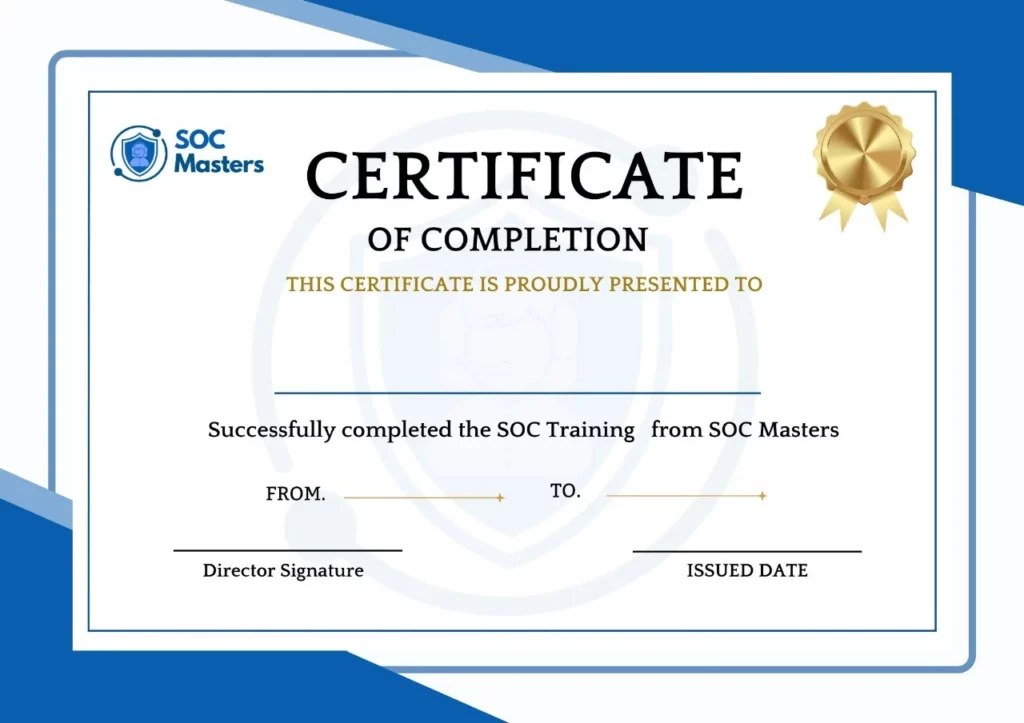
Ask any institute to show you their actual certificate before you enrol. Ask what verifiable ID it carries. Ask, plainly, whether it is a vendor credential or a course certificate — and watch how quickly they answer.
SOC Analyst learning roadmap: beginner to job-ready
Start your cybersecurity journey with this SOC Analyst Learning Roadmap: Beginner to Job-Ready. Learn essential skills like networking, Linux, Windows, SIEM, incident response, and threat detection through a structured path that helps you build real-world expertise and become job-ready.
Stage 1 · Modules 1–4
Networking refresher, Windows Event Logs, Linux syslog, Sysmon, and the threat landscape you are defending against. No SIEM yet — deliberately.
Stage 2 · Modules 5–9
Log pipelines, then Splunk SPL, Sentinel KQL and QRadar offenses. You write queries, build detections, and learn why tuning matters more than adding rules.
Stage 3 · Modules 10–13
EDR alert triage, phishing analysis, packet analysis, malware triage and threat intelligence enrichment. Where you learn to reach a defensible verdict.
Stage 4 · Modules 14–15
Full incident response lifecycle, SOAR playbooks, cloud SOC, the capstone investigations, then targeted exam prep and mock interviews.
SOC Analyst career roadmap: where this actually goes
Build a successful cybersecurity career with this SOC Analyst Career Roadmap. Discover the skills, tools, certifications, and practical experience needed to progress from a beginner to a job-ready SOC Analyst and confidently start your career in Security Operations.
Year 0–2
SOC Analyst L1
The alert queue. Triage, known-pattern handling, escalation, shift handover documentation. Unglamorous and essential — this is where you learn what “normal” looks like in a real estate, which no lab fully teaches. Target credential: SC-200 or CCNA Cybersecurity.
Year 2–4
SOC Analyst L2 / Incident Responder
You stop escalating and start concluding. Deeper investigations, correlation rule tuning, containment decisions, incident reporting. The single largest earnings jump on the ladder. Target: CySA+ CS0-004.
Year 4–6
L3 Analyst / Threat Hunter / Detection Engineer
Two doors. Hunt — proactive campaigns against ATT&CK techniques no rule covers. Or engineer — build and maintain the detection library, own coverage gaps, write the rules everyone else works from. Detection engineering is the better-paid door in most Hyderabad GCCs.
Year 6–10
SOC Lead / Senior Analyst
You own the shift, the escalation model, the metrics and the quality of everyone else’s investigations. Less console, more review and design. Target: GIAC-level credentials, or CISSP if you are heading toward management.
Year 10+
SOC Manager / Head of Security Operations
Strategy, budget, tooling decisions, audit and board reporting. You are hired for judgement, not tool knowledge — which is why we push reasoning over console clicks from module one.
Hands-on SOC labs: what you'll actually build
Nine named exercises, each producing an artefact you keep. Compare these against any other institute’s “practical training” claim.
Lab 1
Build the lab
Stand up Windows and Linux endpoints, install Sysmon, configure log forwarding into the SIEM, and verify ingestion end to end.
Lab 2
Windows log triage
Investigate a failed-logon burst followed by a successful logon. Work 4625 → 4624 → 4672 → 4688 and decide what actually happened.
Lab 3
Splunk SPL hunt
Write SPL from scratch to find suspicious parent-child process relationships across a noisy dataset, then convert it to a saved correlation search.
Lab 4
Sentinel KQL detection
Build a KQL analytics rule for impossible-travel sign-ins, map entities, and tune it until the false positive rate is workable.
Lab 5
Phishing triage
Full header analysis, SPF/DKIM/DMARC evaluation, URL and attachment assessment, and a written verdict with reasoning.
Lab 6
Lateral movement chain
Follow an intrusion from initial access through privilege escalation to lateral movement, mapping every step to MITRE ATT&CK technique IDs.
Lab 7
PCAP analysis
Open a capture cold, identify beaconing behaviour, follow the streams and extract the indicators — against the clock.
Lab 8
EDR alert investigation
Triage an endpoint alert from process tree to command line to containment decision, and justify the isolation call.
Lab 9
Incident report
Write the full incident report and shift handover for one of the above. Peer-reviewed and marked. This is the artefact interviewers ask for.
SOC capstone investigations you'll complete
Six end-to-end investigations that simulate real SOC workload. Each produces a report you can show an interviewer — which is the entire point of doing them.
Project 1
Managed SOC shift simulation
Work a live alert queue across multiple simulated client tenants for a full shift, with escalation decisions and a handover document.
Project 2
Ransomware, end to end
Detection through containment, eradication and recovery, with a written timeline and lessons-learned review.
Project 3
Insider data exfiltration
Investigate anomalous data movement by an authorised user — the hardest case type, because nothing is technically “unauthorised”.
Project 4
Detection engineering pack
Build ten correlation rules against chosen ATT&CK techniques, plus the tuning documentation and false-positive analysis.
Project 5
Threat hunt campaign
Run a hypothesis-driven hunt against a defined TTP set, documenting what you looked for, what you found and what you ruled out.
Project 6
SOC metrics & audit pack
Produce the MTTD/MTTR reporting and evidence pack an auditor would ask for — the deliverable that gets you hired into regulated environments.
SOC tools & technologies covered
Learn the most important SOC Analyst Tools used in real-world Security Operations Centers. Explore SIEM, EDR, threat intelligence, vulnerability management, and network monitoring tools that help SOC Analysts detect, investigate, and respond to cyber threats effectively.
Splunk
Enterprise SIEM and SPL — the most commonly listed skill in Hyderabad SOC job ads.
Microsoft Sentinel
Cloud-native SIEM and KQL — the fastest-growing stack in Indian enterprises.
IBM QRadar
Offense-based SIEM still widely deployed in BFSI and large services accounts.
MITRE ATT&CK
The shared language for describing adversary behaviour. Used in every module.
Sysmon
Deep Windows telemetry — the difference between guessing and knowing.
Microsoft Defender XDR
Endpoint and identity alert triage across the Microsoft estate.
Wireshark
Packet-level analysis for the cases logs cannot answer.
Event Log & syslog
The raw material. Everything else is a view over these.
Threat intelligence
Indicator enrichment, reputation scoring and feed consumption.
SOAR concepts
Playbook design and automation boundaries — what to automate and what never to.
Sandboxing & static triage
Safe handling of suspicious files and IOC extraction.
Cloud audit logs
Entra ID sign-in logs, Azure Activity and CloudTrail from a detection perspective.
Query & scripting languages you'll learn
SOC analyst is not a coding role, but it is a querying role. You will spend more time writing SPL and KQL than anything else. Python and PowerShell appear when you need to automate — not before.
AI and automation in the modern SOC
This affects whether the course is a good investment for you, so it gets an honest section rather than a marketing one.
The vendors have committed
Not speculation. Microsoft doubled the “manage a security operations environment” weight on SC-200 in April 2026 and added agentic AI and Sentinel Graph content. Cisco added AI objectives to 200-201 v1.2. CompTIA added AI coverage to CySA+ CS0-004 in June 2026. Three vendors, same direction, six months.
What automation is taking
Repetitive triage of alerts with known-good and known-bad outcomes. Enrichment lookups. First-pass phishing classification. Routine ticket closure. If your entire value is “I close alerts fast”, that is the layer under pressure.
What it is not taking
Deciding whether an ambiguous chain of events is an incident. Judging whether isolating a production server is worth the outage. Writing a report a regulator will read. Explaining to a business owner why their exception is a risk.
AI is also the new attack surface
Prompt injection, AI-generated phishing without the tell-tale grammar errors, and autonomous agents holding credentials are live SOC concerns. Cisco’s v1.2 objectives specifically added identifying AI-generated social engineering.
Should this worry you?
Partly, honestly. The L1 tier is the most automatable rung and it is also the entry rung. Our answer is the syllabus: disproportionate time on investigation reasoning, detection engineering and written analysis. Treat L1 as a station, not a destination.
What we won't pretend
That “AI-powered SOC training” is a feature. Using an AI assistant is not a skill worth ₹25,000 to learn. Being able to check whether its conclusion is wrong is.
Skills you'll have at the end
The actual test: walk into an L1 interview, be handed a log extract or an alert screenshot, and reason out loud toward a defensible conclusion.
Technical
- Read Windows Event Logs and Linux syslog without a cheat sheet
- Write SPL searches and KQL queries from scratch
- Build and tune a correlation rule until it is usable on shift
- Map an attack chain to MITRE ATT&CK technique IDs
- Triage a phishing email from headers to verdict
- Analyse a PCAP and identify beaconing
- Investigate an EDR alert from process tree to containment call
- Run an incident through the full NIST response lifecycle
Professional
- Write an incident report a SOC lead will sign off
- Hand over cleanly at shift change
- Read a SOC job description and know whether you qualify
- Defend an investigation conclusion under questioning
- Explain false-positive tuning trade-offs to a non-analyst
- Choose the right certification for your background instead of collecting all of them
Training modes — classroom & online
Live online
Instructor-led over video, full lab access, sessions recorded. What most working professionals pick. Next batch: 30 September 2026
Classroom — JNTU
In person at our JNTU metro centre, trainer over your shoulder, peer investigation exercises. Next batch: 5 october 2026
Weekend
Saturday–Sunday for people who work weekdays. Online or classroom. Next batch: 10 october 2026
One-on-one
Private, pace and timing set by you, curriculum shaped to your stack. Start any week.
Corporate / team
On-site or remote for your SOC team, customised to your SIEM and your log sources.
Can't find a batch?
New batches start regularly. Tell us your availability and we’ll fit you into the next one. Call +91 96760 49988
Placement support & internship — stated precisely
Written as two lists rather than a paragraph, so there is nothing to hide behind.
What we do
- Rebuild your CV around the investigations you actually ran here
- Mock interviews — technical and HR — with real feedback
- Share genuine openings from our recruiter network
- Prepare you for company-specific SOC interview questions
- Support you until you land, even after the course ends
- An internship-style capstone portfolio you can put on the CV
What we do not do
- Guarantee a job — no institute honestly can
- Promise a specific salary or CTC
- Invent placement statistics to win your enrolment
- Claim "500+ placed every month" — the number you cannot verify
- Abandon you the day the course ends
Student Success Stories & Reviews
I recently completed my SOC training in Hyderabad and it was great experience to me the training covered all basics of security and helped me I am understand to everything in subject knowledge they are provided hands and training it was really helpful. The real-time projects and internship gave me the practical experience needed for the job market.

★★★★★
My name is chara teja iam recently completed my soc training institutes in SOC Mastrs .they are very improved my knowledge.made learning enjoyable and easy. They provided great insights and were always available for help. The internship was the best part, giving me real-world experience.

Charan Teja
My name is Janardhan iam recently completed my soc analyst course in so masters institute .it was fantastic mentors. They made sure I understood everything clearly and provided lots of hands-on learning opportunities. The internship helped me apply my knowledge in real situations.

SOC Analyst jobs, roles & salary in Hyderabad
Hyderabad hires SOC analysts across GCCs, IT services delivery centres, MSSPs and BFSI captives. Roles are usually advertised by tier. Current openings and employer types are covered in our Hyderabad SOC jobs guide.
SOC Analyst L1
Alert queue triage, escalation, shift handover. The common entry role.
SOC Analyst L2
Deeper investigation, rule tuning, containment decisions. The biggest earnings step.
Incident Responder
Owns incidents end to end through the response lifecycle.
Threat Hunter
Hypothesis-driven hunting for what no rule caught.
Detection Engineer
Builds and maintains the detection library and coverage model.
SOC Lead / Manager
Owns the shift model, metrics, tooling and the audit conversation.
SOC Analyst salary by career level (India)
Explore the latest SOC Analyst Salaries based on experience, skills, certifications, and location. Learn how salary grows from entry-level to senior roles and discover the factors that can help you earn a higher package in the cybersecurity industry.
Splunk vs Microsoft Sentinel vs IBM QRadar: which SIEM should you learn?
The honest answer is that Hyderabad job descriptions are split across all three, which is why this course covers all three rather than betting on one.
How to choose a SOC Analyst training institute in Hyderabad
Every institute claims live labs, real-time projects and placement assistance. The claims are identical, so they carry no information. These questions separate them.
Ask these — and watch how fast they answer
- What exactly does the fee include? Is it published on the page?
- Which SIEM will I get hands-on time in, and for how many hours?
- What is the trainer's actual SOC background — which platform, which environment?
- Can I see a sample incident report a previous student produced?
- What does "placement assistance" mean in writing?
- Is the exam voucher included, and do you know the current exam code?
Walk away if…
- They won't quote a fee without your phone number
- They guarantee a job or a specific salary
- Their page still lists CySA+ as CS0-003 or Cisco as "CyberOps Associate CBROPS"
- Their "live lab" turns out to be recorded screen shares
- They quote a confident exam fee with no source
- Their certificate is designed to resemble a vendor badge
Meet your SOC Analyst trainer

Mr. Dhinesh
Cybersecurity Expert & Lead Instructor | 20+ Years Experience
About the tutor -
Mr. Dhinesh is a seasoned SOC professional with over 20 years of experience in the industry. Having worked with leading organizations to secure critical infrastructures and develop cutting-edge security protocols, Mr. Dhinesh is a highly sought-after expert in the field of cybersecurity.
He is passionate about SOC analyst training the next generation of SOC specialists and is known for his hands-on approach to teaching. His guidance has helped countless students excel in their SOC analyst careers, from obtaining key certifications to securing top jobs in the field.
At SOC Masters, we believe and stand by the fact that he is one of the best SOC analyst trainers in Hyderabad today.
Frequently Asked Questions
Everything freshers and professionals ask before joining the SOC Analyst training in Hyderabad.
What is SOC Analyst Training in Hyderabad?
SOC Analyst Training in Hyderabad is a job-oriented cybersecurity program that teaches SIEM, Microsoft Sentinel, Splunk, threat detection, incident response, log analysis, and security monitoring through hands-on labs and real-world projects. It prepares learners for entry-level SOC Analyst and Blue Team roles
Who can join SOC Analyst Training in Hyderabad?
Anyone interested in cybersecurity can join, including freshers, graduates, working professionals, network engineers, system administrators, and career changers. No prior cybersecurity experience is required to get started.
Is SOC Analyst Training in Hyderabad suitable for freshers?
Yes. The course starts with networking, Linux, and cybersecurity fundamentals before moving to SIEM tools, incident response, and threat detection, making it ideal for beginners.
What are the eligibility criteria for a SOC Analyst course?
Basic computer knowledge and an interest in cybersecurity are enough. Graduates, diploma holders, and IT professionals can enroll regardless of their previous cybersecurity experience.
What skills will I learn during the course?
You’ll learn SIEM, Microsoft Sentinel, Splunk, log analysis, incident response, threat hunting, KQL, Linux, Windows security, MITRE ATT&CK, and security monitoring through practical SOC labs.
Is coding required to become a SOC Analyst?
No. Coding is not mandatory. Basic networking, operating systems, and security concepts are enough to begin. Simple scripting can be learned later.
Which SIEM tools are covered?
The course covers Microsoft Sentinel, Splunk, IBM QRadar, Wazuh, Microsoft Defender XDR, and Kusto Query Language (KQL) for security monitoring and threat detection.
What certifications can I prepare for?
You can prepare for Microsoft SC-200, CompTIA Security+, CompTIA CySA+, Cisco CyberOps Associate, EC-Council CSA, and other cybersecurity certifications.
How long is the SOC Analyst course?
Most job-oriented SOC Analyst courses are completed within 2 to 3 months, depending on the learning mode and batch schedule.
What are the SOC Analyst Training fees in Hyderabad?
Course fees generally range from ₹ 25,000 based on the curriculum, practical labs, certification preparation, and placement support.
Which is the best SOC Analyst Training in Hyderabad?
Choose a course that offers hands-on SOC labs, Microsoft Sentinel, Splunk, live projects, experienced trainers, certification guidance, interview preparation, and placement assistance.
Does the course include placement assistance?
Yes. Students receive placement support, including resume building, mock interviews, career mentoring, and interview preparation for cybersecurity roles.
Are live projects included?
Yes. Learners work on practical SOC scenarios, real-world incident investigations, SIEM alerts, and threat detection projects.
Do you provide hands-on SOC labs?
Yes. Practical lab sessions allow students to work with SIEM tools, log analysis, threat hunting, and incident response in a simulated SOC environment.
Is classroom training available in Hyderabad?
Yes. Weekend and weekday batches are available for students and working professionals.
Is online SOC Analyst Training available?
Yes. Online training includes live instructor-led sessions, recorded classes, practical labs, and mentor support.
Do you offer weekend batches?
Yes. Classroom, online, and hybrid training options are available to suit different learning preferences.
What is the salary of a SOC Analyst in Hyderabad?
Freshers generally earn between ₹3.5 LPA and ₹6 LPA, while experienced professionals can earn ₹8 LPA to ₹18+ LPA based on skills and certifications.
What are the career opportunities after this course?
Career options include SOC Analyst L1, SOC Analyst L2, Security Analyst, Threat Hunter, Incident Responder, Blue Team Engineer, and Security Operations Engineer.
Which companies hire SOC Analysts in Hyderabad?
Cybersecurity professionals are hired by IT services companies, GCCs, fintech organizations, healthcare companies, cloud providers, and Managed Security Service Providers (MSSPs).
Visit Our SOC Training Centre in Hyderabad
Our Hyderabad Centre — train in the classroom or join live online. Drop by, call, or message us to plan your visit.