
SOC Analyst Career Roadmap
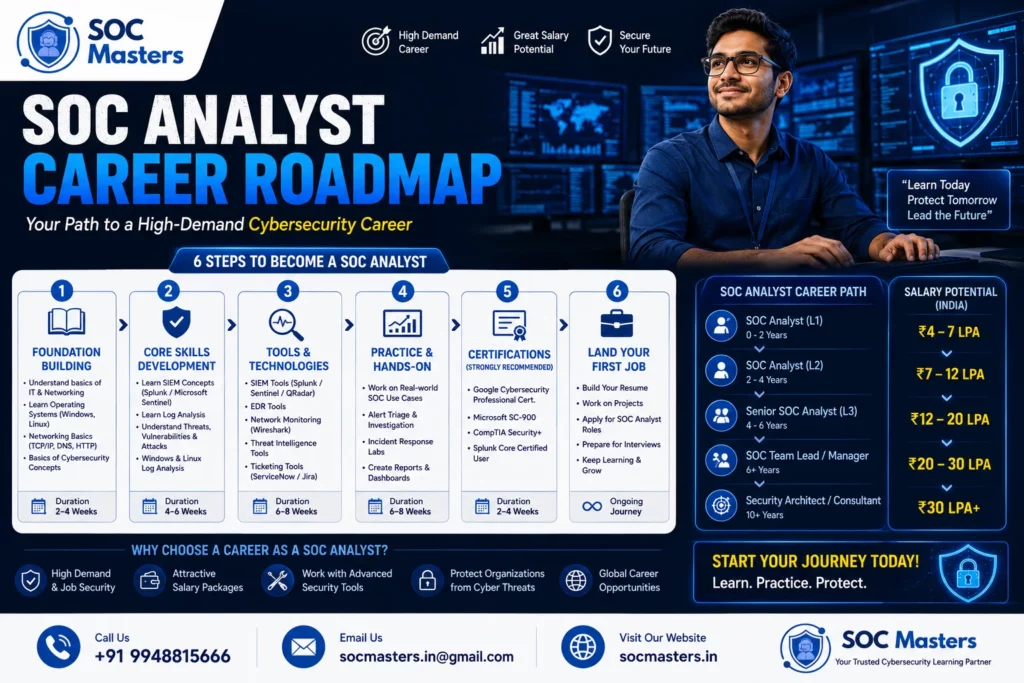
A SOC Analyst Career Roadmap moves through four stages: fundamentals (networking, Windows/Linux, security basics), SIEM operations (Microsoft Sentinel, Splunk, QRadar), incident response and threat hunting, and finally specialization or SOC leadership. Most learners become job-ready in 4–6 months with hands-on labs and one certification such as SC-200 or Security+. Structured SOC Analyst Training in Hyderabad compresses this journey with live SIEM practice and interview preparation.
Introduction
Every organisation with digital assets — banks, hospitals, e-commerce platforms, government departments — now runs or outsources a Security Operations Center (SOC). Inside that SOC sits the professional this guide is about: the SOC Analyst, the person who watches security alerts, investigates suspicious activity, and responds before an incident becomes a breach.
Cybersecurity is one of the fastest-growing career tracks in India for a simple reason: attacks keep increasing while skilled defenders remain scarce. And Hyderabad has become one of the country's strongest cybersecurity hiring hubs — home to over 355 Global Capability Centers, Microsoft's largest campus outside the US, and hundreds of enterprises and MSSPs that all need round-the-clock security monitoring.
But cybersecurity is vast, and without a structured plan, beginners jump between random videos, half-finished courses, and certifications in the wrong order. A clear SOC Analyst Career Roadmap solves this — it tells you exactly what to learn, in what sequence, with which tools, and which certification to attempt at each stage.
This guide lays out that complete roadmap, and shows how structured SOC Analyst Training in Hyderabad — with real SIEM labs, incident simulations, and interview preparation — helps you cover it in months instead of years.
What Is a SOC Analyst?
A SOC Analyst is a cybersecurity professional who works in a Security Operations Center, monitoring an organisation's networks, endpoints, cloud environments, and applications for signs of malicious activity. Day-to-day work includes:
- Monitoring alerts generated by SIEM platforms like Microsoft Sentinel, Splunk, and IBM QRadar
- Triaging alerts — separating false positives from genuine threats
- Investigating suspicious logins, malware detections, phishing emails, and unusual network traffic
- Escalating confirmed incidents and documenting findings
- Supporting incident response and recovery
SOC roles are tiered: L1 analysts handle initial triage, L2 analysts perform deeper investigation, and L3 analysts lead complex incident response and threat hunting. Because the work is defensive, SOC analysts sit firmly on the blue team side of cybersecurity.
💬 Chat on WhatsAppWhy Choose a Career as a SOC Analyst?
Three reasons make this one of the best entry points into cybersecurity:
- Low entry barrier, high ceiling. You don't need a computer science degree to start — you need fundamentals, SIEM skills, and one certification. Yet the same role leads to threat hunting, incident response, and SOC leadership.
- Persistent demand. Every regulated industry — BFSI, healthcare, IT services, pharma — must run security monitoring, and that need only grows with each new breach.
- Skill-priced salaries. Security pay increasingly follows skills rather than years. Analysts who write KQL/SPL queries, run investigations end-to-end, and speak the MITRE ATT&CK language move up faster than peers with identical experience.
Why SOC Analyst Training in Hyderabad Is Growing Rapidly
Hyderabad's cybersecurity job market has a specific character that shapes what training should cover:
- GCC expansion. The city's Global Capability Centers explicitly list cybersecurity professionals among their most in-demand hires, alongside cloud and data roles, and GCC salary hikes for niche skills like security are running well above the market average.
- Microsoft-heavy ecosystem. With Microsoft's massive Hyderabad presence and hundreds of enterprises on Azure, demand for Microsoft Sentinel, Defender XDR, and KQL skills is stronger here than in most Indian cities. This is why the SC-200 certification carries particular weight for Hyderabad job seekers.
- MSSP and Big 4 hiring. Managed Security Service Providers and consulting firms (Deloitte, EY, PwC, KPMG) run large SOC teams in the city and recruit freshers in batches — provided candidates can demonstrate hands-on SIEM work, not just theory.
Structured, lab-based SOC Analyst Training in Hyderabad — the SOC-focused branch of broader cybersecurity training in Hyderabad — exists precisely to close that theory-to-hands-on gap. For a picture of local cyber security jobs in Hyderabad first, see this overview of SOC analyst job opportunities in Hyderabad.
SOC Analyst Career Roadmap in 2026
The 2026 roadmap differs from older versions in three ways: cloud security is now core, not optional (most logs you'll analyse come from Azure, AWS, or M365); AI-assisted operations are standard (analysts increasingly validate and tune AI-generated detections rather than eyeball every alert); and query languages matter more (KQL and SPL fluency separates candidates at interview).
The high-level path: Fundamentals → SIEM operations → Incident response & threat hunting → Specialisation. Everything below expands this.
SOC Analyst Career Roadmap for Beginners
If you're starting from zero, resist the urge to jump straight into tools. The sequence that works:
- Networking and operating system basics (4–6 weeks)
- Security fundamentals and log analysis (3–4 weeks)
- One SIEM deeply — Sentinel or Splunk (4–6 weeks)
- Incident response methodology + MITRE ATT&CK (3–4 weeks)
- Projects, certification, resume, interviews (ongoing)
That's a realistic 4–6 month runway to job-ready. A grounding in the basics comes first — this cybersecurity fundamentals guide for aspiring SOC analysts covers the starting concepts.
💬 Chat on WhatsAppStep-by-Step SOC Analyst Learning Path
Cybersecurity Fundamentals
Learn the CIA triad, common attack types (phishing, malware, ransomware, brute force, DDoS), authentication vs authorisation, and basic cryptography concepts. Why it matters: every alert you triage maps back to one of these attack categories — without this vocabulary, SIEM dashboards are just noise.
Networking Fundamentals Every SOC Analyst Should Learn
- TCP/IP: how packets move, ports, and the three-way handshake. Most network alerts (port scans, beaconing, exfiltration) only make sense if you understand normal traffic first.
- DNS: attackers abuse DNS for command-and-control and tunnelling; DNS logs are among the highest-value data sources in any SOC.
- HTTP/HTTPS: web traffic carries phishing payloads, C2 callbacks, and data theft; you must read headers, status codes, and user-agents.
- Firewalls: understanding allow/deny rules and NAT lets you interpret firewall logs and judge whether traffic should have been blocked.
Windows & Linux Administration
Roughly 80% of enterprise endpoints run Windows — so Windows Security knowledge (Event IDs like 4624/4625/4688, Active Directory basics, PowerShell logging, Sysmon) is non-negotiable. Linux Security matters because servers, cloud workloads, and security tools themselves run on Linux; learn auth logs, syslog, file permissions, and common persistence locations.
SIEM Fundamentals
A SIEM (Security Information and Event Management) platform collects logs from across the environment, correlates them, and raises alerts. It's the SOC analyst's primary workbench. Understand log ingestion, parsing, correlation rules, and dashboards conceptually before touching any specific product — this explainer on SIEM architecture walks through how the pieces fit together.
Microsoft Sentinel Learning Roadmap
Sentinel is Microsoft's cloud-native SIEM and the highest-leverage tool for the Hyderabad market. Learn in this order: data connectors → KQL basics → analytics rules → incident investigation → workbooks → basic SOAR playbooks with Logic Apps. Microsoft's own learning material for the SC-200 Security Operations Analyst exam doubles as a free Sentinel curriculum.
Splunk Learning Roadmap
Splunk dominates large enterprise and MSSP SOCs. Path: architecture (forwarders, indexers, search heads) → SPL fundamentals → fields and lookups → dashboards → alerting → Enterprise Security concepts. Splunk's free trial and BOTS (Boss of the SOC) datasets provide realistic practice data.
QRadar Fundamentals
IBM QRadar appears heavily in banking and older enterprise SOCs. You don't need Splunk-level depth, but understand offenses, flows vs events, rule logic, and magnitude scoring. Familiarity with all three SIEMs makes your resume flexible across employers.
Log Analysis and Security Monitoring
This is the core craft. Practice reading raw Windows Event Logs, Linux auth logs, firewall logs, proxy logs, and cloud audit logs — then answering: what happened, when, from where, and is it malicious? Security monitoring is the continuous version of this: building the habit of baselining normal so anomalies stand out.
Incident Response Roadmap
Learn the standard lifecycle — preparation, detection & analysis, containment, eradication, recovery, lessons learned. Practice writing incident reports and timelines; communication is half the job. Why it matters: interviews almost always include a scenario question ("you see 500 failed logins followed by a success — walk me through your response").
Threat Hunting Skills
Threat hunting is proactively searching for attackers who evaded alerts. It requires hypothesis-driven thinking ("if an attacker used PowerShell for persistence, what would the logs show?") plus strong query skills — the skill that accelerates the L1→L2→L3 climb.
Threat Intelligence Fundamentals
Learn what IOCs (indicators of compromise) are, how threat feeds work, and how to read reports on threat actors and campaigns. Intelligence context turns a generic malware alert into "this matches a known ransomware group's tooling — escalate now."
MITRE ATT&CK Framework
The MITRE ATT&CK framework is the industry's shared dictionary of attacker tactics and techniques. SOC teams map detections, incidents, and hunts to ATT&CK technique IDs (e.g., T1566 Phishing). Fluency here signals professionalism in every interview.
Digital Forensics Basics
You won't be a forensic examiner at L1, but understand disk vs memory forensics conceptually, evidence handling, and common artefacts (prefetch, browser history, registry run keys). It sharpens investigations and opens a specialisation path.
Cloud Security Fundamentals
Learn the shared responsibility model, identity as the new perimeter, and common cloud misconfigurations. Most 2026 SOC alerts originate in cloud and SaaS environments — analysts who can't read cloud logs are increasingly limited.
Azure Security for SOC Analysts
For Hyderabad specifically, Azure depth pays. Learn Entra ID (Azure AD) sign-in and audit logs, conditional access, Azure activity logs, and Defender for Cloud alerts. Azure knowledge plus Sentinel is the exact stack many local employers run.
Microsoft Defender XDR
Defender XDR unifies signals from Microsoft Defender for Endpoint (EDR telemetry, device timelines, isolation actions), Defender for Office 365, Defender for Identity, and Defender for Cloud Apps. Learn advanced hunting with KQL inside the Defender portal — it's the same query language as Sentinel, so the skill transfers directly.
KQL (Kusto Query Language)
KQL is the query language behind Sentinel and Defender XDR. Master where, summarize, join, project, time filters, and parsing functions. Why it matters: KQL fluency is arguably the single most differentiating hard skill for Microsoft-stack SOC roles in Hyderabad — it turns you from an alert-clicker into an investigator.
Python & PowerShell for SOC Analysts
You don't need developer-level coding. Python for parsing logs, automating IOC lookups, and small enrichment scripts; PowerShell for investigating Windows systems and understanding what attacker PowerShell abuse looks like (since attackers use it too). Basic scripting also future-proofs you for automation-heavy SOCs.
Malware Analysis Basics
Learn static basics (hashes, strings, file metadata, VirusTotal workflow) and safe dynamic analysis in a sandbox. L1 analysts aren't reverse engineers, but you must competently answer "is this attachment malicious?"
SOC Analyst Certifications Roadmap
Certifications validate your roadmap progress — but always pair them with labs, since employers test hands-on ability. A detailed comparison table appears later in this post; the short version: start with SC-900 or Security+, make SC-200 your primary job-focused certification for the Hyderabad market, and treat CySA+, AZ-500, CEH, and CISSP as later-stage additions.
Real-Time Projects Every SOC Analyst Should Complete
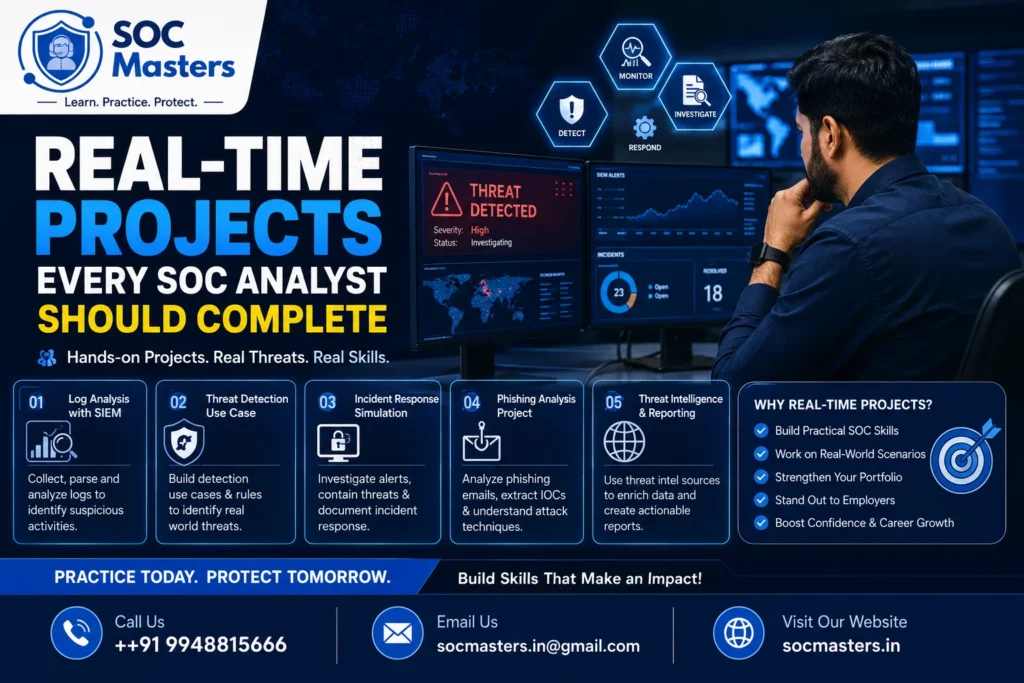
Projects prove you can do the work. Build and document these:
- Home SIEM lab: free Sentinel trial or Splunk Free ingesting logs from a Windows VM with Sysmon — write 5 detection rules.
- Phishing investigation: analyse real phishing samples (headers, URLs, attachments) and write a full incident report.
- Brute-force detection & response: simulate failed-login storms, detect with KQL/SPL, document containment steps.
- MITRE ATT&CK mapping: take a public breach report and map every step to ATT&CK technique IDs.
- Threat-hunting exercise: hunt through the Splunk BOTS dataset and present findings like a real hunt report.
SOC Analyst Career Opportunities
Hyderabad employers hiring SOC talent fall into four buckets: GCC in-house SOCs (Microsoft, Amazon, JPMorgan, pharma GCCs), Big 4 and consulting SOCs, MSSPs running 24×7 monitoring (highest fresher intake), and IT services companies. Adjacent roles include detection engineer, threat intelligence analyst, incident responder, and cloud security analyst.
💬 Chat on WhatsAppSOC Analyst Salary Growth Roadmap
The figures below are market estimates compiled from public salary aggregators and 2026 hiring reports. Actual offers vary widely by company, skills, city, and interview performance — no training program can guarantee any specific salary.
Indicative 2026 ranges in India: freshers/L1 typically ₹3.5–6 LPA (skilled, lab-trained candidates report offers toward the upper end); L2 analysts with 2–5 years around ₹6–12 LPA; L3/senior analysts roughly ₹10–25 LPA; SOC leads and managers beyond that. The steepest inflection is the L1→L2 jump — driven by investigation depth, not tenure. For role-wise and city-wise detail, see SOC Masters' full SOC Analyst salary guide for India.
Industry Trends Shaping SOC Careers
- Hyderabad hiring trends: GCCs took roughly half the city's recent office absorption, and cybersecurity sits alongside AI and cloud among the skills GCC leaders find hardest to hire — a supply gap that favours trained candidates.
- SOC demand across India: national and skill-priced; niche security skills are seeing salary hikes well above the general market.
- MSSP growth: as mid-size firms outsource monitoring, MSSPs keep expanding 24×7 teams — the most reliable fresher entry point.
- Enterprise SOCs are maturing from alert-monitoring shops into detection engineering and threat-hunting functions, raising the ceiling for analysts.
- AI-powered security operations: AI now handles first-pass triage in many SOCs. That shifts the analyst's job toward validating AI conclusions, tuning detections, and investigating what automation escalates — making well-trained analysts more valuable, not less.
- Cloud security demand keeps compounding, and Microsoft's security ecosystem growth (Sentinel, Defender XDR, Entra) makes the Microsoft skill path especially rewarding in Hyderabad.
Skills Required to Become a SOC Analyst
The core SOC analyst skills split into two groups. Technical: networking, Windows/Linux logs, one SIEM deeply (plus familiarity with two others), KQL or SPL, incident response process, MITRE ATT&CK, phishing analysis, basic scripting. Soft skills: written communication (incident reports), calm prioritisation under alert floods, curiosity, and the discipline to document everything.
Tools Every SOC Analyst Should Learn
Microsoft Sentinel, Splunk, IBM QRadar, Microsoft Defender for Endpoint / Defender XDR, Wireshark, Sysmon, VirusTotal, AbuseIPDB, urlscan.io, AnyRun or Hybrid Analysis (sandboxing), and a ticketing platform like ServiceNow or Jira.
Common Mistakes Beginners Make
- Collecting certifications without labs — employers test hands-on skill.
- Trying to learn every SIEM at once instead of one deeply.
- Skipping networking and OS fundamentals to "get to the cool stuff."
- Ignoring documentation and report-writing practice.
- Applying with a generic IT resume that never mentions detections built or incidents investigated.
SOC Analyst Career Roadmap for Freshers
Treat the roadmap as a full-time 4–6 month sprint: fundamentals → one SIEM → projects → SC-900/Security+ → interview prep. Then apply aggressively to MSSPs and Big 4 fresher intakes, which hire in volume. Internships and 24×7 shift willingness meaningfully improve first-job odds.
SOC Analyst Career Roadmap for Working Professionals
If you're already in IT (support, networking, sysadmin, NOC), your infrastructure knowledge maps directly onto log analysis. Compress the roadmap: skim fundamentals, go deep on SIEM + KQL + incident response, target SC-200 directly, and position your transition as "I already understand the systems; now I secure them." Most manage this in 3–5 months of evening study alongside a job.
How to Get Your First SOC Analyst Job
- Finish at least three documented projects and one certification.
- Publish your lab work — a simple GitHub repo or blog counts as portfolio evidence.
- Target MSSPs, Big 4 risk practices, and GCC security teams; apply via LinkedIn, Naukri, and referrals (many GCC roles fill through outreach before posting).
- Frame every application around outcomes: detections written, incidents simulated, reports produced.
- Prepare for scenario interviews, not just definitions.
Interview Preparation Tips
Expect four question categories: fundamentals (ports, protocols, Event IDs), scenario walk-throughs (phishing, brute force, malware alerts), tool questions (write a basic KQL/SPL query), and MITRE ATT&CK mapping. Practise answering aloud in the detect → validate → investigate → contain → document structure. Work through a dedicated SOC analyst interview questions bank until scenario answers feel automatic.
Resume Tips for SOC Analyst Aspirants
Keep it one page. Lead with a skills matrix (SIEM, query languages, frameworks), then projects written as outcomes ("Built 5 Sentinel analytics rules detecting brute-force activity"), then certifications and education. Mirror keywords from each job description to pass ATS filters, and never list tools you can't demonstrate in an interview.
SOC Analyst Career Roadmap Table
90-Day Learning Roadmap
Certification Roadmap Table
Career Progression Table
Key Takeaways
- Follow the sequence, not the hype: fundamentals → one SIEM → incident response → projects. Skipping stages is the #1 reason beginners stall.
- Go deep on Microsoft Sentinel + KQL if you're targeting Hyderabad — it matches the city's employer ecosystem, and SC-200 is your highest-leverage certification.
- Build proof, not just knowledge: five documented projects on GitHub beat a second certification every time.
- Target the L1→L2 jump early by practising investigation depth (why did this happen?) instead of just triage speed (close the ticket).
- Apply where freshers actually get hired: MSSPs, Big 4 SOC teams, and GCC security intakes — with a resume written around detections built and incidents investigated.
Conclusion
A SOC career rewards structure. The learners who land jobs fastest are the ones who followed a clear SOC Analyst Career Roadmap: fundamentals first, one SIEM mastered hands-on, incident response practised until it's muscle memory, projects documented, and a certification like SC-200 earned at the right stage.
Hyderabad gives you an unusually favourable market to do this in — a Microsoft-centred enterprise ecosystem, expanding GCC security teams, and MSSPs hiring trained freshers around the clock. What bridges you into that market is hands-on capability, and that's exactly what structured SOC Analyst Training in Hyderabad is built to deliver: live SIEM labs, real incident simulations, certification preparation, and interview coaching.
If you're ready to start, explore the hands-on training programs at SOC Masters and take the first step on your roadmap today — the demand is real, the path is clear, and the only missing piece is your consistent effort.
Frequently Asked Questions
1. What is the SOC Analyst Career Roadmap for beginners?
Start with networking and OS fundamentals, learn one SIEM (Sentinel or Splunk) deeply, practise incident response with MITRE ATT&CK, complete 3–5 documented projects, and earn SC-900 or Security+ followed by SC-200. Most beginners become interview-ready in 4–6 months of hands-on study.
2. Is SOC Analyst Training in Hyderabad worth it in 2026?
Yes, if the training is lab-based. Hyderabad's GCCs, Big 4 firms, and MSSPs are actively hiring security talent, and employers prefer candidates who can demonstrate live SIEM investigations over theory-only applicants. Choose programs with real Sentinel/Splunk labs and interview preparation.
3. Which certification should a SOC Analyst do first?
SC-900 or CompTIA Security+ first for fundamentals, then SC-200 as your primary job-focused certification — especially in Hyderabad, where Microsoft Sentinel and Defender XDR dominate enterprise SOC stacks.
4. Can a fresher become a SOC Analyst without a degree in computer science?
Yes. SOC hiring is skills-first: any graduate who demonstrates networking basics, hands-on SIEM work, documented projects, and one certification can compete for L1 roles, especially at MSSPs.
5. What is the salary of a SOC Analyst in India?
As a market estimate, freshers typically earn ₹3.5–6 LPA, L2 analysts ₹6–12 LPA, and senior L3 analysts ₹10–25 LPA in 2026, varying by company, city, and skill depth. These are indicative figures, not guarantees.
6. What skills are most important for a SOC Analyst job?
Log analysis, one SIEM platform in depth, KQL or SPL query writing, incident response methodology, MITRE ATT&CK fluency, phishing analysis, and clear written communication for incident reports.
7. Is Microsoft Sentinel better than Splunk for SOC careers?
Neither is universally better. Sentinel is the smarter first choice in Hyderabad's Microsoft-heavy market and pairs with SC-200; Splunk dominates many MSSP SOCs. Learn one deeply, stay conversant in the other.
8. How long does it take to become a SOC Analyst?
Typically 4–6 months full-time for freshers, or 3–5 months part-time for working IT professionals who already know networking and systems — assuming consistent lab practice, not just video courses.
9. What jobs can I get after SOC Analyst training?
SOC Analyst L1 at MSSPs, GCC security teams, Big 4 firms, and IT services companies — progressing to L2/L3, threat hunter, incident responder, detection engineer, or cloud security analyst.
10. What is the future scope of SOC Analysts with AI automation?
Strong. AI handles first-pass triage, but organisations still need humans to validate detections, run investigations, and lead response. The role is shifting toward higher-value investigation and detection engineering — raising the premium on well-trained analysts.