
Best SIEM Tools for SOC Analysts in 2026

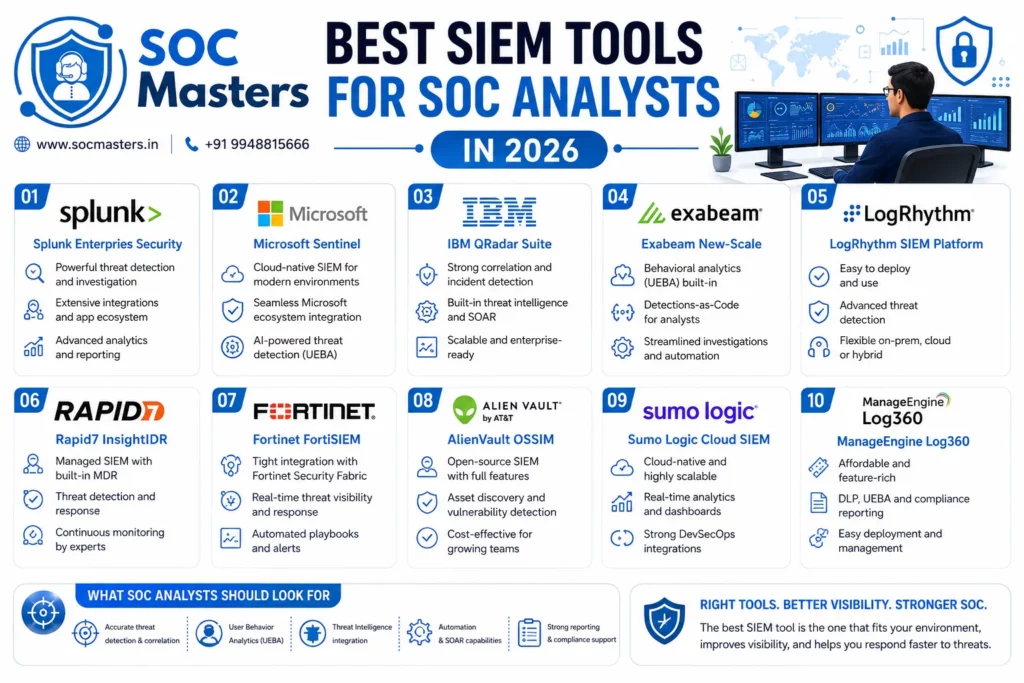
Best SIEM Tools for SOC Analysts in 2026 help security teams monitor systems, detect cyber threats, and respond to incidents faster. Modern SIEM platforms use AI, automation, and real-time log analysis to identify attacks like phishing, ransomware, and malware. Tools such as Splunk, Microsoft Sentinel, and QRadar improve threat visibility and security operations. Learning SIEM tools is essential for beginners and professionals who want to build a successful career in cybersecurity and SOC operations.
Introduction
Security Operations Centers (SOCs) are advancing rapidly as cyber threats become more sophisticated and organizations demand stronger real-time security monitoring.
Cyberattacks are becoming more advanced, cloud environments are growing larger, and organizations now generate massive amounts of security data every second. This is exactly why SIEM tools have become the backbone of modern cybersecurity operations.
If you are a SOC analyst, cybersecurity student, blue team professional, or someone planning to enter the security monitoring field, understanding the best SIEM tools for SOC analysts in 2026 is no longer optional. It is one of the most valuable skills in cybersecurity today.
A Security Information and Event Management (SIEM) platform helps analysts collect, monitor, detect, investigate, and respond to threats across an organization’s infrastructure. Think of a SIEM system like an airport control tower. Thousands of activities happen every minute, but the tower helps operators identify unusual movement before it becomes dangerous. In cybersecurity, SIEM tools perform a similar role by analyzing logs and security events in real time.
The demand for SIEM expertise is increasing because organizations need faster threat detection, compliance reporting, and automated incident response. Modern SIEM platforms now use artificial intelligence, machine learning, behavioral analytics, and cloud-native architecture to reduce alert fatigue and improve detection accuracy.
This guide explores the top SIEM platforms, beginner-friendly explanations, practical projects, setup steps, and expert tips that can help SOC analysts become more efficient in 2026.
SOC teams are typically structured into tiers. Tier 1 analysts handle initial alert monitoring and triage, filtering out false positives. Tier 2 analysts perform deeper investigations and validate potential threats. Tier 3 analysts, often known as threat hunters, proactively search for hidden threats and improve detection strategies. This layered approach ensures efficiency and reduces the risk of overlooking critical incidents.
Organizations across industries rely heavily on SOCs because cyberattacks are increasing both in frequency and sophistication. From ransomware campaigns to insider threats, the range of risks is vast. Without a SOC, companies would struggle to detect attacks early and respond effectively. Understanding how a SOC functions gives you a strong starting point for learning cybersecurity fundamentals for SOC analyst roles, as everything from tools to processes revolves around this environment.
What Is a SIEM Tool?
A SIEM tool combines two major functions:
- SIM (Security Information Management) — Collects and stores logs for analysis and compliance
- SEM (Security Event Management) — Monitors events in real time and generates alerts
SIEM solutions gather data from:
- Firewalls
- Servers
- Endpoints
- Cloud services
- Applications
- Identity systems
- Network devices
The platform then correlates events to identify suspicious activity such as:
- Failed login attempts
- Privilege escalation
- Malware execution
- Lateral movement
- Data exfiltration
For SOC analysts, SIEM tools act as the “central nervous system” of security monitoring.
Why SIEM Tools Are Important for SOC Analysts
SOC analysts face thousands of alerts every day. Without centralized monitoring, investigating incidents would feel like searching for a needle in a digital haystack.
Modern SIEM platforms help analysts:
Organizations in 2026 are prioritizing SIEM solutions because ransomware attacks, insider threats, and cloud-based attacks continue to increase globally.
Whatsapp for More DetailsKey Features to Look for in SIEM Tools in 2026
Before choosing a SIEM platform, SOC analysts should understand which features truly matter.
Real-Time Threat Detection
A strong SIEM platform should identify suspicious activities immediately instead of hours later. Real-time visibility is critical during active attacks.
AI and Machine Learning
Modern SIEM tools use behavioral analytics to identify anomalies. For example, if an employee suddenly downloads massive amounts of data at midnight, AI-driven SIEM platforms can flag it automatically.
Cloud-Native Support
Hybrid and cloud environments dominate modern enterprises. SIEM tools should support:
- AWS
- Azure
- Google Cloud
- Kubernetes
- SaaS applications
Automation and SOAR Integration
Automation reduces repetitive work for SOC analysts. SIEM platforms with SOAR capabilities can:
- Isolate infected devices
- Block malicious IPs
- Disable compromised accounts
- Create tickets automatically
Scalability
Large enterprises process terabytes of logs daily. SIEM platforms must scale without slowing down investigations.
Best SIEM Tools for SOC Analysts in 2026
1. Microsoft Sentinel
Microsoft Sentinel has become one of the most powerful cloud-native SIEM platforms in recent years. Built on Microsoft Azure, it provides scalable threat detection and AI-powered analytics.
Key Features
- Cloud-native architecture
- Built-in AI analytics
- Integration with Microsoft Defender
- Automated playbooks
- Threat intelligence feeds
Best For
Organizations heavily invested in Microsoft ecosystems.
Beginner Project
Detect Failed Login Attacks
Steps:
- Connect Azure Active Directory logs
- Create analytics rules
- Monitor failed login attempts
- Trigger alerts for brute-force behavior
- Investigate suspicious IP addresses
This project helps beginners understand event correlation and identity-based attacks.
2. Splunk Enterprise Security
Splunk remains one of the most recognized SIEM tools for SOC analysts. Its advanced search capabilities and visualization features make investigations extremely powerful.
Key Features
- Advanced log analysis
- Powerful dashboards
- Machine learning toolkit
- Threat intelligence integration
- Flexible data ingestion
Best For
Large enterprises require deep analytics.
Beginner Project
Build a Threat Detection Dashboard
Steps:
- Install Splunk Enterprise
- Import Windows event logs
- Create visual dashboards
- Configure alert rules
- Monitor suspicious PowerShell activity
This project introduces analysts to SIEM dashboards and threat visualization.
3. IBM QRadar
IBM QRadar is widely used in enterprise SOC environments because of its strong correlation engine and network visibility.
Key Features
- User behavior analytics
- Network traffic analysis
- Threat prioritization
- Log correlation
- AI-assisted investigations
Best For
Enterprises needing advanced threat correlation.
Beginner Project
Detect Insider Threat Activity
Steps:
- Configure user activity monitoring
- Ingest endpoint logs
- Create anomaly rules
- Detect unusual file access patterns
- Investigate privileged account behavior
This teaches analysts how insider threat detection works.
4. Elastic Security
Elastic Security has gained popularity because of its flexibility and open-source foundation.
Key Features
- Fast search engine
- Open-source support
- Endpoint security integration
- Threat hunting features
- Cloud monitoring
Best For
Security teams wanting customizable SIEM solutions.
Beginner Project
Monitor Linux Server Attacks
Steps:
- Install Elasticsearch and Kibana
- Configure Filebeat
- Collect Linux authentication logs
- Detect SSH brute-force attacks
- Visualize attack patterns
This project is excellent for learning Linux log analysis.
5. Google Chronicle SIEM
Google Chronicle focuses on high-speed threat detection and massive-scale log storage.
Key Features
- Google threat intelligence
- Fast searches
- Cloud-native scalability
- Detection engineering
- Historical analysis
Best For
Cloud-focused enterprises handling large data volumes.
Beginner Project
Investigate Suspicious DNS Queries
Steps:
- Import DNS logs
- Create detection rules
- Identify suspicious domains
- Analyze beaconing behavior
- Generate incident reports
DNS analysis is a valuable SOC skill because many malware campaigns rely on malicious domains.
6. LogRhythm SIEM
LogRhythm combines SIEM, UEBA, and SOAR capabilities into a unified platform.
Key Features
- Built-in automation
- Threat lifecycle management
- AI analytics
- Compliance reporting
- Endpoint monitoring
Best For
Organizations seeking integrated detection and response.
Beginner Project
Ransomware Detection Workflow
Steps:
- Collect endpoint logs
- Configure ransomware indicators
- Create automated response rules
- Isolate infected systems
- Generate incident reports
This project introduces automated incident response concepts.
7. ArcSight ESM
ArcSight remains popular in highly regulated industries and government sectors.
Key Features
- Advanced correlation
- Compliance management
- Custom threat rules
- Long-term log storage
- Enterprise scalability
Best For
Government and compliance-heavy environments.
Beginner Project
Detect Privilege Escalation
Steps:
- Ingest Windows security logs
- Monitor admin account creation
- Detect unauthorized privilege changes
- Trigger alerts
- Investigate suspicious behavior
Privilege escalation monitoring is a core SOC responsibility.
8. Wazuh
Wazuh is an open-source SIEM and XDR platform that is ideal for learning and home labs.
Key Features
- Free and open-source
- File integrity monitoring
- Vulnerability detection
- Compliance support
- Endpoint security
Best For
Students, labs, and budget-conscious organizations.
Beginner Project
Build a Home SOC Lab
Steps:
- Install Wazuh manager
- Configure agents
- Monitor endpoint events
- Detect malware simulations
- Analyze alerts in dashboards
This is one of the best hands-on projects for aspiring SOC analysts.
9. Sumo Logic Cloud SIEM
Sumo Logic focuses on cloud-native security monitoring and analytics.
Key Features
- SaaS-based SIEM
- Threat intelligence
- Cloud monitoring
- Real-time analytics
- Automated detections
Best For
Cloud-first companies.
Beginner Project
Detect AWS Misconfigurations
Steps:
- Connect AWS CloudTrail
- Monitor IAM changes
- Detect public S3 buckets
- Trigger cloud alerts
- Review suspicious API activity
Cloud security monitoring is becoming essential for SOC careers in 2026.
Enroll For Free Demo 🔥Soft Skills That Make a Difference
While technical skills are crucial, soft skills often determine long-term success. Analytical thinking is perhaps the most important, as SOC analysts must interpret complex data and identify patterns.
Communication skills are also essential. Analysts often need to explain technical issues to non-technical stakeholders, making clarity and simplicity important.
Time management plays a significant role, as analysts must prioritize multiple alerts and incidents simultaneously. Knowing which issues require immediate attention is critical.
Curiosity and continuous learning are equally important. Cybersecurity is constantly evolving, and staying updated ensures that you remain effective in your role.
How Beginners Can Start Learning SIEM Tools
Many newcomers feel overwhelmed when first exploring SIEM platforms. The dashboards look complex, alerts appear nonstop, and log analysis can feel confusing at first. The key is to approach SIEM learning step by step instead of trying to master everything immediately.
Start by understanding logs. Logs are the foundation of every SIEM platform. Learn common log sources such as:
- Windows Event Logs
- Linux Syslogs
- Firewall Logs
- DNS Logs
- Web Server Logs
After understanding logs, move into alert creation. Build simple rules such as:
- Multiple failed login attempts
- Suspicious PowerShell execution
- Malware hash detection
The next stage is learning investigation workflows. SOC analysts typically follow a process:
- Receive an alert
- Validate the threat
- Gather evidence
- Determine impact
- Respond to the incident
- Document findings
Building a home SOC lab using tools like Wazuh, Splunk Free, or Elastic Stack is one of the fastest ways to gain practical experience.
Tips for SOC Analysts Using SIEM Tools
Reduce Alert Fatigue
One of the biggest problems in SOC environments is alert overload. Analysts can receive thousands of notifications daily, many of which are false positives.
Improve efficiency by:
- Tuning detection rules
- Prioritizing high-risk alerts
- Using automation
- Removing noisy detections
Learn Query Languages
Each SIEM platform has its own search language:
Strong querying skills dramatically improve investigation speed.
 Whatsapp for More Details
 Common Challenges with SIEM Platforms
Even the best SIEM tools come with challenges.
High Storage Costs
SIEM systems collect massive amounts of data. Cloud-based storage expenses can increase rapidly.
Complex Configuration
Advanced SIEM deployments require careful planning and tuning.
False Positives
Poorly configured rules generate unnecessary alerts, slowing investigations.
Skills Gap
Many organizations struggle to find experienced SIEM analysts.
This is why hands-on projects and practical labs are becoming more important for cybersecurity careers.
Conclusion
The demand for SIEM expertise continues to grow because organizations face increasingly sophisticated cyber threats. The best SIEM tools for SOC analysts in 2026 are no longer just log collection platforms. They are intelligent security ecosystems capable of threat detection, automated response, behavioral analytics, and cloud-scale monitoring.
Platforms like Microsoft Sentinel, Splunk, QRadar, Elastic Security, and Wazuh each offer unique advantages depending on organizational needs and analyst experience levels. Beginners should focus on hands-on projects, log analysis, and real-world attack detection workflows to build practical SOC skills.
The most successful SOC analysts are the ones who continuously learn, experiment with labs, tune detections, and stay updated with evolving attacker techniques. SIEM tools are powerful, but the real strength comes from analysts who know how to interpret the data and respond effectively.
FAQs
What is the best SIEM tool for beginners in 2026?
Wazuh and Splunk Free are excellent choices for beginners because they provide hands-on experience without high licensing costs.
Which SIEM tool is most used by enterprises?
Splunk, Microsoft Sentinel, and IBM QRadar remain widely used across enterprise SOC environments.
Is SIEM difficult to learn?
SIEM tools can feel complex initially, but learning becomes easier through practical labs, log analysis, and real-world projects.
What skills are needed for SIEM analysts?
Important skills include log analysis, networking, threat detection, scripting, incident response, and query language knowledge.
Are SIEM tools replacing SOC analysts?
No. SIEM platforms automate many tasks, but human analysts are still essential for investigations, threat hunting, and decision-making.