SIEM Tools in Cyber Security
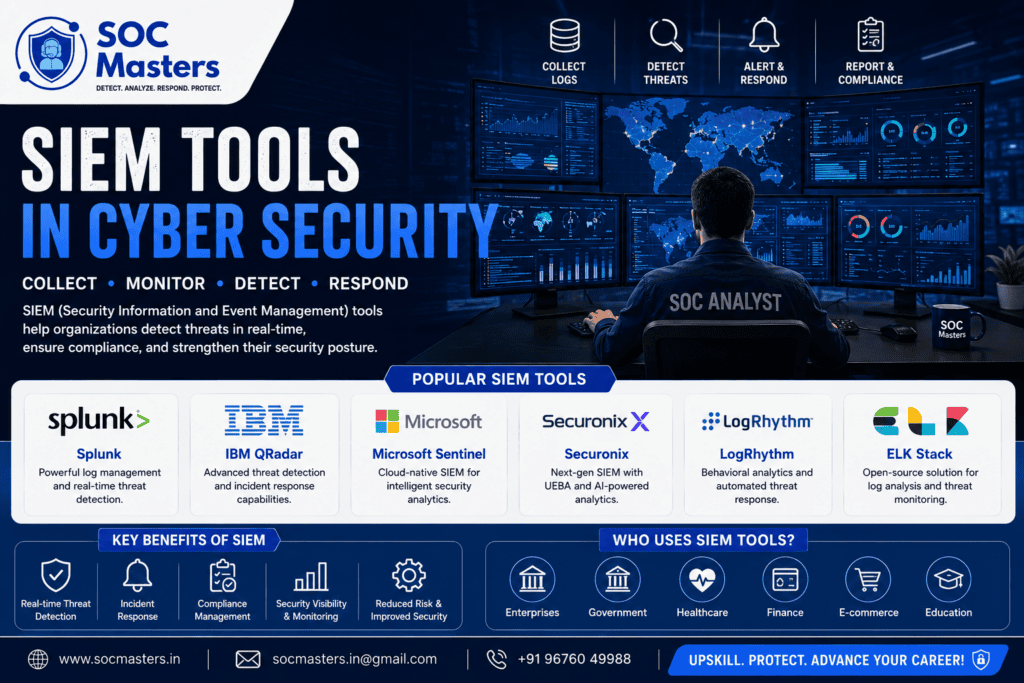
SIEM (Security Information and Event Management) tools collect logs from across an organisation, normalise them, correlate events, and raise security alerts when activity looks malicious. SOC Analysts work inside these platforms daily — triaging alerts, investigating incidents and hunting threats. Practical SIEM skill is the clearest dividing line between a candidate shortlisted for a SOC role and one who is not.
Table of Contents
Introduction
Every laptop, firewall, server and identity provider writes logs — hundreds of millions of events a day in a mid-sized company. No human team can read that. SIEM software turns the flood into a manageable queue of security alerts an analyst can work through.
SIEM stands for Security Information and Event Management. It is the central nervous system of a Security Operations Center, where firewall logs, Windows security events, endpoint detections, DNS queries and cloud audit trails land, get stitched together, and get compared against detection rules in real-time.
This matters because SOC job descriptions are written in SIEM language. Interviewers ask you to explain a correlation rule or confirm whether a PowerShell detection is a true positive — questions you cannot answer from theory. Closing that gap is what structured SOC Analyst Training in Hyderabad is built to do, through labs where you investigate live alerts instead of memorising definitions.
This guide covers what SIEM tools in cyber security are, how the technology works, which SIEM platforms SOC teams run in 2026, and how a beginner should sequence their learning.
What Are SIEM Tools in Cyber Security?
SIEM tools are security platforms that centralise log data from across an IT environment, normalise it into a consistent structure, correlate events across sources, and generate prioritised alerts for analysts to investigate.
The full form of SIEM is Security Information and Event Management, a merger of two older categories:
- SIM (Security Information Management) — log storage, search and compliance reporting
- SEM (Security Event Management) — real-time cybersecurity monitoring, correlation and alerting
Modern SIEM solutions do both, adding threat intelligence enrichment, UEBA, security analytics dashboards and AI-assisted triage.
The core purpose is visibility with context. A failed login on one server means nothing. Four hundred failed logins from one IP across twelve servers, followed by one success and a new admin account, is an attack. No single log source sees that pattern; a SIEM does.
Inside a Security Operations Center, SIEM in cyber security covers four functions: security monitoring, threat detection, incident investigation and compliance reporting. It also anchors the wider set of SOC analyst tools an L1 uses each shift. Our explainer on what a Security Operations Center is covers the operating model.
How Does SIEM Work? The Nine-Stage Pipeline
A SIEM does not simply store logs — it runs a pipeline. Understanding each stage separates a candidate who has used a SIEM from one who has only clicked around in it.
- Data collection. Agents, forwarders, syslog listeners and API connectors pull events from endpoints, firewalls, proxies, domain controllers, cloud platforms and identity providers.
- Log aggregation. Everything ships to a central store — indexer cluster, cloud workspace or data lake — so analysts query one place, not twenty consoles.
- Normalisation and parsing. Normalisation maps differing log formats to a common schema — ECS in Elastic, UDM in Google SecOps, native tables in Sentinel — so a source IP is the same field everywhere. A broken parser means a silent blind spot.
- Enrichment. Events gain context: geolocation, asset criticality, user department, threat-intel reputation of an IP or hash.
- Event correlation. Rules link related security events across sources and time. This is where “many failed logins” plus “one success” plus “new privileged group membership” becomes one story.
- Threat detection. Signature rules, thresholds, behavioural baselines, ML anomalies and threat-intel matches fire. Mature teams map detections to <a href=”https://attack.mitre.org/matrices/enterprise/” target=”_blank” rel=”noopener”>the MITRE ATT&CK Enterprise Matrix</a>, which since the v19 release in April 2026 covers 15 tactics and 222 techniques.
- Alert generation. Detections become scored alerts in the analyst queue.
- Investigation. The analyst validates the alert, determines scope, then closes it as a false positive or escalates for containment.
- Reporting. Dashboards and metrics go to management and auditors — mean time to detect, mean time to respond, coverage gaps.
See our breakdown of SIEM architecture and data flow for the components behind these stages.
Why Are SIEM Tools Important for Cybersecurity?
- Centralised monitoring. One console instead of dozens of disconnected SOC security tools.
- Real-time threat detection. Correlation catches multi-stage cyber threats individual tools miss.
- Log management. Searchable history for investigations reaching back weeks or months.
- Security alert management. Deduplication, severity scoring and prioritisation.
- Incident investigation. A single timeline across identity, endpoint, network security and cloud.
- Compliance. Audit evidence for ISO 27001, PCI DSS, HIPAA and SOC 2 — and for Indian organisations, CERT-In directions requiring specified cyber incidents to be reported within six hours of detection.
- Threat intelligence integration. Known-bad indicators matched against live traffic.
- Faster response. Enriched alerts cut the time spent assembling context before a decision.
Which SIEM Platforms Do SOC Teams Use?
The market consolidated between 2024 and 2026, so vendor status matters as much as feature lists. Questions about the best SIEM tools have one honest answer: the platform your target employer runs. Our comparison of SIEM platforms for security operations teams goes deeper on selection.
Microsoft Sentinel
Cloud-native, built on Azure, queried with KQL, and integrated deeply with Entra ID, Defender for Endpoint and Microsoft 365 — which matters because many Indian enterprises are Microsoft-first. Sentinel is now managed mainly through the Microsoft Defender portal, and the Azure portal experience retires on 31 March 2027 (extended from July 2026). New capabilities ship to the Defender portal only.
Splunk Enterprise Security
Splunk, now part of Cisco, remains one of the most widely deployed SIEM monitoring tools in large enterprises and MSSPs. Analysts query with SPL. Enterprise Security 8.x ships in Essentials and Premier editions, with Premier bundling SOAR, UEBA and the AI Assistant. SPL is among the most requested skills in Indian SOC postings.
IBM QRadar
Blanket statements about QRadar are usually wrong. IBM divested the QRadar SaaS assets to Palo Alto Networks in September 2024; the cloud line reached end of life on 14 April 2026, with QRadar EDR/XDR following on 31 August 2026. The on-premises QRadar SIEM was not divested — IBM released version 7.6.x on 30 June 2026 with a published support lifecycle. So on-prem QRadar remains a live skill, but a syllabus advertising “QRadar Cloud” or “QROC” labs is outdated.
LogRhythm (now part of Exabeam)
LogRhythm merged with Exabeam in July 2024 and the combined company kept the Exabeam name. Its SIEM and log-management lineage continues inside the Exabeam Security Operations Platform. If a job description says “LogRhythm”, the vendor today is Exabeam.
Elastic Security
Built on the Elasticsearch stack and popular with detection-engineering teams. Rules are written in ES|QL and KQL, detections map to MITRE ATT&CK, and Attack Discovery groups related alerts into one narrative. Its advantage for learners is accessibility: a home lab needs no enterprise licence.
Google Security Operations (formerly Chronicle)
Google rebranded Chronicle as Google Security Operations in April 2024. It ingests at very large scale, normalises into the UDM schema, and uses YARA-L rules. Gemini-powered triage agents reached general availability in Q1 2026, and it inherits Mandiant threat intelligence.
SIEM Tools Used by SOC Analysts
Whatever the platform, daily use of SIEM tools for SOC Analysts is the same:
- Alert monitoring — working a live queue on shift
- Alert triage — assigning severity and priority
- Log analysis — querying the events behind an alert
- Threat detection — validating whether behaviour is malicious
- Incident investigation — building a timeline and blast radius
- Threat hunting — searching for what no rule has flagged
- Correlation rule tuning — cutting false positives without losing coverage
- Dashboard monitoring — tracking anomalies and detection health
- Escalation — handing off to L2/L3 with a clear write-up
- Reporting — case documentation, handover notes, metrics
Our guide to the day-to-day responsibilities of a SOC Analyst maps these against L1, L2 and L3 tiers.
SIEM Tools and SOC Analyst Training in Hyderabad
The Nasscom GCC Landscape Report 2026 records that more than half of India’s newly established BFSI global capability centres chose Hyderabad, and Telangana’s IT department reported 43 new GCC commitments in the first half of 2026, after 84 began operations in 2025. These centres run round-the-clock security operations, and those SOCs hire locally.
This is why SOC Analyst Training in Hyderabad differs in emphasis from a general cyber security course in Hyderabad: hiring managers here staff 24×7 monitoring teams and screen for platform fluency.
A SIEM-focused programme should give you:
- Hands-on SIEM labs — your own workspace, not screenshots in a slide deck
- Live alert investigation — a queue with real detections and real false positives
- Log analysis practice — KQL or SPL against messy data
- Incident response exercises — detection through containment
- Attack simulation — generating the telemetry yourself, then detecting it
- Detection engineering — writing a correlation rule, then testing whether it fires
- Documented projects — investigation write-ups you can show an interviewer
At SOC Masters, sessions are led by Mr. Dinesh S, who brings over 20 years of industry experience, and labs are built around the platforms Hyderabad employers run. The SOC Analyst course in Hyderabad runs self-paced, live online and classroom, from centres near JNTU Metro Pillar A689 and at Manjeera Trinity Corporate, Kukatpally.
SIEM Tools for Beginners: A Seven-Stage Learning Path
Skipping stages is why beginners stall. Each exists because the next depends on it.
Stage 1 — Cybersecurity fundamentals
CIA triad, attack lifecycle, common attack types, defence in depth and vulnerability management basics. Start with cybersecurity fundamentals for the SOC Analyst role.
Stage 2 — Networking fundamentals
TCP/IP, ports and protocols, DNS, HTTP/HTTPS, proxies, VPNs, NAT. You cannot read a firewall log without this.
Stage 3 — Windows and Linux logs
Windows Security Event IDs (4624, 4625, 4688, 4720), Sysmon, and Linux auth.log, syslog and audit.log. This is the raw material of every investigation.
Stage 4 — SIEM architecture
Collectors, forwarders, parsers, indexing, retention tiers and licensing. Know why logs go missing before someone asks you to explain it.
Stage 5 — One SIEM platform, properly
Pick one and go deep. Depth in one platform transfers; shallow familiarity with five does not.
Stage 6 — Alert investigation practice
Generate attacks in a lab, watch the alerts fire, investigate end to end, and write up each case as if handing it to an L2.
Stage 7 — Full SOC scenarios
Multi-stage incidents: phishing to credential theft to lateral movement to exfiltration. Rehearse explaining them aloud — that is what the interview tests. Our SOC Analyst interview question bank is a useful checkpoint.
SIEM Tools Comparison
SIEM Tool | Deployment | Best Use Case | Beginner Friendly | Key Capability |
Microsoft Sentinel | Cloud-native (managed in Defender portal) | Microsoft-centric and cloud-first SOCs | High — free tier plus Microsoft Learn labs | KQL analytics, Entra/Defender integration, data lake |
Splunk Enterprise Security | On-premises, cloud or hybrid | Large enterprises and MSSPs with heavy data volumes | Medium — SPL has a learning curve | SPL search at scale, risk-based alerting, SOAR/UEBA in Premier |
IBM QRadar | On-premises (SaaS line ended in 2026) | Existing on-prem enterprise SOC estates | Medium — limited free access | Offense-based correlation, network flow analysis |
Elastic Security | Self-managed, cloud or on-premises | Detection engineering and home-lab learning | High — open and self-hostable | ES|QL search, ECS schema, Attack Discovery |
LogRhythm (Exabeam) | On-premises and cloud | Mid-market and compliance-driven SOCs | Medium — commercial access only | Log management plus Exabeam UEBA and behavioural analytics |
Google SecOps | Cloud-native | Very high-volume ingestion, intel-led detection | Medium — enterprise access required | UDM normalisation, YARA-L rules, Gemini triage agents |
SIEM vs Other Security Technologies
Technology | Primary Purpose | Used By |
SIEM | Centralised log collection, correlation, detection and investigation across all sources | SOC Analysts, detection engineers, compliance teams |
EDR | Deep visibility and response on endpoints — process trees, memory, file activity | SOC Analysts, endpoint and IR teams |
XDR | Correlated threat detection and response across endpoint, identity, email and cloud | SOC Analysts, security engineering |
SOAR | Automating repetitive response actions through playbooks and case workflow | SOC Analysts, automation engineers |
IDS/IPS | Detecting or blocking malicious network traffic via signatures and anomalies | Network security teams, SOC monitoring |
Firewall | Enforcing network access policy at the perimeter and between segments | Network and infrastructure teams |
These are complementary, not competing. Firewalls and IDS/IPS block what they can and log the rest; EDR and XDR produce high-fidelity endpoint and identity detections; the SIEM ingests everything and correlates across it; SOAR executes repetitive response steps. The SIEM sees the whole attack because it is the only layer holding every source at once.
Skills Required to Work with SIEM Tools
- Networking — TCP/IP, ports, routing, segmentation
- DNS — resolution flow, tunnelling and beaconing indicators
- HTTP/HTTPS — methods, status codes, headers, user agents, TLS
- Windows security logs — authentication, process creation, account management
- Linux logs — authentication, sudo, cron, audit records
- SQL basics — the query mindset transfers to KQL and SPL
- Regular expressions — parsing, field extraction, indicator matching
- Threat intelligence — IOCs, TTPs, reputation sources and their limits
- Incident response — see our
- Log analysis — knowing what normal looks like
- MITRE ATT&CK — mapping behaviour to tactics and techniques
- Basic scripting — Python or PowerShell for enrichment tasks
Common SIEM Use Cases and How Analysts Investigate Them
Brute-force attacks. Check source IP reputation, confirm whether any attempt succeeded, review what the account did next.
Failed login anomalies. A spike outside business hours or from an unusual location — compare against the user’s baseline and check whether MFA was satisfied.
Privilege escalation. New Domain Admins membership, or a service account gaining rights. Identify who made the change and whether a ticket exists.
Malware detection. Pull the process tree, file hash and network connections, then check whether the hash appears on other hosts.
Suspicious PowerShell. Decode the encoded command, check the parent process, look for follow-on network activity.
Impossible travel. Two logins from distant locations in an implausible window. Rule out VPN and roaming first — high false-positive rate.
Data exfiltration. Unusual outbound volume or DNS tunnelling. Establish the baseline, identify the destination, assess data sensitivity.
Phishing investigation. Trace the email, extract URLs and attachments, check who clicked, look for credential submission and later sign-ins.
Insider threat indicators. Bulk file access or activity outside role scope. Involve HR and legal — process discipline matters here.
Ransomware detection. Mass file modification, shadow-copy deletion, backup tampering. Containment first: isolate, then investigate.
Real-Time SOC Analyst Workflow Using SIEM
Alert → Triage → Investigation → Enrichment → Validation → Containment → Escalation → Documentation
- Alert. A detection rule fires and creates a case in the queue.
- Triage. Assess severity, asset criticality and user context; decide priority.
- Investigation. Query the logs, build a timeline, pivot from alert to host to user to network.
- Enrichment. Add threat intelligence, asset ownership and historical activity for the same entities.
- Validation. Confirm true or false positive. Over-escalating burns credibility; under-escalating misses breaches.
- Containment. Isolate the host, disable the account or block the indicator, within your tier’s authority.
- Escalation. Hand off to L2/L3 with what happened, what you verified and what remains open.
- Documentation. Close the case with findings and a tuning recommendation.
This cycle is the core of security incident management and of threat detection and response — and it is what employers mean by SOC experience.
Benefits of Learning SIEM Tools
- Job readiness. SOC job descriptions name SIEM platforms explicitly; fluency clears the screening filter.
- Stronger fundamentals. Working with logs forces real understanding of networking and authentication.
- Investigation skill. You reason from evidence instead of assuming from alert titles.
- Interview performance. Most SOC interviews are scenario-based; lab experience gives specific answers.
- Career mobility. SIEM underpins detection engineering, threat hunting and incident response.
SIEM Career Opportunities
SIEM skills open several paths:
- SOC Analyst (L1, L2, L3)
- Security Analyst / Cybersecurity Analyst
- SIEM Analyst / SIEM Engineer
- Security Monitoring Analyst
- Incident Response Analyst
- Threat Detection Engineer
- Threat Hunter
Most people enter at L1 monitoring and move to L2 investigation within one to two years. Compensation varies by employer type, shift pattern and certification profile — our SOC Analyst salary overview for India presents market estimates only, not guaranteed figures, and outcomes depend on individual performance and hiring conditions. For live openings, see SOC Analyst job opportunities in Hyderabad — the market where structured cyber security training in Hyderabad pays off fastest.
How to Choose the Right SIEM Tool to Learn
Score any platform against this checklist before committing to it:
- Learning resources — official documentation, free labs, structured paths
- Community support — forums and public detection repositories
- Industry usage — how often it appears in postings in your target market
- Cloud integration — support for AWS, Azure and GCP telemetry
- Hands-on access — can you build a lab, or only read about it?
- Detection capability — rule flexibility, behavioural analytics, ATT&CK mapping
- Career relevance — does it lead to roles you want in two years?
- Certification availability — is a recognised credential attached?
On that basis, Sentinel and Elastic Security are the strongest starting points for beginners in India: accessible for self-study, cloud-relevant, and Sentinel has a direct certification path.
Common Mistakes Beginners Make While Learning SIEM
- Starting with the tool instead of the fundamentals. Without networking and log knowledge, a SIEM is an unfamiliar search box.
- Memorising queries instead of understanding alerts. Interviewers ask why an alert fired.
- Ignoring networking. Most alerts are network stories in disguise.
- Ignoring raw logs. If you cannot read the event, you cannot validate the detection built on it.
- Watching instead of practising. Video-only learning produces recognition, not capability.
- Collecting platforms. Familiarity with five SIEMs is weaker than depth in one.
- Studying a retired syllabus. Vendor changes are frequent — check what you are learning is current.
The Future of SIEM in Cybersecurity
SIEM is becoming the data and decision layer of an AI-assisted SOC.
- Agentic triage. Vendors now ship AI agents that perform first-pass investigation; Google reports its triage agent compressing a typical 30-minute manual analysis into roughly a minute.
- Cloud SIEM and data lakes. Cheaper long-term retention is decoupling storage from analytics.
- SIEM, XDR and SOAR convergence. Boundaries keep blurring into unified security operations consoles.
- Detection-as-code. Rules in version control, tested in pipelines, reviewed like software.
- Threat intelligence at ingestion. Enrichment happens automatically rather than manually.
- AI-driven threats. New techniques, including AI-orchestrated intrusion activity now reflected in MITRE ATT&CK, create new detection requirements.
None of this removes the analyst. It moves the analyst up the stack: less manual evidence-gathering, more judgement, validation, tuning and detection engineering.
Key Takeaways
- SIEM centralises logs from every source, correlates events, and produces the alert queue SOC Analysts work.
- The nine-stage pipeline — collection to reporting — is the foundation of every SIEM interview.
- The vendor landscape changed materially through 2024–2026; check any syllabus reflects current platform status.
- Depth in one SIEM platform, backed by networking and log fundamentals, beats shallow exposure to several.
- Hands-on investigation practice is what converts SIEM knowledge into a SOC job offer.
Conclusion
SIEM tools in cyber security are the backbone of modern security operations. They collect what everything else generates, correlate what no single tool sees alone, and produce the alerts that make defensive security a repeatable discipline rather than a reactive scramble.
For anyone targeting a SOC role the priority is clear: build the fundamentals, pick one SIEM platform, and spend most of your time investigating alerts rather than reading about them. Platforms keep changing — vendors merge, portals retire, AI agents take over first-pass triage. The analyst skill underneath does not. Structured SOC Analyst Training in Hyderabad shortens that path by providing the lab environment, the alert queue and the mentorship that self-study rarely offers.
Start Your SOC Career with SIEM Skills Employers Recognise
At SOC Masters, Hyderabad, our SIEM-focused SOC Analyst programme is delivered by Mr. Dinesh S with 20+ years of industry experience, built around hands-on labs, live alert investigation and documented case projects.
- Formats: Self-paced (₹15,000) | Live online and classroom (₹25,000)
- Centres: JNTU Metro Pillar A689 and Manjeera Trinity Corporate, Kukatpally, Hyderabad
- Call: +91 96760 49988
- Email: socmasters.in@gmail.com
- Message us on WhatsApp for the current batch schedule and syllabus.
Talk to our team about which SIEM platform fits your background — get in touch to plan your learning path.
Frequently Asked Questions
What are SIEM tools in cyber security?
SIEM tools collect log and event data from across an organisation’s IT environment, normalise it, correlate related events, and generate alerts for analysts to investigate. They are the primary working environment of a Security Operations Center.
What is the full form of SIEM?
SIEM stands for Security Information and Event Management. It combines Security Information Management (log storage and reporting) with Security Event Management (real-time monitoring and alerting).
Which SIEM tool is best for beginners?
Microsoft Sentinel and Elastic Security. Sentinel offers free-tier access with structured Microsoft Learn paths; Elastic can be self-hosted for a home lab. Both allow hands-on practice without an enterprise licence.
What SIEM tools do SOC Analysts use?
The platforms most common in Indian SOC job descriptions are Microsoft Sentinel, Splunk Enterprise Security, IBM QRadar (on-premises), Elastic Security, Google Security Operations and Exabeam (formerly LogRhythm).
Is SIEM important for SOC Analysts?
Yes. Alert triage, log analysis and incident investigation all happen inside the SIEM, which makes it the most frequently listed technical requirement in SOC Analyst job postings.
Is SIEM difficult to learn?
The interface is not difficult. The difficulty sits underneath — networking, Windows and Linux logging, authentication flows. Learners with those basics become productive quickly; those without them struggle whatever the tool.
How long does it take to learn SIEM tools?
With consistent daily practice, most learners reach working familiarity with one platform in two to three months, assuming networking and log fundamentals are in place. Add two to three months if starting from scratch.
What skills are required to become a SOC Analyst?
Networking fundamentals, Windows and Linux log analysis, knowledge of common attack techniques, familiarity with MITRE ATT&CK, hands-on SIEM experience, incident response process knowledge, and clear written communication.
Is SOC Analyst Training in Hyderabad useful for beginners?
It is useful when the programme is lab-led rather than lecture-led — the value comes from investigating real alerts, tuning detections and documenting cases. Hyderabad’s BFSI and healthcare GCC concentration also keeps local SOC hiring active.
Which certification is useful for SIEM and SOC careers?
Microsoft’s <a href=”https://learn.microsoft.com/en-us/credentials/certifications/security-operations-analyst/” target=”_blank” rel=”noopener”>SC-200 Security Operations Analyst certification</a> maps directly to Sentinel work. CompTIA CySA+ is a strong vendor-neutral option — CS0-004 launched on 23 June 2026 and CS0-003 retires in English on 22 December 2026. See our guide to SOC Analyst certifications.