
SOC Analyst Roles and Responsibilities
A SOC Analyst monitors an organisation’s security alerts, triages them by severity, analyses logs from firewalls, endpoints and cloud services, investigates suspicious activity, and responds to confirmed incidents. Core responsibilities include SIEM monitoring, alert triage, threat intelligence lookups, incident containment, escalation to senior analysts, and documenting every investigation for audit and reporting purposes.
Table of Contents
Introduction
Every organisation that keeps data online — a bank, a hospital, a mid-size IT services firm in Madhapur — needs somebody watching for attacks while everyone else is asleep. That somebody is the SOC Analyst.
A Security Operations Center, or SOC, is the team and technology stack that handles cybersecurity monitoring for a business. It runs around the clock, usually in shifts, and its job is simple to state and hard to do: notice trouble early enough to stop it.
Demand has grown for an unglamorous reason. Attacks have not become more exotic so much as more frequent, and most still start in ordinary ways — a stolen password, a phishing email, an unpatched server. Catching those early needs humans reading machine output.
Hyderabad matters specifically: it hosts a dense cluster of global capability centres, managed security service providers and BFSI back-office operations — the employers who staff 24×7 monitoring teams. That is why entry-level openings appear here in volume.
SOC Analyst roles and responsibilities are often described in job postings using flattering language — “threat hunting,” “detection engineering” — when the entry-level reality is closer to disciplined, repetitive investigation under time pressure. Both are true at different levels. This article separates them, then covers the L1/L2/L3 split, skills, tools, salaries and the route in. Practical SOC Analyst Training in Hyderabad closes the gap between knowing what a SIEM is and working an alert queue on day three without freezing.
What Is a SOC Analyst?
A SOC Analyst is a cybersecurity professional who monitors an organisation’s IT environment for signs of attack, investigates them, and coordinates response when an incident is confirmed.
The SOC is a centralised function. Logs from firewalls, servers, laptops, identity systems and cloud platforms flow into one place — typically a SIEM — where correlation rules flag activity that looks wrong. Analysts work that output. For the architectural picture, see our explainer on what a Security Operations Center is.
Analysts protect organisations three ways: they shorten the time between an attacker getting in and someone noticing, they stop small compromises becoming large ones through fast containment, and they build institutional memory — every documented incident sharpens the next detection rule.
Proactive versus reactive monitoring
Reactive security alert monitoring means responding to what the tooling generates — an EDR agent flags a suspicious process, an analyst investigates. This is the bulk of L1 work and no criticism: the alert queue is where most real incidents surface.
Proactive monitoring means looking for what nothing has alerted on. A threat hunter forms a hypothesis — “if an attacker were using this technique here, what would the logs look like?” — and queries for it. That is senior work, requiring enough knowledge of the environment to recognise normal. Mature SOCs do both.
SOC Analyst Roles and Responsibilities
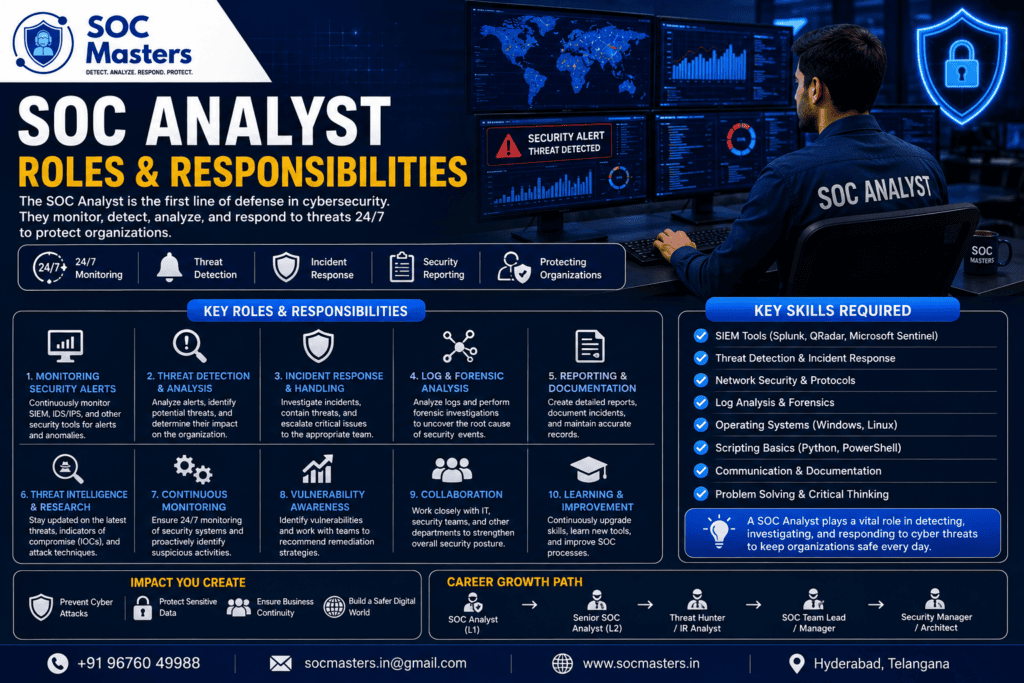
Core SOC Analyst duties break into ten areas. During a live shift they blur together, but are worth understanding separately.
1. Security Monitoring
SOC monitoring is continuous review of dashboards and alert consoles for malicious or unusual activity.
Analysts watch SIEM dashboards covering authentication activity, network traffic and endpoint detections, tracking queue depth so nothing ages out unreviewed. Quiet indicators matter as much as loud ones — a service account logging in at an odd hour, outbound traffic to a country the business does not operate in, a spike in failed authentications. Network and endpoint activity are watched together because attackers move between them.
2. Alert Triage
Alert triage is reviewing incoming alerts, deciding how serious each is, and ordering them for action.
This is the highest-volume SOC Analyst responsibility. A mid-size SOC generates thousands of alerts daily and most are false positives — a vulnerability management scan doing its job, a developer running a tool that resembles reconnaissance, a backup touching files at scale.
Triage asks four questions: what triggered this, is the activity genuinely abnormal here, how important is the asset, and does it correlate with anything else happening now. A phishing alert against a finance mailbox outranks a malware alert on a lab machine, and knowing that separates a useful analyst from a merely fast one. Every false positive closed with a proper note becomes tuning input for the rule that produced it.
3. Log Analysis
Log analysis is examining system records to reconstruct what happened and in what order. SOC Analysts routinely work with:
- Firewall logs — allowed and blocked connections, addresses, ports
- Windows Event Logs — logons, process creation, service installation, PowerShell
- Linux logs — auth.log, secure, syslog, audit records for SSH and privilege use
- Authentication logs — Active Directory and identity provider records
- Application logs — web server access records, database queries, errors
- Cloud logs — API calls, role assumptions, configuration changes
The real skill is timeline construction. Individual log lines mean little; the sequence tells the story. A successful login is unremarkable until followed by a privilege change and a large data transfer.
4. Incident Detection
Threat detection means recognising the attack pattern behind suspicious activity. Common categories:
- Malware — unexpected executables, unusual parent-child processes, persistence
- Phishing — spoofed sender domains, credential harvesting links, attachments
- Brute-force attacks — high-volume failed authentications from few sources
- Suspicious logins — unusual geographies, impossible travel, first-time devices
- Privilege escalation — accounts gaining rights they should not have
- Data exfiltration — abnormal outbound volume, archiving before transfer
5. Incident Response
Incident response is the structured handling of a confirmed incident. Investigation establishes scope and root cause. Containment limits spread by isolating a host, disabling an account or blocking an address. Escalation passes it up. Remediation removes the attacker’s foothold. Recovery restores normal operation with verification. Documentation records the sequence.
Juniors typically own investigation, initial containment and escalation; seniors own remediation decisions. Our breakdown of the SOC incident response process covers each phase.
6. Threat Intelligence
Threat intelligence is external context about attackers and their infrastructure, applied to your own alerts.
Analysts handle indicators of compromise — IP addresses, domains, URLs, file hashes — checking them against feeds and reputation services, and read reporting on threat actors targeting their industry.
MITRE ATT&CK is the shared language here, cataloguing real adversary behaviour as tactics and techniques. It is actively maintained: version 19, released April 2026, restructured the Enterprise matrix to 15 tactics and 222 techniques, splitting the old Defense Evasion tactic into separate Stealth and Defense Impairment categories. Anyone studying material that still describes 14 tactics is learning a version that no longer matches the live ATT&CK Enterprise Matrix.
7. Security Investigation
Security incident investigation means correlating evidence from multiple sources to determine whether an event is malicious and how far it reached.
One alert rarely answers the question. An analyst investigating suspicious PowerShell execution pulls the process tree, the user’s authentication history, network connections from that host, and email received in the preceding hours. The conclusion comes from the overlap, not any single source.
8. SIEM Monitoring
SIEM monitoring is operating the platform that aggregates logs, applies detection logic and produces alerts. Common options are Microsoft Sentinel, Splunk and IBM QRadar. Analysts write and refine queries, tune correlation rules to cut noise, and build detections for gaps vendor content misses.
Two platform facts matter before you specialise. Sentinel is consolidating into the Microsoft Defender portal, with the Azure portal experience scheduled for retirement on 31 March 2027 — extended from an earlier July 2026 date. And the QRadar picture is more nuanced than the “QRadar is dead” claim circulating online: the cloud-hosted SaaS line acquired by Palo Alto Networks reached end of life in April 2026, while on-premises QRadar SIEM was never divested and received a 7.6.x release in June 2026 with a full support lifecycle. See our comparison of the best SIEM tools for SOC analysts and the SIEM architecture guide.
9. Endpoint Monitoring
EDR (Endpoint Detection and Response) records process execution, file operations, registry changes and network connections on hosts, flags suspicious patterns, and enables response actions — isolating a machine, killing a process, quarantining a file — remotely. XDR extends this by correlating endpoint telemetry with email, identity and cloud signals into a single incident view.
10. Reporting and Documentation
Documentation is the responsibility beginners underestimate and SOC managers evaluate hardest: incident reports capturing timeline, impact and actions; investigation notes written during the work, not afterwards; escalation summaries giving the next analyst enough context; shift handover reports; playbook documentation. In regulated sectors this is what auditors review.
SOC Analyst Daily Activities
A SOC Analyst’s day follows a repeatable workflow:
Monitor → Detect → Triage → Investigate → Escalate → Respond → Document
Monitor. The shift opens with a handover review, then continuous dashboard monitoring.
Detect. Alerts arrive from the SIEM, EDR platform and email gateway.
Triage. Each alert is assessed for severity, asset criticality and correlation, then queued.
Investigate. Surviving alerts get evidence gathering — log pulls, IOC checks, user verification.
Escalate. Anything beyond the analyst’s authority moves up with full context.
Respond. Containment and remediation execute within defined authority.
Document. Everything is written up before the alert is closed.
Between these, analysts handle tuning requests, user-reported phishing and investigations carried over from earlier shifts. Night shifts are standard in 24×7 environments and worth weighing honestly.
SOC Analyst L1, L2 and L3 Roles
SOC Level | Primary Role | Main Responsibilities | Experience |
L1 | Alert Monitoring | Dashboard monitoring, alert triage, false-positive identification, initial investigation, escalation | Entry level (0–2 years) |
L2 | Investigation | Deep incident investigation, threat analysis, containment decisions, detection tuning, vulnerability management support | Intermediate (2–5 years) |
L3 | Advanced Response | Threat hunting, complex multi-stage incidents, forensics, detection engineering, SOC process design | Advanced (5+ years) |
Entry level SOC Analyst responsibilities centre on the alert queue. A good L1 is measured not by alerts closed but by how accurately they separate noise from signal and how completely they document escalations.
L2 responsibilities begin where triage ends — scope, root cause and blast radius, containment calls, detection tuning, and usually the first level trusted to act on production systems.
Senior SOC Analyst responsibilities at L3 cover incidents nobody has a playbook for: proactive hunting, forensics, detection engineering, and often the SOC’s technical direction.
Progression from L1 to L2 typically takes eighteen months to three years and depends less on time served than on demonstrated investigation quality.
SOC Analyst Skills Required
Technical skills
Networking — TCP/IP, OSI model, subnetting, common ports
DNS — resolution flow, record types, why DNS logs reveal so much
HTTP/HTTPS — request structure, status codes, headers, TLS
Linux — command line, permissions, services, log locations
Windows — Active Directory, Event Log structure, key event IDs
SIEM — query writing, rule logic, log source onboarding
EDR — process trees, detection review, response actions
Log analysis — parsing, correlation, timeline building
Threat intelligence — IOC handling, feed usage, actor context
Incident response — lifecycle phases and containment methods
MITRE ATT&CK — mapping observed behaviour to techniques
If your networking and OS base is shaky, start there rather than with tools. Our guide to cybersecurity fundamentals for the SOC role covers that layer.
Analytical skills
Problem-solving under incomplete information. Critical thinking — asking whether the obvious explanation is correct. Pattern recognition, which comes from volume and cannot be shortcut.
Soft skills
Written communication above all, since most analyst output is text others must act on. Plus documentation discipline, teamwork across shifts, decision-making under pressure, and time management when the queue outlasts the shift.
SOC Analyst Tools and Technologies
Tool | Category | SOC Use |
Microsoft Sentinel | SIEM | Cloud-native security monitoring, KQL hunting |
Splunk | SIEM | Log aggregation and search-driven analysis |
IBM QRadar | SIEM | Event correlation and offence management |
CrowdStrike Falcon | EDR | Endpoint detection and response actions |
Microsoft Defender | EDR/XDR | Endpoint and cross-domain telemetry |
Wireshark | Network analysis | Packet-level investigation |
VirusTotal | Threat intelligence | File hash, URL and domain reputation |
MITRE ATT&CK | Threat framework | Technique mapping and coverage assessment |
Nmap | Network scanning | Host and service discovery, validation |
Windows Event Viewer | Log analysis | Native Windows event inspection |
You do not need all ten on day one. One SIEM learned properly beats three learned superficially, and interviewers can tell the difference within five minutes.
SOC Analyst Responsibilities in Real-Time Projects
Scenario 1: Phishing attack
Alert → Investigation → IOC analysis → User verification → Containment → Documentation
An email gateway flags a credential-harvesting link. The analyst reviews headers for sender authentication, submits the URL for reputation analysis, and queries mail logs to identify recipients. Endpoint and proxy logs show who clicked. Affected users are contacted and credentials reset, the sender blocked, the message purged, the incident documented with all indicators.
Scenario 2: Brute-force attack
Multiple failed logins → Alert → IP investigation → Account analysis → Blocking → Incident report
A correlation rule fires on repeated authentication failures. The analyst checks source reputation and geography, reviews the pattern — one account or many, one source or a spread — and critically, whether any attempt succeeded. A success turns attempted access into confirmed compromise. Containment blocks the source and disables the account pending reset.
Scenario 3: Malware detection
Endpoint alert → File hash analysis → Process investigation → Isolation → Remediation
EDR flags a suspicious executable. The analyst submits the hash for reputation checking, examines the process tree to establish what launched it and what it launched, and reviews network connections for command-and-control indicators. Confirmed activity triggers host isolation, removal, a persistence check and verified recovery.
SOC Analyst Career Path
SOC Analyst L1 → SOC Analyst L2 → SOC Analyst L3 → Threat Hunter → Security Engineer → SOC Manager
L1 builds monitoring discipline and log fluency. L2 develops investigation depth and detection tuning. L3 adds hunting, forensics and engineering. From there the path forks: Threat Hunter goes deeper into proactive detection; Security Engineer builds the security stack; SOC Manager moves to people, process and metrics.
Adjacent moves are common — incident response consulting, threat intelligence, cloud security, detection engineering. Our comparison of SOC analyst versus cybersecurity analyst roles is a useful starting point.
SOC Analyst Salary in Hyderabad
Compensation varies with experience, SOC level, SIEM depth, certifications, industry, shift willingness and employer type. Product companies and capability centres typically pay above managed service providers for the same title.
Experience | Role | Indicative Range (₹ per annum) |
0–2 years | SOC Analyst L1 | ₹3.5 – 6 LPA |
2–4 years | SOC Analyst L2 | ₹6 – 10 LPA |
4–7 years | SOC Analyst L3 | ₹10 – 18 LPA |
7+ years | Senior / Lead SOC Analyst | ₹18 – 30 LPA |
These are market estimates, not guarantees. For reference, Glassdoor’s Hyderabad data as of mid-2026 placed the average reported SOC Analyst salary near ₹5.3 lakh per annum, with a typical range of ₹4.15–7.66 lakh across 161 self-reported submissions. Self-reported data skews toward whoever chooses to report, so treat such figures as directional. No training programme, ours included, can promise a specific package.
What actually moves an offer is hands-on SIEM capability, investigation reasoning shown in interviews, and shift flexibility. See our analysis of SOC analyst salary in India for a breakdown by city and company type.
SOC Analyst Certifications
Certifications open doors to interviews. They do not replace the ability to work an alert.
- CompTIA Security+ (SY0-701) — the vendor-neutral baseline, still current and widely used as an entry filter
- Microsoft SC-200 — Security Operations Analyst, focused on Sentinel and Defender; refreshed twice during 2026, so work from the current SC-200 objectives on Microsoft Learn, not older courseware
- CompTIA CySA+ — moved to exam code CS0-004 on 23 June 2026, with heavier incident response weighting, updated vulnerability management coverage and new AI content; study CS0-004 objectives
- CEH — broad offensive-awareness coverage, recognised by many Indian recruiters, though blue-team depth is limited
- Blue-team certifications — practical lab-based credentials testing investigation ability directly
- SIEM vendor certifications — Splunk and Microsoft credentials signalling tool competence
Sequence matters more than quantity: Security+ first, then SC-200 or CySA+ once hands-on exposure exists. Our guide to SOC analyst certifications compares cost, difficulty and hiring recognition.
Why SOC Analyst Training in Hyderabad Is Important
The gap most freshers hit is not knowledge — theory does not transfer to a live queue. You can explain what a SIEM does and still not know where to click when an alert fires.
Structured training closes that gap through practical SIEM work in a real console rather than slides, simulated attack scenarios where you triage alerts you did not expect, incident response labs forcing containment decisions under time pressure, log analysis across Windows, Linux and cloud sources, threat detection exercises mapped to current ATT&CK techniques, and interview preparation grounded in what technical panels ask.
At SOC Masters, training is delivered by Mr. Dinesh S, who brings over 20 years of industry experience, in self-paced and live formats. The institute has trained 2,000+ students and operates near JNTU Metro Pillar A689 and at Manjeera Trinity Corporate, Kukatpally. The broader cyber security course in Hyderabad covers the wider domain if SOC operations are not your fit.
Whatever programme you choose, evaluate it on lab access and instructor experience — not placement claims.
How to Become a SOC Analyst in Hyderabad
Step 1: Learn networking fundamentals. TCP/IP, subnetting, DNS, HTTP. Without this, log analysis becomes memorisation.
Step 2: Learn Linux and Windows security. File systems, permissions, authentication, and where each OS writes its logs.
Step 3: Learn a SIEM. Pick one — Sentinel and Splunk appear most in Hyderabad postings — and learn its query language properly.
Step 4: Practise log analysis. Reconstruct events from sample datasets until timelines come naturally.
Step 5: Learn incident response. Understand the lifecycle and practise containment decisions.
Step 6: Learn threat intelligence. IOC handling, feed usage, ATT&CK mapping.
Step 7: Practise real-time SOC scenarios. Phishing, brute-force and malware investigations end to end.
Step 8: Build a portfolio. Document investigations as you would in a real SOC — this becomes interview evidence.
Step 9: Prepare for certifications. Add credentials once the hands-on base exists.
Step 10: Apply. Target managed security providers and capability centres, which hire entry-level analysts in volume. See our guidance on SOC analyst jobs in Hyderabad and our SOC analyst resume guide.
Common Mistakes Beginners Make
Learning tools before fundamentals. Navigating a SIEM without understanding TCP/IP produces someone who can click but cannot interpret.
Ignoring networking. The most common gap in failed interviews.
Watching videos without practising. Passive consumption creates confidence that collapses under assessment.
Never touching a SIEM. Free tiers and trial environments exist. Use them.
Not learning log formats. Windows Event IDs and Linux auth logs come up constantly.
Skipping documentation practice. Interviewers ask you to walk through an investigation; vague answers fail.
Relying on certifications alone. A certificate with no hands-on ability shows within minutes.
Avoiding end-to-end projects. Complete investigations, not fragments, are what you can discuss.
Reviewing SOC analyst interview questions early surfaces these gaps before a recruiter does.
Is SOC Analyst a Good Career in 2026?
For most people entering cybersecurity, yes — with realistic expectations.
The case for it. Cybersecurity monitoring is one of the few genuinely accessible entry points into the field. Demand is steady rather than speculative, because organisations under regulatory obligation must maintain monitoring capability regardless of economic conditions. Skills transfer well and progression is clearly defined.
The honest caveats. Entry-level pay is moderate. Shift work is standard in 24×7 environments. Alert fatigue is real, and analysts who never progress beyond triage do burn out. The learning never stops — the ATT&CK restructure and the Sentinel portal migration are both from the last eighteen months.
Those who do well treat L1 as a starting position, not a destination.
Key Takeaways
- Responsibilities span monitoring, triage, log analysis, threat detection, incident response, threat intelligence, investigation, SIEM operation, endpoint monitoring and documentation.
- Alert triage is the highest-volume duty; most alerts are false positives, and separating signal from noise is the core entry-level skill.
- L1 monitors and escalates, L2 investigates and decides, L3 hunts and engineers. Progression depends on investigation quality, not tenure.
- Fundamentals before tools — networking and OS knowledge decide whether SIEM training is useful or superficial.
- Framework and certification data changes fast: CySA+ moved to CS0-004 in June 2026, ATT&CK restructured to 15 tactics in April 2026.
- All salary figures are estimates that vary by employer, skills and market conditions.
Conclusion
SOC Analyst roles and responsibilities are more structured and more demanding than most job descriptions suggest. The work rewards patience, methodical thinking and clear writing more than tool trivia. If that appeals, the route in is well mapped: build fundamentals, learn one SIEM properly, practise complete investigations, document everything.
Hyderabad remains one of India’s stronger markets for this role because of its concentration of security operations employers. The opportunity is real; so is the need to arrive with practical skills rather than a list of course completions.
To discuss course structure, batch timings or your starting point, get in touch with the SOC Masters team or call +91 96760 49988.
Frequently Asked Questions
1. What are the roles and responsibilities of a SOC Analyst?
A SOC Analyst monitors security alerts, triages them by severity, analyses logs from firewalls, endpoints, identity systems and cloud services, investigates suspicious activity, responds to confirmed incidents through containment and escalation, and documents every investigation for reporting and detection tuning.
2. What does a SOC Analyst do daily?
A typical day follows monitor, detect, triage, investigate, escalate, respond and document. Analysts begin with a shift handover, review dashboards continuously, work the alert queue, investigate whatever survives triage, escalate anything beyond their authority, and write up every alert before closing it.
3. What skills are required to become a SOC Analyst?
Networking fundamentals, Linux and Windows basics, SIEM query skills, log analysis, EDR familiarity, incident response knowledge and MITRE ATT&CK awareness. Equally important: analytical thinking, pattern recognition and clear written communication, since most SOC output is documentation another person must act on.
4. What is the difference between SOC L1, L2 and L3?
L1 handles monitoring, triage and escalation at entry level. L2 performs deeper investigation, containment decisions and detection tuning. L3 covers threat hunting, forensics, complex incidents and detection engineering. The real distinction is investigation depth and decision authority, not years served.
5. Which SIEM tools should a SOC Analyst learn?
Microsoft Sentinel and Splunk appear most often in Indian job postings, with QRadar still present in banking and enterprise environments. Learn one thoroughly rather than three superficially. Sentinel is consolidating into the Microsoft Defender portal ahead of the Azure portal retirement in March 2027.
6. Is SOC Analyst a good career for freshers?
It is one of the most accessible cybersecurity entry points, since organisations hire L1 analysts in volume and train them internally. Expect moderate starting pay and rotating shifts at first, with meaningful progression after eighteen months to three years of solid investigation experience.
7. What is the SOC Analyst salary in Hyderabad?
Public aggregator data from mid-2026 places the average reported figure near ₹5.3 lakh per annum, with entry-level roles commonly between ₹3.5 and ₹6 lakh. Figures vary widely by employer, SIEM expertise, certifications and shift willingness, so treat them as directional.
8. How can I become a SOC Analyst in Hyderabad?
Build networking and operating-system fundamentals, learn one SIEM properly, practise log analysis and incident response on realistic scenarios, document complete investigations as portfolio evidence, add a certification such as Security+ or SC-200, then apply to managed security providers and capability centres.
9. Which certification is best for a SOC Analyst?
CompTIA Security+ is the standard starting credential. Microsoft SC-200 suits Sentinel and Defender environments. CompTIA CySA+ — exam code CS0-004 since June 2026 — targets analyst-level detection and response. Choose based on the tooling your target employers use, after building hands-on skills.
10. Is SOC Analyst training necessary to get a job?
Not strictly necessary, but structured training compresses the timeline. The hard part for self-taught candidates is realistic practice — a working SIEM, unpredictable alert scenarios, and feedback on investigation quality. Anyone who can build that independently can succeed without it.