
SOC Analyst vs Cybersecurity Analyst
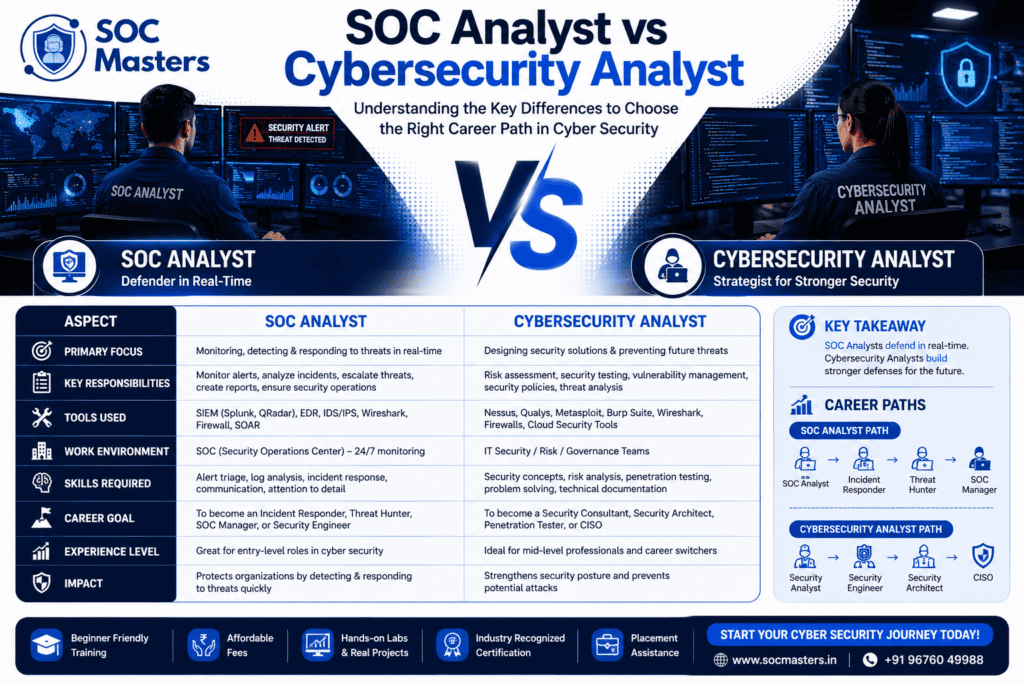
A SOC Analyst works inside a Security Operations Center, monitoring SIEM alerts in shifts and triaging, investigating and responding to incidents in real time. A Cybersecurity Analyst has a broader remit — vulnerability management, risk assessment, security controls and compliance — and usually works business hours. Both roles overlap on incident response, but the SOC role is detection-first while the analyst role is prevention-first.
Table of Contents
Introduction
If you are looking for a way into cybersecurity, two job titles keep appearing: SOC Analyst and Cybersecurity Analyst. On job portals they look interchangeable. They are not — and picking the wrong starting point can cost you a year of misdirected effort.
A SOC Analyst sits inside a Security Operations Center. Their day revolves around a queue: alerts arrive from a SIEM, and the analyst decides which are noise and which are the early signal of a real attack. Monitoring-led, shift-based, tool-driven.
A Cybersecurity Analyst works across a wider surface — scanning for vulnerabilities, assessing risk, hardening systems, reviewing access, supporting audits, and helping with incidents when they happen. Assessment-led, usually business hours.
The two get confused for a simple reason: Indian job descriptions often use “Cybersecurity Analyst” as an umbrella title, then describe a SOC role underneath it. Candidates end up preparing for the wrong interview.
Meanwhile demand keeps climbing, and Hyderabad has become one of the strongest places in India to start. Per the Nasscom GCC Landscape Report 2026, more than half of India’s newly established BFSI Global Capability Centres chose Hyderabad; Telangana’s IT department reports 70+ GCCs choosing the city in 2024, 84 commencing operations in 2025, and 43 more committing in H1 2026. BFSI, healthcare and pharma GCCs run round-the-clock security operations — and that means analysts on every shift.
That is the practical case for structured SOC Analyst Training in Hyderabad: it converts general interest into the specific, testable skills a hiring manager will actually probe — SIEM query writing, log interpretation, triage logic, incident documentation.
Here is an honest breakdown of both roles: what each does, where they overlap, what they pay, and how to choose.
What Is a SOC Analyst?
A Security Operations Center (SOC) is the function inside an organisation responsible for detecting and responding to security threats. Large enterprises run their own. Everyone else buys it from a Managed Security Service Provider (MSSP). Either way, the SOC is the room where alerts land.
A SOC Analyst’s core responsibilities:
- Security monitoring — watching dashboards and alert queues across endpoints, network, cloud and identity sources.
- Alert detection — working with correlation rules and analytics that convert raw logs into actionable alerts.
- Alert triage — the single most important daily skill. Given fifty alerts, decide which three matter.
- Incident investigation — pivoting through logs to reconstruct what happened, in what order, and to which assets.
- SIEM monitoring — living inside a Security Information and Event Management platform, writing queries rather than clicking through menus.
- Threat detection — recognising attacker behaviour patterns, not just signatures.
- Incident response — containment, escalation, and coordination with IT and engineering teams.
- Security reporting — documenting findings clearly enough that the next shift and the client can follow them.
Common SOC tools
Tool | What a SOC Analyst uses it for |
Microsoft Sentinel | Cloud-native SIEM; KQL queries, analytics rules, incident investigation |
Splunk | SPL searches, dashboards, correlation searches, Enterprise Security |
IBM QRadar | Offense-based investigation, log source management |
CrowdStrike Falcon | Endpoint detection, process tree analysis, host containment |
Microsoft Defender XDR | Endpoint, identity, email and cloud app signals in one incident view |
Wireshark | Packet-level analysis when logs alone do not explain the behaviour |
This tooling is moving fast. Microsoft is consolidating Sentinel into the Defender portal — its documentation states Sentinel customers on the Azure portal were being redirected by July 2026, with the Azure portal experience sunsetting 31 March 2027. Separately, after Palo Alto Networks acquired IBM’s QRadar SaaS assets, QRadar on Cloud, SOAR and Log Insights reached end of life on 14 April 2026, with QRadar EDR and XDR following on 31 August 2026. QRadar on-premises continues under IBM support.
The lesson is not “learn every tool.” It is that the tool changes, the analysis doesn’t. Someone who genuinely understands a Windows authentication log moves between platforms in weeks. Someone who memorised a Sentinel menu cannot.
What Is a Cybersecurity Analyst?
A Cybersecurity Analyst is responsible for the overall security posture of an organisation rather than one alert queue. The work is broader and, on most days, less time-critical.
Typical responsibilities:
- Security monitoring — often at a summary or exception level rather than live triage.
- Vulnerability analysis — running scans, validating findings, removing false positives, and prioritising what actually needs patching.
- Risk assessment — judging which weaknesses matter given the business context.
- Security controls — reviewing and tuning firewalls, endpoint policies, email security and access rules.
- Incident response — participating in investigations, often as a technical contributor rather than first responder.
- Threat analysis — mapping the threat landscape relevant to the organisation’s sector.
- Security compliance — supporting ISO 27001, SOC 2, PCI DSS, RBI or HIPAA-driven evidence collection and audits.
- Security improvement — closing gaps identified by assessments, audits and incidents.
Here is the honest caveat: this title varies enormously by company. In a 200-person SaaS firm, the Cybersecurity Analyst may be the entire security team — SOC, vulnerability management, compliance and awareness training in one person. In a large BFSI GCC, a Cybersecurity Analyst might do nothing but vulnerability management for one business unit.
Always read the job description, not the title. If it mentions shifts, SIEM and alert queues, it is a SOC role wearing a different name. If you want the underlying concepts before you compare roles, our primer on cybersecurity fundamentals for the SOC analyst role covers the base layer both jobs assume you already have.
SOC Analyst vs Cybersecurity Analyst: What Is the Difference?
SOC Analyst | Cybersecurity Analyst | |
Primary Focus | Detect and respond to active threats in real time | Reduce risk and strengthen security posture over time |
Daily Responsibilities | Alert triage, log analysis, incident investigation, escalation, shift handover | Vulnerability scanning, risk assessment, control review, audit support, remediation tracking |
Tools | SIEM (Sentinel, Splunk, QRadar), EDR/XDR, SOAR, threat intel platforms, Wireshark | Vulnerability scanners (Nessus, Qualys), GRC platforms, IAM tools, cloud posture tools |
Skills | Log analysis, SIEM query languages, attacker TTPs, triage judgement, documentation | Risk analysis, vulnerability prioritisation, security architecture basics, compliance frameworks, stakeholder communication |
Work Environment | SOC floor or remote SOC; often 24×7 rotating shifts | Mostly business hours; project and stakeholder driven |
Career Path | L1 → L2 → L3 → Threat Hunter / Incident Responder / Detection Engineer → SOC Manager | Analyst → Senior Analyst → Security Engineer → Consultant → Architect / Manager |
SOC Analyst vs Cybersecurity Analyst: Key Differences
1. Job Responsibilities
The SOC Analyst owns detection and response; the Cybersecurity Analyst owns prevention and reduction. One asks “is this alert a real attack?” The other asks “why was this possible, and what stops the next one?”
2. Daily Work
SOC work is queue-driven and interrupt-heavy — finish one investigation and the next alert is waiting. Cybersecurity Analyst work is project-driven: a scan cycle, a control review, an audit deadline. Dislike unpredictability? The second fits. Find scheduled work dull? The first.
3. Security Tools
SOC Analysts go deep on a small stack used daily: one SIEM, one EDR, one ticketing system. Cybersecurity Analysts go broad: scanners, cloud consoles, IAM, GRC tooling. For a beginner, depth is easier to demonstrate in an interview than breadth — one reason the SOC route is a more reliable entry point.
4. Incident Response
Both do IR, at different stages. SOC Analysts handle detection, initial containment and escalation, usually within minutes. Cybersecurity Analysts more often contribute to root cause analysis and post-incident hardening, over days or weeks.
5. Threat Detection
Detection is the SOC Analyst’s defining skill: recognising that a service account authenticating from a new geography at 3 a.m. is worth investigating — and knowing how to prove it. Cybersecurity Analysts consume detection output; they rarely build it.
6. Vulnerability Management
This is the Cybersecurity Analyst’s territory: scanning, validating, prioritising by exploitability and business impact, chasing remediation. SOC Analysts benefit from understanding it — knowing an asset is unpatched changes how you rate an alert against it — but do not own the cycle.
7. Risk Analysis
Cybersecurity Analysts translate technical findings into business language: likelihood, impact, cost to fix. That is a communication skill as much as a technical one, and a common reason mid-career professionals prefer this track.
8. Career Growth
SOC careers progress by depth — better, faster, more accurate investigations — leading to threat hunting, detection engineering, incident response and SOC leadership. Cybersecurity Analyst careers progress by breadth, leading to security engineering, consulting and architecture.
9. Required Skills
SOC roles weight technical fundamentals heavily — networking, operating systems, logs. Cybersecurity Analyst roles weight judgement, frameworks and stakeholder management. This is why freshers find SOC roles more accessible: the entry test is knowledge you can build in months, not experience you can only earn over years.
10. Certifications
Both start at CompTIA Security+. They diverge after that: SOC toward SC-200 and SIEM-specific credentials, Cybersecurity Analyst toward CySA+ and governance-oriented certifications. We cover this in detail in the sections below and in our full guide to SOC analyst certifications.
SOC Analyst Skills
- Networking fundamentals — TCP/IP, DNS, HTTP, ports, and what normal traffic looks like. Non-negotiable.
- Linux — file system layout, permissions, processes, and where the logs live.
- Windows security — Event IDs, authentication flows, Active Directory basics, process behaviour.
- SIEM — one platform properly: data sources, query language, analytics rules, incident workflow.
- Log analysis — reading a raw log and explaining what happened, without a dashboard interpreting it for you.
- Threat intelligence — using IOCs and context to enrich an investigation, and knowing when intel is stale.
- Incident response — the lifecycle: preparation, detection, containment, eradication, recovery, lessons learned.
- Alert triage — prioritisation under time pressure. Practised, not read.
- MITRE ATT&CK — mapping observed behaviour to known techniques. Start with the <a href=”https://attack.mitre.org/matrices/enterprise/” target=”_blank” rel=”noopener”>MITRE ATT&CK Enterprise matrix</a> and learn to place an alert on it.
- Cybersecurity fundamentals — CIA triad, attack types, defence-in-depth.
- Basic scripting — Python or PowerShell for parsing, enrichment and repetitive work.
- Security monitoring — knowing what “normal” looks like in the environment you are defending.
Cybersecurity Analyst Skills
- Risk assessment — likelihood × impact, expressed in terms a business owner will act on.
- Vulnerability management — the full cycle, not just running the scanner.
- Security controls — preventive, detective and corrective controls, and how to verify they work.
- Incident response — supporting investigations and driving the fixes that follow.
- Threat analysis — sector-relevant threat landscape and attacker motivation.
- Network security — segmentation, firewalls, VPN, zero trust principles.
- Endpoint security — EDR policy, hardening baselines, patch management.
- Identity and access management — least privilege, MFA, privileged access. Privileged accounts are the most common escalation path in real breaches, which is why CyberArk training has become a common specialisation from this track.
- Security policies — writing and maintaining standards people will actually follow.
- Compliance awareness — ISO 27001, SOC 2, PCI DSS, and India’s breach reporting expectations.
SOC Analyst Salary in Hyderabad
Important: every figure below is a market estimate compiled from public salary aggregators and observed hiring ranges as of 2026. It is not a guaranteed or offered salary. Actual compensation varies significantly by employer, role level, skills, certifications, interview performance and negotiation.
Experience | Typical Role | Estimated Range (Hyderabad) | Key Skills That Move the Number |
0–2 Years | SOC Analyst L1 | ₹3.0 – 6.0 LPA | SIEM basics, log analysis, triage discipline, clear documentation |
2–5 Years | SOC Analyst L2 / Security Analyst | ₹6 – 12 LPA | Deep investigation, use-case tuning, EDR, scripting, SC-200 or CySA+ |
5–8 Years | SOC Analyst L3 / Incident Responder / Threat Hunter | ₹12 – 20 LPA | Threat hunting, detection engineering, forensics, cloud security |
8+ Years | SOC Lead / Security Engineer / SOC Manager | ₹18 LPA+ (wide variance) | Team leadership, SOC design, automation strategy, client management |
For calibration: Glassdoor’s Hyderabad data for “SOC Analyst” showed an average of roughly ₹5.3 LPA as of mid-2026, with a typical band between about ₹4.15 LPA and ₹7.66 LPA and top reported earners near ₹12.9 LPA. That average sits low because the sample is dominated by L1 roles — which is exactly why the progression from L1 to L2 matters more than the starting number. Our dedicated breakdown of SOC Analyst salary in India goes deeper by city, skill and certification.
Cybersecurity Analyst Salary in India
Cybersecurity Analyst compensation overlaps heavily with SOC compensation at entry level and separates later, largely because the senior end of the analyst track moves into engineering and architecture. Public aggregator data for “Security Analyst” in Hyderabad in mid-2026 showed an average near ₹6 LPA, a typical band of roughly ₹4.45–8.55 LPA, and top reported figures above ₹15 LPA. Again — estimates, not offers.
Factors that actually move the number:
- Experience — the steepest jump is usually between year two and year five, when you stop needing supervision.
- Location — Hyderabad, Bengaluru and Pune pay above the national average; the gap narrows for remote roles.
- Industry — BFSI and healthcare pay a premium because their regulatory exposure is higher.
- Certifications — they open interviews and support negotiation. They do not by themselves produce offers.
- Technical skills — cloud security, detection engineering and automation carry the largest premium right now.
- Company type — product companies and GCCs typically pay above IT services; MSSPs sit lower at entry but offer faster exposure.
- Specialisation — narrow, in-demand expertise (cloud detection, identity security, IR) beats generalist breadth.
SOC Analyst Career Path
SOC Analyst L1 → L2 → L3 → Senior Security Analyst → Incident Response Specialist → Security Engineer → SOC Manager
- L1 — monitor the queue, triage alerts, apply playbooks, escalate correctly, document clearly. Typically 0–2 years.
- L2 — own deeper investigations, correlate across data sources, tune noisy rules, mentor L1. Typically 2–4 years.
- L3 — handle the hardest incidents, hunt proactively, build and test new detections, define playbooks.
- Senior Security Analyst — technical authority for detection quality across the SOC; often the escalation point for clients.
- Incident Response Specialist — leads major incidents end to end, including forensics, containment strategy and post-incident reporting.
- Security Engineer — builds the platform instead of operating it: pipelines, integrations, SOAR automation, detection-as-code.
- SOC Manager — accountable for coverage, SLAs, staffing, metrics and stakeholder reporting.
Most people do not walk this path in a straight line, and that is fine — detection engineering, cloud security and threat intelligence are all common branches off it.
Cybersecurity Analyst Career Path
Junior Cybersecurity Analyst → Cybersecurity Analyst → Senior Cybersecurity Analyst → Security Engineer → Security Consultant → Security Architect / Security Manager
- Junior Analyst — supports scanning, evidence collection and basic control checks.
- Analyst — owns a vulnerability management cycle or control domain independently.
- Senior Analyst — leads assessments, sets remediation priorities, handles audit interactions.
- Security Engineer — implements and operates the controls rather than assessing them.
- Security Consultant — advises multiple clients; strong communication becomes as important as technical depth.
- Security Architect / Manager — designs the target-state security model, or runs the function and its budget.
Which Career Is Better: SOC Analyst or Cybersecurity Analyst?
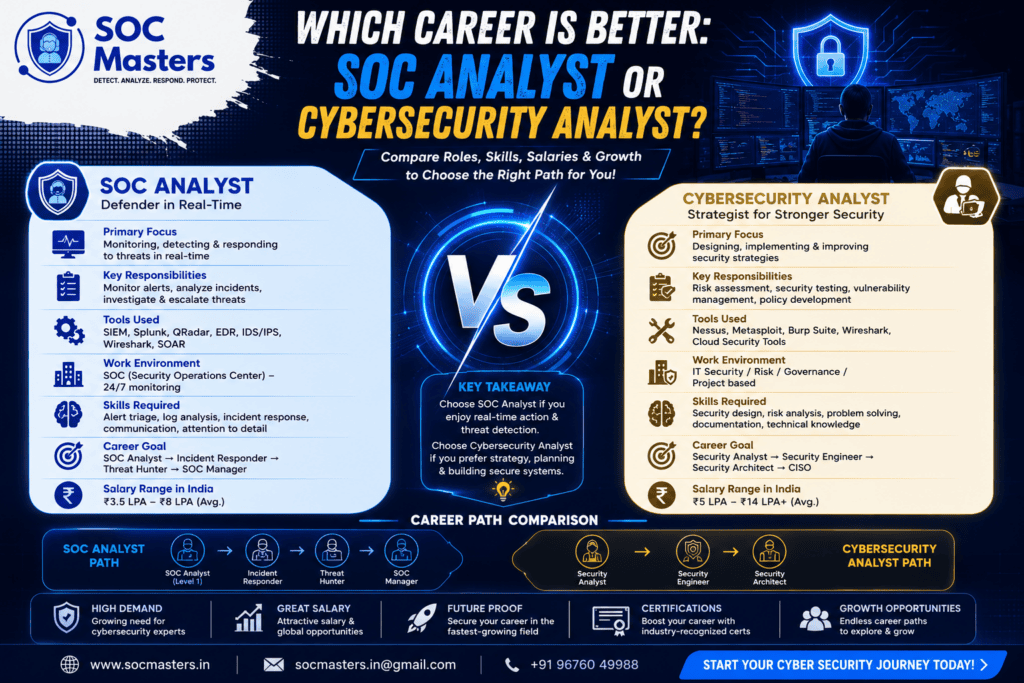
Neither is universally better. They reward different temperaments.
A SOC Analyst role may suit you if you enjoy:
- Real-time monitoring and the pace that comes with it
- Working inside a SIEM every day
- Investigating alerts and chasing an answer through data
- Incident response under time pressure
- Recognising attacker behaviour before it becomes a breach
A Cybersecurity Analyst role may suit you if you enjoy:
- Structured security assessment work
- Risk analysis and prioritisation
- Owning vulnerability management end to end
- Contributing to security strategy
- Broader responsibility across several domains
One practical consideration for beginners: SOC roles hire more freshers. A 24×7 SOC has structurally more entry-level seats than a governance-oriented security team does, and the skills it tests are ones you can build and prove in months. That does not make it the better career — it makes it the more available first door. Many people walk through it and move sideways into the analyst track after two or three years.
Certifications for SOC Analysts
- CompTIA Security+ (SY0-701) — still the baseline credential most Indian employers recognise for entry-level security roles. SY0-701 is the current version; a successor (informally referenced as SY0-801) is in draft with no confirmed launch date, so verify on CompTIA’s site before booking.
- Microsoft SC-200 (Security Operations Analyst) — the most directly relevant certification for a modern SOC role. Its current structure covers managing the security operations environment, responding to incidents, and threat hunting with KQL. Microsoft updated the English skills-measured list in April 2026 and again on 28 July 2026, so use the current <a href=”https://learn.microsoft.com/en-us/credentials/certifications/security-operations-analyst/” target=”_blank” rel=”noopener”>official SC-200 credential page</a> rather than older courseware.
- Splunk certifications — Splunk Core Certified User and Core Certified Power User build genuine SPL fluency; Splunk Enterprise Security Certified Admin is the security-specific step for those in Splunk shops.
- Blue team certifications — practical, lab-based blue team credentials are increasingly valued because they test investigation ability rather than recall.
A certification proves you studied. A lab notebook full of investigations you actually ran proves you can do the job. Bring both.
Certifications for Cybersecurity Analysts
- CompTIA Security+ — the same starting point.
- CompTIA CySA+ — the analyst-focused credential. Note the version change: CS0-004 launched on 23 June 2026, replacing CS0-003. Reporting on the exact CS0-003 retirement date has been inconsistent, so confirm current availability on CompTIA’s own certification page before you buy study material.
- Microsoft security certifications — SC-200 for operations, SC-300 for identity, SC-100 for architecture-level roles.
- CEH (v13) — EC-Council’s current version, now with AI attack-and-defence content folded into the core curriculum. It is widely used as an HR filter in India; it is less useful as proof of hands-on skill.
- Other credentials — cloud security certifications (AZ-500/SC-500, AWS Security) and, later in a career, CISSP or CISM for leadership tracks.
Be clear about what certifications do. They get your CV past filters and give structure to your study. They do not guarantee interviews and they do not guarantee jobs. Every hiring manager we speak to tests the same thing: can you explain an investigation you personally ran, start to finish?
SOC Analyst Training in Hyderabad: What to Look For
Not all training is equal. If you are evaluating SOC Analyst Training in Hyderabad, judge programmes on what you will actually be able to do at the end. A quality programme should include:
- Live SIEM practice — hands-on access to a real SIEM, not screenshots. You should write your own queries.
- Real-time security scenarios — simulated attacks you have to detect, not pre-solved case studies.
- Alert investigation — repeated practice at triage, because judgement only develops through repetition.
- Log analysis — Windows Event Logs, Linux logs, firewall, proxy, DNS and cloud sign-in logs.
- Incident response — the full lifecycle, with the documentation each stage requires.
- Threat intelligence — using intel to enrich investigations rather than collecting feeds.
- MITRE ATT&CK — mapping observed activity to techniques and using the matrix to spot detection gaps.
- Malware analysis fundamentals — enough static and behavioural analysis to classify a sample and escalate properly.
- Vulnerability analysis — reading scan output and judging what actually matters.
- Interview preparation — scenario-based mock interviews, not memorised answer lists.
- Hands-on labs — the majority of your hours should be in a lab, not a slide deck.
- Practical projects — work you can show and defend.
Two warning signs: any programme promising guaranteed placement, and any programme teaching a tool’s menus rather than the analysis underneath. Before enrolling anywhere, ask for the detailed SOC Analyst course syllabus and check how many hours are lab hours.
SOC Analyst Course in Hyderabad: What Should You Learn?
Beginner
- Networking — TCP/IP, DNS, HTTP/S, ports, packet basics
- Linux — CLI, file system, permissions, log locations
- Windows — Event Logs, authentication, Active Directory basics
- Cybersecurity fundamentals — attack types, CIA triad, defence in depth
Intermediate
- SIEM — architecture, data onboarding, query language, analytics rules (our guide to SIEM architecture covers the components you should be able to draw from memory)
- Log analysis — correlating events across multiple sources
- Threat intelligence — IOCs, TTPs, enrichment, intel quality
- Alert triage — prioritisation frameworks and escalation criteria
Advanced
- Incident response — full lifecycle with documentation
- Threat hunting — hypothesis-driven searching without an alert to start from
- MITRE ATT&CK — technique mapping and detection gap analysis
- Digital forensics fundamentals — evidence handling, timeline reconstruction
Job Ready
- Real-world projects with defensible outcomes
- SOC dashboards you built and can explain
- End-to-end incident investigations, written up properly
- Mock interviews under realistic pressure
- Resume and LinkedIn preparation aligned to actual JDs
If you are still choosing a platform to specialise in, our comparison of the best SIEM tools for SOC analysts is a useful starting point.
SOC Analyst Jobs in Hyderabad
Organisations in Hyderabad that commonly hire security operations staff include:
- IT services companies — large delivery centres running SOCs for global clients
- Banking and financial services — the most regulated and therefore the most monitored sector
- Healthcare and pharma — a strong Hyderabad cluster with sensitive data and strict compliance obligations
- E-commerce — high transaction volumes and constant fraud and bot pressure
- SaaS companies — customers increasingly demand SOC 2 evidence, which drives security hiring
- Global Capability Centres (GCCs) — a major driver of the local market, especially BFSI
- Managed Security Service Providers (MSSPs) — the highest volume of true entry-level SOC roles
We do not publish job counts, because portal numbers double-count aggressively and go stale within weeks. For a current view of employer types and the titles they use, see our page on SOC analyst jobs in Hyderabad.
Cybersecurity Analyst Jobs in Hyderabad
The same work appears under many titles. When searching, cover all of these:
- Cybersecurity Analyst
- Security Analyst
- SOC Analyst
- Incident Response Analyst
- Threat Analyst
- Security Operations Analyst
- Vulnerability Analyst
Read the responsibilities, not the heading. Two roles with identical titles at two companies can be completely different jobs.
SOC Analyst vs Cybersecurity Analyst: Which Skills Overlap?
Skill | SOC Analyst | Cybersecurity Analyst | Importance |
Networking | Critical | Critical | Foundation for both |
SIEM | Critical | Moderate | Daily tool vs occasional reference |
Threat Intelligence | High | High | Enrichment vs landscape analysis |
Incident Response | Critical | High | Front line vs supporting role |
Linux | High | Moderate | Log analysis vs system hardening |
Windows Security | Critical | High | Event analysis vs policy and baselines |
Vulnerability Management | Moderate | Critical | Context for alerts vs core duty |
Risk Analysis | Moderate | Critical | Alert prioritisation vs business risk |
MITRE ATT&CK | Critical | Moderate | Detection mapping vs gap assessment |
Scripting | High | Moderate | Parsing and automation vs reporting |
Career Comparison: SOC Analyst vs Cybersecurity Analyst
Factor | SOC Analyst | Cybersecurity Analyst |
Entry Difficulty | Lower — more fresher openings, testable skills | Higher — usually expects prior IT or security exposure |
Daily Work | Alert queue, investigations, shift handover | Scans, assessments, control reviews, audit support |
Main Tools | SIEM, EDR/XDR, SOAR, threat intel platforms | Vulnerability scanners, GRC and IAM tooling, cloud consoles |
Technical Depth | Deep in a narrow, detection-focused stack | Broad across many domains |
Career Growth | Fast early progression through L1→L2→L3 | Steadier, widening scope over time |
Salary Potential | Strong, accelerating with hunting and IR specialisation | Strong, accelerating with engineering and architecture moves |
Best For | Beginners, career switchers, people who like pace | Experienced IT professionals, people who like structure |
Typical Next Role | Threat Hunter, Incident Responder, Detection Engineer | Security Engineer, Consultant, Architect |
Future of SOC and Cybersecurity Careers
- AI in cybersecurity — AI handles a growing share of first-pass correlation and enrichment. What it does not do is decide, in context, whether an anomaly matters to this business.
- Security automation and SOAR — containment actions are increasingly scripted, raising the expectation that analysts can read and modify playbooks.
- XDR — endpoint, identity, email and cloud signals converging into single incident views.
- SIEM modernisation — the shifts described earlier (Sentinel into the Defender portal, QRadar’s cloud sunset) are part of a broader consolidation. Analysts who understand data, not menus, survive them.
- Cloud security — most new workloads are cloud-native, and cloud logs behave differently from on-prem logs.
- Threat intelligence — more operational, more automated.
- Security orchestration — analysts increasingly design the workflow as well as run it.
- Zero Trust and identity security — identity is now the primary attack surface, pushing IAM knowledge into every security role.
The honest summary: AI is changing what analysts spend time on, not removing the need for analysts. Fewer hours on obvious false positives; more on judgement, attacker intent, validating automation output and hunting for what it missed. That raises the skill floor at entry level — the argument for structured, hands-on training over self-study alone.
Who Should Choose SOC Analyst as a Career?
- Freshers — the most realistic entry point into cybersecurity, with the clearest skill checklist.
- IT support professionals — you already troubleshoot systematically; that is 60% of triage.
- Network professionals — packet and protocol knowledge is a serious head start.
- System administrators — you already know what normal looks like, which is exactly what detection needs.
- Career switchers from non-IT backgrounds — possible, but expect to spend real time on networking and operating systems first.
- Cybersecurity beginners — the SOC teaches you how attacks actually appear in data, which makes every later specialisation easier.
Who Should Choose Cybersecurity Analyst as a Career?
- Experienced IT professionals — your architecture context lets you judge risk credibly from day one.
- Existing security professionals — a natural widening of scope after SOC or engineering work.
- Network engineers — segmentation and control design map directly onto this role.
- System administrators — hardening and patch management are already adjacent to your work.
- Risk and compliance professionals — you bring the framework fluency; add the technical depth.
- Security-focused career switchers with domain expertise — banking, healthcare or manufacturing background plus security skills is a genuinely strong combination.
Common Mistakes Beginners Make
- Learning tools without fundamentals. You can pass a Sentinel tutorial without understanding DNS. You cannot pass an interview that way.
- Skipping networking. Every serious SOC interview goes here. Every one.
- Ignoring Linux. A large share of server and cloud logs come from Linux systems.
- Memorising interview answers. Interviewers ask follow-up questions. Memorised answers collapse at the second one.
- Avoiding hands-on labs. Reading about triage builds no triage judgement whatsoever.
- Collecting certifications without practical skills. Four certificates and zero investigations is a visible pattern, and hiring managers recognise it.
- Not understanding logs. If you cannot read a raw log without a dashboard, you are not ready.
- Not practising incident investigation. Being able to narrate one complete investigation — what you saw, what you checked, what you concluded, what you did — is the single highest-value interview asset you can build.
Practising against realistic questions helps here; our set of SOC analyst interview questions is built around scenarios rather than definitions.
Key Takeaways
- SOC Analyst = real-time detection, triage and response inside a SIEM, usually on shifts.
- Cybersecurity Analyst = broader risk, vulnerability, controls and compliance work, usually business hours.
- The roles overlap most on incident response and diverge most on vulnerability and risk work.
- Titles are unreliable in India. Read the responsibilities before applying.
- Entry-level pay is comparable; the paths separate at senior level — hunting and IR on one side, engineering and architecture on the other.
- Fundamentals beat tools. Networking, Linux and Windows logs outlast every SIEM platform change.
- Certifications open doors; demonstrated investigations get offers.
- Hyderabad’s GCC growth — particularly in BFSI — makes it a strong local market for both roles.
Conclusion
There is no universally better choice here — only a better fit for how you like to work.
If live investigation energises you, you want the fastest realistic route in, and shift work does not bother you, start in a SOC. If you prefer structured assessment, broader ownership and business-hours predictability — and you already have IT experience — the Cybersecurity Analyst track fits better.
For most beginners in Hyderabad, the SOC route is simply the more available door. Well-designed SOC Analyst Training in Hyderabad works because it targets exactly what employers test: can you read a log, judge an alert, investigate an incident and write it up clearly? Certifications, tools and titles follow from that.
Whichever path you choose, build fundamentals first, spend most of your hours in a lab, and make sure you can narrate one complete investigation end to end. That single ability will do more for your career than any certificate alone.
Frequently Asked Questions
1. What is the difference between a SOC Analyst and a Cybersecurity Analyst?
A SOC Analyst monitors and investigates security alerts in real time inside a Security Operations Center, usually on shifts. A Cybersecurity Analyst works more broadly on vulnerability management, risk assessment, security controls and compliance, usually during business hours. Both handle incidents; the SOC role is detection-first, the analyst role is prevention-first.
2. Is SOC Analyst a good career for freshers?
It is one of the more accessible entry points: 24×7 SOCs have structurally more entry-level seats, and the required skills — networking, Linux, Windows logs, SIEM basics — can be built and demonstrated within months. Shift work is a genuine trade-off to weigh before committing.
3. Is SOC Analyst better than Cybersecurity Analyst?
Neither is better. SOC roles suit people who like real-time investigation and pace; Cybersecurity Analyst roles suit those who prefer structured assessment and broader scope. Many do both across a career, starting in a SOC and widening later.
4. What skills are required for a SOC Analyst?
Networking fundamentals, Linux, Windows security and Event Logs, SIEM query skills, log analysis, alert triage judgement, incident response process, threat intelligence basics, MITRE ATT&CK familiarity, and basic scripting in Python or PowerShell.
5. What skills are required for a Cybersecurity Analyst?
Risk assessment, vulnerability management, security control review, network and endpoint security, identity and access management, security policy writing, compliance framework awareness, and the communication skills to translate technical risk into business language.
6. What is the salary of a SOC Analyst in Hyderabad?
Market estimates for 2026 place entry-level roles in Hyderabad at roughly ₹3–6 LPA, mid-level at ₹6–12 LPA, and senior roles at ₹12–20 LPA and above. These are aggregator-based estimates, not guaranteed figures, and vary widely by employer, skills and certifications.
7. Which certification is best for SOC Analysts?
For a modern SOC role, Microsoft SC-200 is the most directly relevant, usually after CompTIA Security+ for foundations. Splunk certifications help in Splunk environments. The best choice depends on the SIEM used by the employers you are targeting.
8. Can I become a SOC Analyst without experience?
Yes — SOC L1 is designed as an entry-level role. What replaces experience is demonstrable practical skill: lab investigations you can walk through, log analysis you can explain, and clear incident documentation you can show.
9. Is SOC Analyst training useful for beginners?
It is useful when it is lab-heavy. Structured training compresses the trial-and-error phase and provides scenarios you cannot easily build alone. Training that is mostly theory and slides adds little over free resources.
10. What is the career path after becoming a SOC Analyst?
Typically L1 → L2 → L3, then specialisation into threat hunting, incident response, detection engineering or security engineering, and eventually senior analyst or SOC management. Lateral moves into cloud security or GRC are common after two to three years.