
Difference Between SOC and NOC
The difference between SOC and NOC comes down to purpose: a Security Operations Center (SOC) monitors, detects, and responds to cyber security threats, while a Network Operations Center (NOC) monitors network performance, uptime, and infrastructure health. SOC protects data from attackers; NOC keeps systems running smoothly. Both are essential, but they solve different problems.
Table of Contents
Introduction
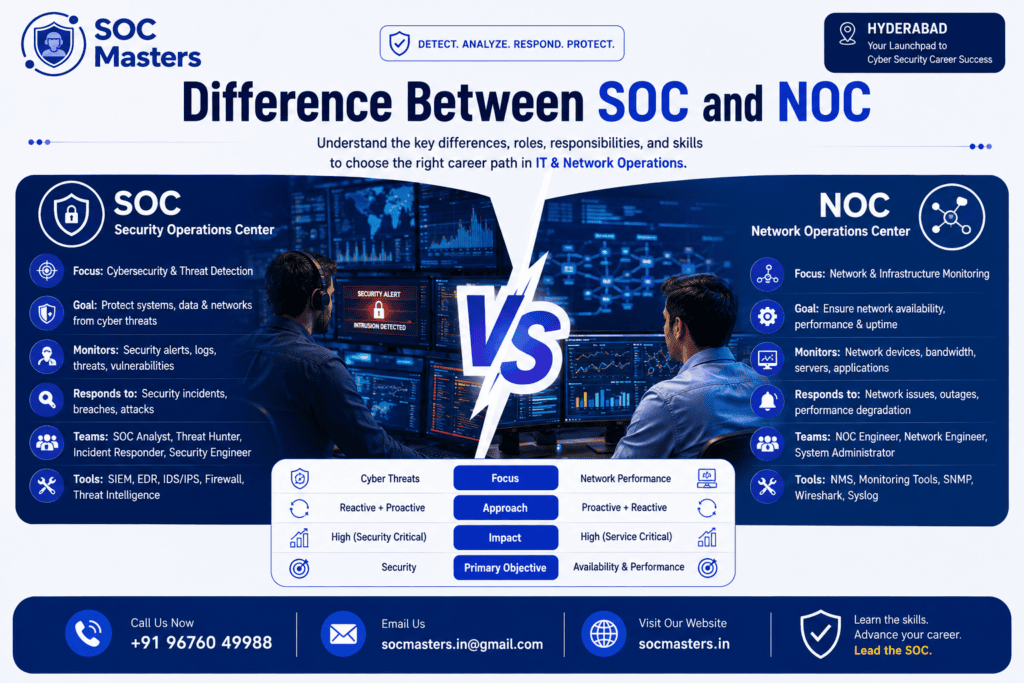
If you have spent any time researching careers in IT or cyber security, you have probably come across two terms that sound similar but mean very different things: SOC and NOC. Both are control-room style teams. Both stare at screens full of dashboards and alerts. Both play a critical role in keeping a business running. And that is exactly why so many beginners get confused about the difference between SOC and NOC.
Here is the short version before we go deep: a Security Operations Center (SOC) exists to protect an organization from cyber threats. Its analysts hunt for suspicious activity, investigate alerts, and respond to attacks before they cause damage. A Network Operations Center (NOC) exists to keep an organization’s network and IT infrastructure running smoothly. Its engineers watch servers, routers, and connections to make sure everything stays online and performs well.
In simple terms, SOC deals with “Is someone attacking us?” while NOC deals with “Is everything working?”
Organizations need both teams because a network can be perfectly secure and still go down due to a hardware failure, and a network can be running perfectly and still be under a silent cyber attack. Security and performance are two separate problems, which is why most mid-size and large companies run SOC and NOC as separate, specialized teams — sometimes working closely together, sometimes even sharing a physical operations floor.
Beginners often mix up SOC and NOC because both teams:
- Work in 24×7 shifts
- Monitor dashboards and alerts in real time
- Use similar-sounding monitoring tools
- Escalate issues through tiered support structures (L1, L2, L3)
- Are entry points into the broader IT and cyber security industry
But once you understand what each team actually protects — security versus performance — the confusion disappears. This guide breaks down everything you need to know: the difference between SOC and NOC, their tools, responsibilities, required skills, certifications, salaries in India, and which career path might be the better fit for you. If you are looking to build job-ready expertise in either field, SOC Masters offers structured, hands-on training designed for exactly this kind of career decision.
What is a Security Operations Center (SOC)?
A Security Operations Center, or SOC, is a dedicated team (and often a physical or virtual facility) responsible for continuously monitoring, detecting, investigating, and responding to cyber security threats across an organization’s systems, networks, and data.
Think of a SOC as the digital security guard of a company. Instead of watching CCTV cameras for intruders, SOC analysts watch security logs, network traffic, endpoint activity, and threat intelligence feeds for signs of hackers, malware, phishing attempts, insider threats, or data breaches.
A typical SOC operates 24 hours a day, 7 days a week, because cyber attacks do not follow business hours. SOC teams are usually organized in tiers:
- Tier 1 (L1) Analysts — Monitor alerts, perform initial triage, and escalate genuine threats.
- Tier 2 (L2) Analysts — Investigate escalated incidents in depth, perform threat analysis, and contain attacks.
- Tier 3 (L3) Analysts / Threat Hunters — Conduct proactive threat hunting, forensic analysis, and handle advanced persistent threats (APTs).
- SOC Manager / Lead — Oversees operations, reporting, compliance, and coordination with other teams.
A SOC’s core mission is to reduce the time between when an attack happens and when it is detected and stopped — often measured using metrics like Mean Time to Detect (MTTD) and Mean Time to Respond (MTTR).
What is a Network Operations Center (NOC)?
A Network Operations Center, or NOC, is a team responsible for monitoring, managing, and maintaining an organization’s network infrastructure to ensure maximum uptime, performance, and availability.
Where a SOC worries about attackers, a NOC worries about outages, slow performance, hardware failures, and connectivity issues. NOC engineers keep an eye on servers, routers, switches, firewalls (from a performance standpoint), cloud infrastructure, and applications to make sure everything is running as expected.
If a company’s website goes down, a database server crashes, or internet connectivity drops at a branch office, it is the NOC team that gets the first alert and works to restore service quickly.
Like a SOC, a NOC typically runs in shifts around the clock and follows a tiered support model:
- NOC Tier 1 Engineers — Monitor dashboards, identify performance issues, and perform basic troubleshooting.
- NOC Tier 2 Engineers — Handle deeper technical issues, configuration changes, and root cause analysis.
- NOC Tier 3 Engineers / Network Architects — Manage complex infrastructure changes, capacity planning, and long-term network design.
- NOC Manager — Oversees SLAs (Service Level Agreements), reporting, and coordination with vendors and other IT teams.
The NOC’s core mission is to maximize uptime and performance, often measured through metrics like network availability percentage, latency, and Mean Time to Repair.
Difference Between SOC and NOC
Now that we understand both terms individually, let’s break down the actual difference between SOC and NOC in a way that is easy to remember.
The one-line difference: SOC protects the organization from threats; NOC keeps the organization’s systems running.
Here are the key distinctions:
- Purpose: SOC focuses on security (confidentiality, integrity or a system). NOC focuses on availability and performance.
- What triggers action: SOC responds to suspicious or malicious activity. NOC responds to outages, slowdowns, or hardware/software failures.
- Mindset: SOC analysts think like investigators and defenders. NOC engineers think like maintenance and performance engineers.
- Data they analyze: SOC looks at security logs, threat intelligence, and attack patterns. NOC looks at bandwidth, latency, server health, and uptime metrics.
- Consequence of failure: A SOC failure can lead to data breaches, financial loss, and regulatory penalties. A NOC failure can lead to downtime, poor customer experience, and lost productivity.
- Collaboration point: Both teams often share visibility, because a network outage can sometimes be caused by a cyber attack (like a DDoS attack), which is where SOC and NOC responsibilities overlap.
Understanding this SOC vs NOC distinction is the first step toward choosing the right career path in the IT or cyber security industry.
SOC vs NOC Comparison Table
Feature | SOC | NOC |
Primary Objective | Detect, investigate, and respond to security threats | Monitor and maintain network performance and uptime |
Team Focus | Cyber security and threat management | Network health, availability, and infrastructure |
Daily Responsibilities | Alert triage, incident response, threat hunting | Performance monitoring, troubleshooting, maintenance |
Tools Used | SIEM, EDR, threat intelligence platforms | Network monitoring and performance management tools |
Required Skills | Security concepts, log analysis, incident response | Networking protocols, troubleshooting, system administration |
Certifications | CompTIA Security+, CEH, SOC Analyst courses | CCNA, CompTIA Network+, ITIL |
Career Path | SOC Analyst to SOC Manager or CISO | NOC Engineer to Network Architect or IT Manager |
Average Salary | Generally higher, especially with experience | Competitive, grows steadily with expertise |
Work Environment | 24×7 security operations floor | 24×7 network operations floor |
Industries | Banking, IT, healthcare, government, e-commerce | Telecom, ISPs, IT services, data centers, enterprises |
Job Demand | Rapidly growing due to rising cyber threats | Steady and consistent across all industries |
Growth Opportunities | High, especially in cloud security and threat intelligence | Good, especially in cloud networking and automation |
Roles and Responsibilities of a SOC Analyst
A SOC Analyst is the frontline defender against cyber threats. On any given day, a SOC Analyst may:
- Monitor security alerts generated by SIEM and EDR tools
- Investigate suspicious activity such as unusual login attempts or malware alerts
- Perform log analysis to trace the origin and impact of an incident
- Escalate confirmed threats to senior analysts or incident response teams
- Document incidents and maintain detailed reports for compliance
- Stay updated on the latest threat intelligence and attack techniques
- Assist in vulnerability assessments and patch management coordination
- Support audits and regulatory compliance activities (ISO 27001, PCI-DSS, GDPR)
This role demands sharp attention to detail, since missing a genuine alert among thousands of false positives can be costly for the organization.
Roles and Responsibilities of a NOC Engineer
A NOC Engineer is responsible for keeping the lights on — quite literally, in terms of digital infrastructure. Typical responsibilities include:
- Monitoring network devices, servers, and applications for performance issues
- Identifying and troubleshooting outages, latency spikes, or connectivity failures
- Performing routine maintenance, patching, and configuration updates
- Coordinating with vendors and ISPs during major outages
- Managing escalations according to defined SLAs
- Generating uptime and performance reports for stakeholders
- Assisting with capacity planning and infrastructure upgrades
- Documenting network changes and maintaining accurate network diagrams
A good NOC Engineer combines strong technical troubleshooting skills with the ability to stay calm under pressure during outages.
SOC vs NOC: Which Career is Better?
There is no universal answer to “SOC vs NOC, which career is better” — it truly depends on your interests, strengths, and long-term goals.
Choose SOC if you:
- Enjoy investigating problems like a detective
- Are fascinated by hacking, malware, and cyber attacks
- Want to work in the fast-growing cyber security field
- Are comfortable with high-pressure, high-stakes decision-making
Choose NOC if you:
- Enjoy networking, infrastructure, and systems
- Like solving technical performance problems
- Prefer a slightly more predictable, process-driven environment
- Want a strong foundation before moving into network architecture or cloud infrastructure roles
Many professionals actually start in NOC roles and later transition into SOC roles, since networking fundamentals are valuable in cyber security too. We will cover that transition path later in this guide.
Skills Required for SOC Analysts
To succeed as a SOC Analyst, you generally need:
- Understanding of networking fundamentals (TCP/IP, DNS, firewalls)
- Knowledge of operating systems (Windows, Linux)
- Familiarity with SIEM tools and log analysis
- Understanding of common attack techniques (phishing, malware, ransomware)
- Knowledge of the MITRE ATT&CK framework
- Basic scripting skills (Python, PowerShell) for automation
- Strong analytical and problem-solving skills
- Clear communication and documentation skills
Skills Required for NOC Engineers
To succeed as a NOC Engineer, you generally need:
- Strong understanding of networking concepts (routing, switching, subnetting)
- Familiarity with network monitoring tools and dashboards
- Knowledge of server and cloud infrastructure basics
- Troubleshooting skills for hardware and software issues
- Understanding of SLAs and escalation procedures
- Basic scripting or automation knowledge (a growing requirement)
- Ability to work calmly under pressure during outages
- Good documentation and reporting habits
SOC Tools vs NOC Tools
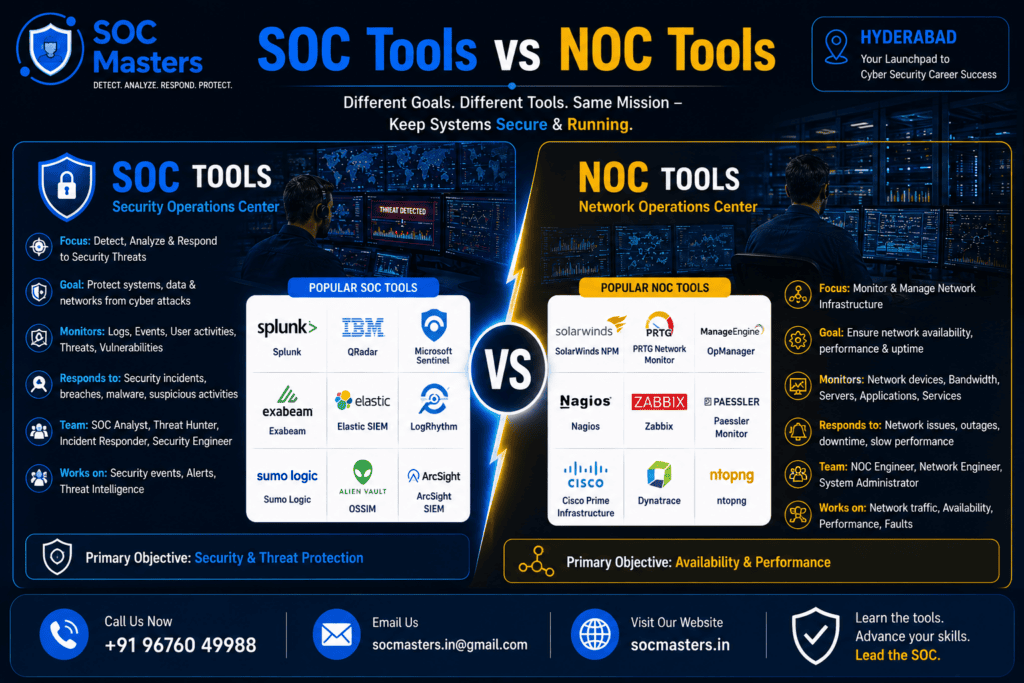
Both SOC and NOC teams rely heavily on specialized software to do their jobs effectively. Here is a breakdown of the most widely used tools in each field — see our detailed guide to the best SIEM tools for SOC analysts for a deeper look at the security side.
Popular SOC Tools
- Microsoft Sentinel — A cloud-native SIEM and SOAR platform that collects security data across an organization and uses AI to detect threats and automate responses.
- Splunk — A powerful platform for searching, monitoring, and analyzing machine-generated data, widely used for security log analysis and SIEM use cases.
- IBM QRadar — A SIEM solution that correlates events across the network to detect suspicious activity and prioritize alerts for analysts.
- ArcSight — An enterprise SIEM tool used for real-time threat detection, log management, and compliance reporting in large organizations.
- Wazuh — An open-source security monitoring platform used for threat detection, integrity monitoring, and incident response.
- Microsoft Defender XDR — An extended detection and response platform that unifies signals across endpoints, identities, email, and cloud apps.
- CrowdStrike Falcon — A cloud-native endpoint detection and response (EDR) platform known for fast threat detection and lightweight agents.
- VirusTotal — An online service that scans files and URLs against multiple antivirus engines to identify malware.
- MITRE ATT&CK — A globally accessible framework that documents real-world adversary tactics and techniques, used to map and understand attacker behavior.
- Wireshark — A network protocol analyzer used to capture and inspect traffic at a granular level, useful in both security investigations and network troubleshooting.
Popular NOC Tools
- SolarWinds — A widely used network monitoring suite that tracks device health, bandwidth usage, and performance metrics across infrastructure.
- Nagios — An open-source monitoring tool used to track the status of servers, network devices, and services with customizable alerting.
- PRTG Network Monitor — A comprehensive monitoring tool that provides real-time visibility into network performance, bandwidth, and device availability.
- Zabbix — An open-source monitoring solution for networks, servers, and applications, known for flexibility and scalability.
- Cisco DNA Center — A centralized network management and automation platform for Cisco infrastructure, offering visibility and analytics.
- ManageEngine OpManager — A network monitoring tool that provides fault management, performance monitoring, and network mapping.
- Wireshark — Also used by NOC teams for deep packet-level troubleshooting of connectivity and performance issues.
- Grafana — A visualization tool used to build real-time dashboards from various data sources, popular for network and system performance monitoring.
- Prometheus — An open-source monitoring and alerting toolkit, especially popular for cloud-native and containerized infrastructure.
- NetFlow Analyzer — A tool that analyzes network traffic flow data to identify bandwidth bottlenecks and unusual usage patterns.
Industries That Hire SOC and NOC Professionals
Both SOC and NOC professionals are in demand across a wide range of industries — see our roundup of SOC Analyst jobs in Hyderabad for a closer look at who is hiring locally, including:
- Banking, Financial Services, and Insurance (BFSI) — heavy investment in both security and uptime due to regulatory pressure
- IT Services and Consulting — large SOC and NOC teams supporting multiple client environments
- Telecommunications — NOC-heavy demand for managing massive network infrastructure
- Healthcare — growing SOC demand due to sensitive patient data and compliance requirements
- E-commerce and Retail — need both teams to protect customer data and ensure site uptime during high-traffic events
- Government and Defense — strong SOC demand for national security and critical infrastructure protection
- Data Centers and Cloud Providers — heavy NOC presence to maintain infrastructure at scale
- Managed Security Service Providers (MSSPs) — dedicated SOC teams serving multiple client organizations
SOC Analyst Salary vs NOC Engineer Salary in India
Salaries vary based on company size, location, and experience, but here is a general overview of what professionals can expect in India. For a deeper breakdown by career level, see our full SOC Analyst salary in India guide.
Experience | SOC Analyst Salary | NOC Engineer Salary |
Fresher (0–1 yr) | ₹2.5 – ₹4.5 LPA | ₹2 – ₹4 LPA |
2–4 Years | ₹5 – ₹8 LPA | ₹4 – ₹7 LPA |
5–8 Years | ₹9 – ₹15 LPA | ₹7 – ₹12 LPA |
Senior (8+ yrs) | ₹15 – ₹22 LPA | ₹12 – ₹18 LPA |
Lead / Manager | ₹22 LPA+ | ₹18 LPA+ |
Note: These figures are indicative estimates and can vary based on company, city, certifications, and specific skill sets. Always check current job portals for the latest numbers.
Generally, SOC roles tend to command slightly higher salaries at senior levels due to the specialized nature of cyber security and the higher stakes involved in protecting organizational data.
Career Growth in SOC and NOC
Both SOC and NOC careers offer clear, structured growth paths. Our detailed SOC Analyst career roadmap breaks the SOC side down stage by stage.
SOC Career Path: SOC Analyst (L1) → SOC Analyst (L2) → Senior SOC Analyst (L3) → Threat Hunter / Incident Responder → SOC Team Lead → SOC Manager → Security Architect or CISO (Chief Information Security Officer)
NOC Career Path: NOC Engineer (L1) → NOC Engineer (L2) → Senior NOC Engineer (L3) → Network Administrator → Network Architect → NOC Manager → IT Infrastructure Manager or Director
Career Roadmap Table
Experience | SOC Career Path | NOC Career Path |
Fresher | SOC Analyst (L1) | NOC Engineer (L1) |
Junior | SOC Analyst (L2) | NOC Engineer (L2) |
Mid-Level | Senior SOC Analyst (L3) | Senior NOC Engineer / Network Admin |
Senior | Threat Hunter / Incident Responder | Network Architect |
Lead | SOC Team Lead | NOC Team Lead |
Manager | SOC Manager / Security Architect | NOC Manager / IT Infrastructure Manager |
SOC vs NOC Certifications
Certifications can significantly boost your credibility and job prospects in both fields — our SOC Analyst certifications guide covers current exam codes and 2026 updates in detail.
Popular SOC Certifications:
- CompTIA Security+
- Certified SOC Analyst (CSA)
- Certified Ethical Hacker (CEH)
- GIAC Security Essentials (GSEC)
- Microsoft SC-200 (Security Operations Analyst)
- Splunk Core Certified Power User
Popular NOC Certifications:
- CompTIA Network+
- Cisco Certified Network Associate (CCNA)
- ITIL Foundation
- Cisco Certified Network Professional (CCNP)
- SolarWinds Certified Professional
Which One Should Freshers Choose?
If you are a fresher trying to decide between SOC and NOC, here is a practical way to think about it:
- If you are more curious about how attacks happen and how to stop them, start with SOC. It offers a faster path into the high-growth cyber security field.
- If you are more comfortable with networking, hardware, and infrastructure, start with NOC. It builds a strong technical foundation that is valuable across all of IT.
- If you are unsure, a NOC role can be a great stepping stone. Many professionals gain 1–2 years of NOC experience, learn networking deeply, and then transition into SOC roles with a stronger technical base than SOC-only beginners.
Both paths are excellent entry points into the broader IT and cyber security industry, so you cannot go entirely “wrong” — the key is picking the one that matches your genuine interest, since that will keep you motivated through the learning curve. If you lean toward SOC, our SOC Analyst training roadmap lays out a beginner-to-job-ready path stage by stage.
Future Scope of SOC and NOC Careers
The future looks bright for both SOC and NOC professionals, driven by several industry trends:
- Growing cyber security market: As cyber attacks increase in frequency and sophistication, organizations across every sector are investing heavily in SOC teams and tools.
- Increasing demand for SOC Analysts: With ransomware, phishing, and data breaches making regular headlines, skilled SOC Analysts are increasingly sought after in nearly every industry.
- Demand for NOC Engineers: As businesses expand their digital infrastructure and cloud footprint, the need for professionals who can maintain performance and uptime continues to grow steadily.
- Remote work opportunities: Many SOC and NOC roles can now be performed remotely, especially with cloud-based monitoring tools, opening up opportunities beyond geographic boundaries.
- AI and automation impact: AI-powered tools are automating repetitive tasks in both fields (like alert triage in SOC and basic troubleshooting in NOC), which is shifting entry-level roles toward higher-value analytical and decision-making work.
- Cloud security trends: As more infrastructure moves to the cloud, both SOC and NOC professionals are expected to develop cloud-specific skills (AWS, Azure, GCP) to stay relevant. Frameworks like the NIST Cybersecurity Framework are increasingly used by organizations to standardize how both SOC and NOC teams assess and manage risk.
Professionals who continuously upskill in automation, cloud technologies, and AI-assisted tools will have a significant advantage in both career paths over the next several years.
Top Reasons to Choose a Career in SOC
- High demand across nearly every industry, including finance, healthcare, and government
- Intellectually engaging work that feels like solving a puzzle or investigating a case
- Strong long-term career growth into specialized and leadership roles
- Opportunity to work with cutting-edge AI-driven security tools
- Meaningful work that directly protects organizations and people from harm
- Competitive salaries that scale well with experience and certifications
Top Reasons to Choose a Career in NOC
- Strong foundational knowledge of networking that applies across all of IT
- Consistent, steady demand across telecom, IT, and enterprise sectors
- Clear, structured escalation and career paths
- Hands-on, practical work that shows immediate, visible results (fixing outages)
- A natural stepping stone into network architecture, cloud infrastructure, or SOC roles
- Lower entry barrier for beginners with basic networking knowledge
Can You Switch from NOC to SOC?
Yes, switching from a NOC role to a SOC role is a common and realistic career transition, especially since networking knowledge is genuinely valuable in cyber security.
Required Skills for the Switch:
- Strong understanding of security concepts (beyond networking)
- Familiarity with SIEM tools and log analysis
- Understanding of common attack vectors and the MITRE ATT&CK framework
- Basic scripting knowledge for automation and analysis
Certifications That Help:
- CompTIA Security+
- Certified SOC Analyst (CSA)
- Microsoft SC-200
Learning Roadmap:
- Strengthen your networking fundamentals (you likely already have this from NOC experience)
- Learn core security concepts: CIA triad, common attack types, encryption basics
- Get hands-on with a SIEM tool like Splunk or Microsoft Sentinel through free trials or labs
- Study the MITRE ATT&CK framework to understand attacker behavior
- Earn a foundational certification like CompTIA Security+
- Apply for SOC Analyst (L1) roles, highlighting your networking background as an asset
Career Transition Tips:
- Mention your NOC experience explicitly in interviews — understanding normal network behavior helps you spot abnormal (malicious) behavior faster
- Build a home lab to practice log analysis and threat detection
- Network with SOC professionals on LinkedIn and join cyber security communities
- Consider internal transfers if your current company has both SOC and NOC teams
- Prepare with our SOC Analyst interview questions guide once you start applying
SOC vs NOC: Which Is Better for Beginners?
For absolute beginners with no prior IT background, NOC roles are often considered slightly easier to enter, since the learning curve focuses on networking fundamentals that are well-documented and widely taught.
However, SOC roles are increasingly beginner-friendly too, especially with the rise of structured SOC Analyst training programs, free-tier security tools, and entry-level certifications like CompTIA Security+.
The real answer depends on your background:
- Coming from a networking or hardware background → NOC may feel more natural initially
- Coming from a general IT, computer science, or self-taught coding background → SOC may be an equally accessible starting point
Ultimately, both are beginner-friendly if you commit to structured learning, hands-on labs, and relevant certifications.
Key Takeaways
- SOC focuses on cyber security threat detection and response, while NOC focuses on network performance and uptime.
- Both teams typically operate 24×7 in tiered structures (L1, L2, L3) and are essential to modern organizations.
- SOC tools center around SIEM, EDR, and threat intelligence, while NOC tools center around network monitoring and performance management.
- SOC salaries tend to edge slightly higher at senior levels, but both careers offer strong, steady growth.
- Transitioning from NOC to SOC is a realistic and common career path for professionals looking to move into cyber security.
Conclusion
Understanding the difference between SOC and NOC is the first step toward choosing the right career path in the IT and cyber security industry. If you are drawn to investigating threats, analyzing attacker behavior, and protecting organizations from cyber criminals, a career in SOC could be your calling. If you enjoy working with networks, infrastructure, and keeping systems running smoothly, a career in NOC might be the better fit.
The good news is that neither choice is final. Skills from one field often transfer to the other, and many successful cyber security professionals began their careers in NOC roles before moving into SOC. Whichever path you choose, investing in the right certifications, hands-on lab practice, and continuous learning will open doors across the rapidly growing IT and cyber security industry — an industry that shows no signs of slowing down.
Ready to start? Visit SOC Masters to explore structured SOC and NOC training programs built to take you from beginner to job-ready professional.
Frequently Asked Questions
1. What is the main difference between SOC and NOC?
The main difference between SOC and NOC is purpose: SOC focuses on detecting and responding to cyber security threats, while NOC focuses on monitoring and maintaining network performance and uptime.
2. Is SOC harder than NOC?
SOC is generally considered more analytically demanding because it involves investigating security incidents and adversarial behavior, while NOC focuses more on technical troubleshooting and performance monitoring. Difficulty ultimately depends on your personal strengths.
3. Which pays more, SOC or NOC?
SOC roles often pay slightly more at senior levels due to the specialized and high-stakes nature of cyber security work, though entry-level salaries in both fields are fairly comparable.
4. Can a NOC engineer become a SOC analyst?
Yes, NOC engineers can transition into SOC roles by learning security fundamentals, earning relevant certifications like CompTIA Security+, and gaining hands-on experience with SIEM tools.
5. Do SOC and NOC teams work together?
Yes, SOC and NOC teams often collaborate, especially during incidents like DDoS attacks, where a network performance issue may actually be caused by a security threat.
6. What qualifications are needed for SOC and NOC jobs?
A degree in computer science, IT, or a related field is helpful but not always mandatory. Relevant certifications, hands-on lab experience, and foundational networking or security knowledge are often more important to employers.
7. Is NOC a good career for freshers?
Yes, NOC is considered a strong entry-level career for freshers, especially those with basic networking knowledge, and it can serve as a stepping stone into more advanced IT or security roles.
8. What tools should a beginner SOC analyst learn first?
Beginners should start with a SIEM tool like Splunk or Microsoft Sentinel, along with Wireshark for packet analysis and familiarity with the MITRE ATT&CK framework.
9. What tools should a beginner NOC engineer learn first?
Beginners should start with foundational monitoring tools like SolarWinds, Nagios, or PRTG Network Monitor, along with basic networking concepts.
10. Is SOC or NOC better for long-term career growth?
Both offer strong long-term growth, but SOC currently has an edge due to the rapidly expanding cyber security industry and rising global demand for skilled security professionals.