
SOC Analyst Training Roadmap
A SOC Analyst Training Roadmap is a structured learning path that takes you from networking and operating system fundamentals to SIEM tools like Microsoft Sentinel, Splunk, and IBM QRadar, then into incident response, threat hunting, and cloud security. Most beginners become job-ready in 4–6 months by combining hands-on labs, real-time SOC projects, and certifications such as SC-200 and Security+.
Introduction
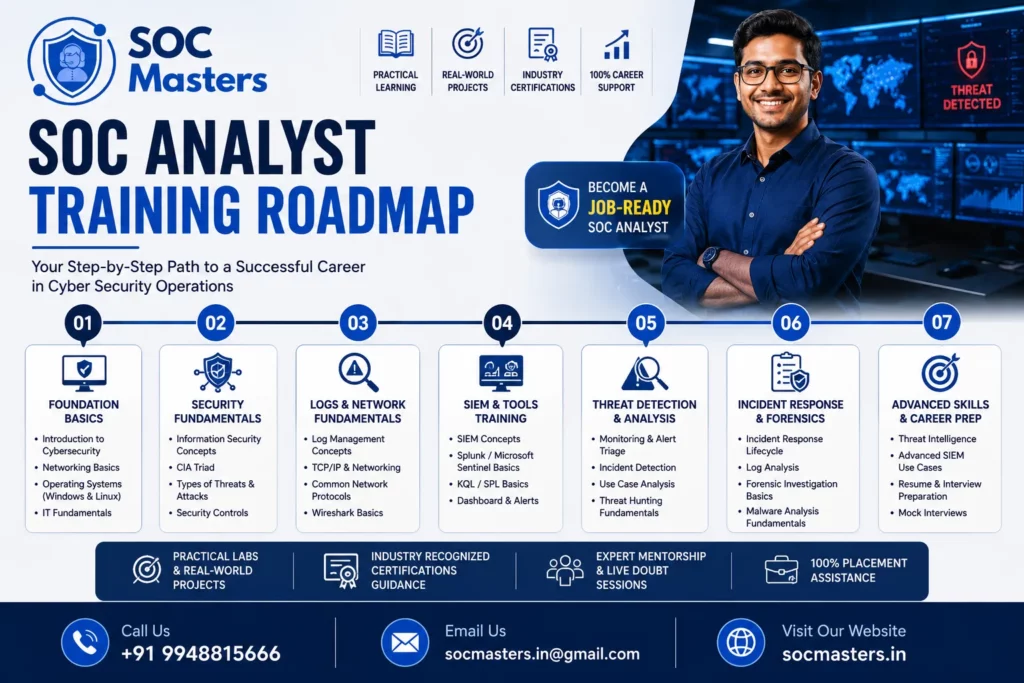
Every time a company gets attacked — ransomware, phishing, a stolen password — someone has to spot it first. That someone is usually a SOC Analyst.
A SOC (Security Operations Center) Analyst monitors an organisation's networks, endpoints, and cloud environments around the clock, investigates suspicious activity, and responds before a small alert becomes a full-blown breach. It is the most common entry point into cybersecurity, and demand for the role keeps climbing as regulations like India's DPDP Act push every large enterprise to build 24×7 security monitoring capability.
Hyderabad sits right at the centre of this growth. The city hosts one of the largest concentrations of Global Capability Centers (GCCs) in India — Microsoft, Amazon, Google, Deloitte, Accenture, and hundreds of others run security operations from here. That translates into a steady pipeline of SOC hiring across MSSPs, product companies, and consulting firms.
But here's the catch: most beginners fail not because the field is too hard, but because they learn in the wrong order. They jump straight into a SIEM tool without understanding networking, or memorise certification answers without ever triaging a real alert. That's exactly why a structured SOC Analyst Training Roadmap matters — it tells you what to learn, in what sequence, and how deep to go at each stage.
This guide lays out the complete roadmap: 8 learning stages, a certification path, a career and salary progression view, a 90-day plan, and the mistakes to avoid. Whether you're a fresher, a career switcher, or an IT professional moving into security, choosing structured SOC Analyst Training in Hyderabad with this roadmap gives you the fastest realistic path to your first SOC role.
What Is a SOC Analyst?
A SOC Analyst is a cybersecurity professional who works inside a Security Operations Center — the team responsible for detecting, investigating, and responding to cyber threats.
The day-to-day work revolves around a SIEM (Security Information and Event Management) platform, which collects logs from firewalls, servers, endpoints, and cloud services, correlates them, and raises alerts. The analyst's job is to decide which alerts are genuine attacks, which are false positives, and what to do next.
Typical responsibilities include:
- Security monitoring — watching SIEM dashboards and alert queues in real time
- Alert triage — prioritising alerts by severity and business impact
- Log analysis — digging into Windows, Linux, firewall, and cloud logs for evidence
- Incident response — containing and escalating confirmed incidents
- Threat intelligence — using external intel feeds to add context to investigations
- Documentation — writing incident reports and updating playbooks
SOC teams are usually tiered: L1 analysts handle first-level triage, L2 analysts investigate incidents end-to-end, and L3 analysts handle advanced threats, threat hunting, and detection engineering.
💬 Chat on WhatsAppWhy Choose SOC Analyst Training in Hyderabad?
If you're going to invest 4–6 months in training, location context matters. Here's why Hyderabad specifically makes sense for a SOC career:
- GCC and MSSP density. Hyderabad accounts for roughly a fifth of India's GCC activity, and global capability centers are increasingly running full security operations — not just back-office work — from the city. Managed security service providers (MSSPs) and Big 4 consulting firms also hire SOC analysts here in regular batches. (This is market-demand context, not a placement promise from any single company.)
- Microsoft ecosystem dominance. Hyderabad has a heavy Microsoft and Azure enterprise footprint, which makes Microsoft Sentinel + KQL one of the highest-ROI skill combinations for the local job market. A roadmap that includes Microsoft security tools directly matches what Hyderabad employers screen for.
- Cost of living vs salary balance. Metro-city SOC salaries with a lower cost base than Mumbai or Bengaluru.
- Training and community access. Offline labs, meetups, and peer groups make it easier to practise incident scenarios with others — something purely self-taught learners miss.
You can see the current openings pattern yourself in this breakdown of SOC analyst jobs in Hyderabad.
Why You Need a SOC Analyst Training Roadmap
Cybersecurity is a huge field. Without a roadmap, beginners typically make one of two errors:
- Tool-first learning: jumping straight into Splunk or Sentinel without networking and OS fundamentals. Result: you can click dashboards but can't explain what a log actually means in an interview.
- Theory-first learning: finishing a certification syllabus without ever touching a lab. Result: you freeze on scenario-based questions like "walk me through a phishing investigation."
A SOC Analyst Training Roadmap solves both by sequencing skills the way SOC work actually builds: fundamentals → security concepts → SIEM and core skills → Microsoft tools → cloud → automation → projects → interviews. Each stage assumes the previous one, so nothing you learn is wasted and nothing critical is skipped.
SOC Analyst Training Roadmap for Beginners
Here's the entire path at a glance before we go stage by stage:
Enroll for Free DemoStep-by-Step SOC Analyst Training Roadmap in 2026
Now let's break each stage down.
Stage 1: Learn Cybersecurity Fundamentals
Everything in a SOC ultimately comes back to network traffic and operating system behaviour, so this stage is non-negotiable.
- Networking basics — how devices communicate, IP addressing, ports, and protocols
- TCP/IP — the handshake, common ports (80, 443, 22, 3389, 53), and what abnormal traffic looks like
- DNS — how name resolution works and why attackers abuse it (DNS tunnelling, malicious domains)
- HTTP/HTTPS — request/response structure, status codes, TLS basics
- Firewalls — allow/deny rules, and how firewall logs feed a SIEM
- Operating systems — how processes, services, and permissions work
- Linux basics — file system navigation, permissions, grep, and reading /var/log
- Windows basics — Event Viewer, critical Event IDs (4624 logons, 4688 process creation), registry fundamentals
A deeper primer is available in this guide to cybersecurity fundamentals for the SOC analyst role.
Time investment: 3–4 weeks with daily labs.
Stage 2: Learn Security Fundamentals
With the technical base in place, add the security concepts every interview tests:
- CIA triad — confidentiality, integrity, availability: the lens for judging every incident's impact
- Authentication vs authorization — proving who you are vs what you're allowed to do; the root of most identity attacks
- Encryption — symmetric vs asymmetric, hashing, TLS, and why "encrypted" doesn't mean "safe"
- Vulnerability management — scanning, CVSS scoring, patching cycles
- Risk management — likelihood × impact thinking, and why SOCs prioritise some alerts over others
Time investment: 2 weeks.
Stage 3: Learn SOC Analyst Core Skills
This is the heart of the roadmap — the skills that define the job:
- SIEM — understand the architecture first (log ingestion → parsing → correlation → alerting), not just the UI. This walkthrough of SIEM architecture explains the pipeline end to end.
- Microsoft Sentinel — Microsoft's cloud-native SIEM; the fastest-growing platform in Indian enterprises thanks to Azure adoption
- Splunk — the most widely deployed enterprise SIEM globally; learn SPL search basics
- IBM QRadar — common in banking and large MSSPs; understand offenses and rule logic
- Log analysis — reading Windows Security logs, Linux auth logs, firewall and proxy logs
- Incident response — the lifecycle: detection → containment → eradication → recovery → lessons learned
- Threat intelligence — IOCs, TTPs, and enriching alerts with intel feeds
- Threat hunting — proactively searching for threats that evaded detection, guided by hypotheses
- Alert triage — severity assessment, false-positive identification, escalation judgment
- Security monitoring — building the discipline of methodical, documented investigation
Map everything you learn here to MITRE ATT&CK — the industry-standard knowledge base of attacker tactics and techniques. Interviewers increasingly expect you to describe incidents in ATT&CK terms.
Time investment: 6–8 weeks. This is where most of your lab hours go.
Stage 4: Learn Microsoft Security Tools
For Hyderabad's Microsoft-heavy job market, this stage separates shortlisted candidates from rejected ones:
- Microsoft Defender XDR — the unified portal correlating signals across endpoints, identities, email, and apps
- Microsoft Defender for Endpoint — EDR: device timelines, alert investigation, response actions
- Microsoft Defender for Cloud — security posture management and workload protection for Azure resources
- Microsoft Entra ID — identity and access management (formerly Azure AD); sign-in logs are central to identity-attack investigations
- Microsoft Purview — data governance, classification, and DLP — increasingly relevant under DPDP compliance
Time investment: 3–4 weeks.
Stage 5: Learn Cloud Security
Enterprises have moved their workloads to the cloud, and so have attackers:
- Microsoft Azure security — the shared-responsibility model, network security groups, Azure Firewall
- Azure security posture tooling (Defender for Cloud's secure score and recommendations)
- Identity & Access Management — RBAC, least privilege, privileged identity management
- Conditional Access — policy-based access control; a frequent interview topic
- Cloud monitoring — Azure Monitor, activity logs, and routing cloud telemetry into Sentinel
Time investment: 2–3 weeks.
💬 Chat on WhatsAppStage 6: Learn Scripting & Automation
Automation skill is what accelerates you from L1 toward L2/L3:
- KQL (Kusto Query Language) — the query language for Sentinel and Defender; the single highest-ROI technical skill for the Hyderabad market
- PowerShell — Windows investigation and response automation
- Python basics — log parsing, API calls, small automation scripts
- Automation concepts / SOAR — Security Orchestration, Automation and Response: playbooks that auto-enrich or auto-contain routine alerts, so analysts focus on judgment calls
Time investment: 3 weeks (KQL first, then PowerShell, then Python).
Enroll for Free DemoStage 7: Work on Real-Time SOC Projects
Nothing on your resume matters more than demonstrable hands-on work:
- Security monitoring project — build a home SOC lab: Windows + Linux VMs shipping logs into Sentinel or Splunk
- Incident investigation — simulate a brute-force attack, then investigate it from the logs
- Malware analysis (introductory) — safe static analysis of samples, hash lookups, sandbox reports
- Phishing investigation — analyse email headers, extract URLs/attachments, verify IOCs
- Threat detection — write your own detection rules in KQL or SPL and tune out false positives
- Blue team exercises — attack-defend labs where you detect simulated adversary behaviour mapped to ATT&CK techniques
Stage 8: Prepare for SOC Analyst Interviews
The final stage converts skills into offers:
- Resume preparation — lead with projects and tools, quantify lab work, avoid keyword stuffing
- Mock interviews — practise explaining investigations aloud; communication is scored as heavily as technical accuracy
- Scenario-based questions — "You see 500 failed logins followed by one success — what do you do?" Practise structured answers: observe → hypothesise → investigate → contain → report
- Practical assessments — many employers now give a live SIEM task; your Stage 7 lab hours pay off here
Work through this bank of SOC analyst interview questions as part of your preparation.
SOC Analyst Certifications Roadmap
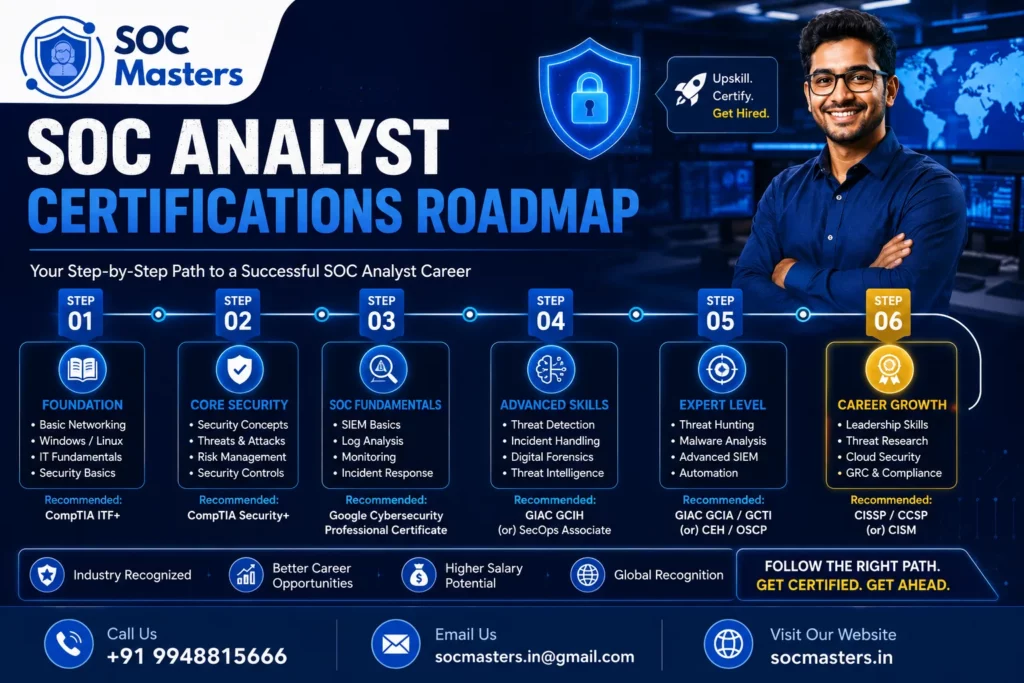
Certifications don't replace skills, but they get your resume past screening filters. The sensible order:
- SC-900 (Microsoft Security Fundamentals) — entry-level validation of security, compliance, and identity concepts
- Security+ (CompTIA) — the globally recognised baseline security certification
- SC-200 (Microsoft Security Operations Analyst) — the most job-relevant certification for SOC roles in Microsoft-stack companies; covers Sentinel, Defender XDR, and KQL. See the official Microsoft SC-200 certification page for the current syllabus
- Splunk Core Certified User — validates SPL search skills for Splunk-based SOCs
- CySA+ (CompTIA) — intermediate blue-team analytics certification, ideal for the L1→L2 jump
- CEH — broad offensive-security awareness; useful for understanding attacker behaviour
- AZ-500 (Azure Security Engineer) — for the later move into cloud security engineeri
Certification Comparison Table
Recommendation: For most Hyderabad-focused beginners, the highest-value path is SC-900 → Security+ (optional) → SC-200 → Splunk Core Certified User, because it matches what local employers actually deploy. CEH and CySA+ are better taken after you're employed, and AZ-500 after 1–2 years.
Enroll for Free DemoSOC Analyst Career Roadmap
The role ladders clearly:
Fresher → SOC Analyst L1 → SOC Analyst L2 → SOC Analyst L3 → specialist tracks → leadership
- L1 (0–2 yrs): alert monitoring, triage, escalation, documentation
- L2 (2–5 yrs): end-to-end incident investigation, detection rule tuning, mentoring L1s
- L3 (5–8 yrs): advanced threats, proactive threat hunting, detection engineering
- Specialist branches: Security Engineer, Incident Responder, Threat Hunter — each a distinct high-value track
- Leadership: SOC Lead (shift and escalation management) → SOC Manager (team, process, and client ownership)
The single biggest career inflection point is the move from "monitoring alerts" (L1) to "owning incidents" (L2). Everything in Stages 6–7 of this roadmap is designed to shorten that jump.
SOC Analyst Salary Growth Roadmap
Based on published salary data from job portals and industry salary guides as of mid-2026, typical ranges in India look like this. Treat these as market estimates, not guarantees — actual offers vary by company type, city, certifications, and interview performance:
Metro hubs like Hyderabad typically pay above tier-2 cities, and product companies and GCCs generally pay above service firms. Hands-on lab and project experience consistently correlates with higher starting offers than theory-only profiles. For a full breakdown by level, city, and certification impact, see this detailed guide on SOC analyst salary in India.
Skills You Will Learn During SOC Analyst Training
By the end of a complete roadmap, your skill inventory should include: SIEM operations (Sentinel, Splunk, QRadar), log analysis across Windows, Linux, network, and cloud sources, MITRE ATT&CK mapping, Windows security internals and Event ID fluency, Linux security and log triage, Azure security and identity protection, threat hunting methodology, incident response lifecycle execution, threat intelligence consumption, and disciplined security monitoring habits.
That list doubles as your resume's skills section — but only claim what you've actually practised in labs.
Common Mistakes Beginners Make During SOC Training
- Skipping networking. You cannot investigate what you don't understand. Analysts who can't read a packet capture stall permanently at L1.
- Ignoring Windows/Linux fundamentals. Most alerts are OS-level events; Event ID fluency is expected in interviews.
- Not practising SIEM hands-on. Watching Sentinel videos is not the same as writing KQL queries against real logs.
- Avoiding labs. Employers now test practically. No lab hours = visible in the first 10 minutes of an assessment.
- Focusing only on theory/certifications. A certificate gets you the interview; scenario answers get you the offer.
Why Real-Time Projects Matter
- Resume building: "Built a home SOC lab ingesting Windows and Linux logs into Microsoft Sentinel; wrote 15 KQL detection rules" beats any list of course names.
- Practical skills: projects force you through the messy reality of noisy logs and false positives — exactly what the job is.
- Placement readiness: live SIEM assessments are now standard in SOC hiring; project experience is direct rehearsal.
- Interview confidence: when you've genuinely investigated a phishing email or brute-force attack, scenario questions become stories you tell, not answers you memorise.
Complete SOC Analyst Training Roadmap: 90-Day Learning Plan
If you can commit 3–4 focused hours a day, here's a compressed 90-day version of the roadmap:
For a visual version of this progression, this SOC career roadmap maps the same stages graphically.
6-Month SOC Analyst Career Roadmap
If you're studying part-time (evenings/weekends), stretch the same sequence: Months 1–2 on fundamentals (Stages 1–2), Months 3–4 on SIEM and Microsoft tools (Stages 3–4), Month 5 on cloud + automation (Stages 5–6), and Month 6 on projects and interview prep (Stages 7–8). The order stays identical; only the pace changes.
SOC Analyst Training Roadmap for Freshers
Freshers should over-invest in Stages 1–3 and Stage 7. You're not competing on experience — you're competing on demonstrable fundamentals and lab evidence. Any graduate background works (BTech, BSc, BCA, even non-IT degrees with self-study); employers screen for skills, not branches. Aim for SC-900 + SC-200 plus a documented home lab before applying.
SOC Analyst Roadmap for Working Professionals
If you're already in IT (support, networking, sysadmin, NOC), you can skip or fast-track Stage 1 — you likely have it. Your leverage is translating existing experience: a network engineer already reads firewall logs; a sysadmin already knows Event Viewer. Focus 70% of your time on Stages 3–6 (SIEM, Microsoft tools, KQL) and position your transition as "adding detection skills to operations experience." Career switchers from this profile frequently interview above entry-level bands.
Top Skills Employers Look for in SOC Analysts
Across current Indian SOC job descriptions, the recurring screen-in skills are: SIEM hands-on (Sentinel or Splunk named explicitly), log analysis, incident response process knowledge, MITRE ATT&CK familiarity, KQL or SPL query ability, phishing investigation experience, communication/documentation quality, and willingness to work rotational shifts at L1. Cloud security exposure and scripting are the most common "preferred" additions that push a profile from shortlist to offer.
Industry Trends: Why 2026 Is a Strong Year to Enter SOC Work
- Regulatory push: DPDP Act enforcement and CERT-In's incident-reporting requirements are forcing Indian enterprises to build and staff 24×7 SOC capability — mandatory demand, not discretionary.
- SOC demand in Hyderabad: GCC expansion continues, with Hyderabad among the top destinations for new security operations setups; the city's Azure-heavy enterprise base keeps Microsoft security skills in high demand.
- Cloud security growth: as workloads move to Azure and AWS, cloud log analysis and identity-attack investigation are becoming core (not optional) SOC skills.
- Microsoft Security ecosystem: Sentinel, Defender XDR, and Entra ID adoption keeps rising in Indian enterprises, making SC-200-aligned skills unusually job-relevant.
- AI-driven cybersecurity: AI is automating a growing share of routine L1 triage. This is reshaping the role, not removing it — analysts who can supervise automation, hunt threats, and investigate deeply are earning more, while pure alert-clicking is losing value.
- Managed SOC services: MSSPs remain volume hirers of freshers and the fastest way to accumulate real incident experience in your first two years.
Future Scope of SOC Analysts Beyond 2026
- AI-powered SOC: machine-assisted triage and investigation copilots will handle noise; humans handle judgment, context, and response decisions. Learn to work with automation.
- Cloud security: multi-cloud monitoring becomes the default SOC scope.
- XDR platforms: consolidated detection across endpoint, identity, email, and cloud replaces siloed tools — Defender XDR skills age well.
- Zero Trust security: identity becomes the new perimeter; Entra ID and Conditional Access expertise grows in value.
- Managed SOC services: the MSSP market keeps expanding as mid-size companies outsource security operations.
- Security automation: SOAR playbook design becomes a standard analyst skill rather than a specialist one.
The through-line: routine work gets automated, investigative and engineering work gets more valuable. A roadmap that ends at "watch dashboards" is already outdated; this one deliberately ends at automation and projects for that reason.
Key Takeaways
- Follow the sequence, not shortcuts: networking and OS fundamentals before SIEM tools, tools before automation, and projects before interviews — skipping stages is the #1 reason beginners stall.
- Prioritise Microsoft Sentinel + KQL for Hyderabad: the city's Azure-heavy enterprise and GCC base makes SC-200-aligned skills the highest-ROI investment for local job seekers.
- Log lab hours, not just video hours: build a home SOC lab, investigate simulated attacks, and document everything — practical assessments are now standard in SOC hiring.
- Certify in order: SC-900 → SC-200 → Splunk Core Certified User covers most Hyderabad job filters; save CEH, CySA+, and AZ-500 for after your first role.
- Aim past L1 from day one: learn KQL, PowerShell, and incident ownership early — the L1→L2 jump is where both responsibility and salary accelerate.
Conclusion
The SOC Analyst role remains the most accessible, highest-demand entry point into cybersecurity in 2026 — but access goes to candidates who trained in the right order. The SOC Analyst Training Roadmap in this guide takes you from zero to interview-ready in 8 clear stages: fundamentals, security concepts, SIEM mastery, Microsoft security tools, cloud security, automation, real-time projects, and interview preparation — backed by a certification path and a realistic salary view at every step.
Don't try to learn everything at once, and don't collect certificates without labs. Pick the roadmap, commit to daily hands-on practice, build a portfolio of investigations you can talk through, and let the structure do the compounding for you.
If you want expert-led, hands-on SOC Analyst Training in Hyderabad that follows this exact roadmap — with real-time projects on Sentinel, Splunk, and Defender XDR — book a free demo with SOC Masters or reach out directly on WhatsApp. Your first SOC role is a structured 4–6 months away; start with Stage 1 today.
Frequently Asked Questions
1. What is a SOC Analyst Training Roadmap?
It's a structured, stage-by-stage learning path — from networking and OS fundamentals through SIEM tools, Microsoft security, cloud security, and automation, to real-time projects and interview preparation — designed to make you job-ready for SOC roles in a defined timeframe.
2. How long does it take to become a SOC Analyst?
With full-time effort (3–4 hours daily), most beginners reach interview-readiness in 3–4 months. Part-time learners typically need 5–6 months. The variable is lab hours, not calendar time.
3. Can a non-IT graduate become a SOC Analyst?
Yes. SOC hiring is skills-based; BCom, BSc, BCA, and non-technical graduates regularly enter through structured training plus lab evidence. Expect to spend extra time on Stage 1 fundamentals.
4. Which SIEM tool should I learn first — Sentinel, Splunk, or QRadar?
Learn SIEM concepts first, then Microsoft Sentinel if you're targeting Hyderabad (Azure-heavy market), with Splunk as your second tool. QRadar can be learned on the job if you join a bank or MSSP that uses it.
5. Is coding required for SOC Analyst roles?
Not to start. But KQL, PowerShell, and basic Python significantly accelerate promotion to L2/L3 and are increasingly expected in detection engineering.
6. What is the salary of a SOC Analyst in Hyderabad?
Published 2026 estimates put fresher L1 roles around ₹3.5–6 LPA, L2 at ₹6–12 LPA, and senior/L3 roles at ₹10–18+ LPA. These are market estimates that vary by employer type and skills — not guaranteed figures.
7. Which certification is best for SOC Analyst jobs?
SC-200 has the strongest direct job relevance for Microsoft-stack SOCs, with SC-900 as the entry step and Security+ as the vendor-neutral baseline. Splunk Core Certified User adds value for Splunk shops.
8. Do SOC Analysts work night shifts?
Usually yes at L1 — most SOCs run 24×7 rotations. By L2, many analysts move to day or hybrid shifts. Shift allowances also add meaningfully to L1 take-home pay.
9. Will AI replace SOC Analysts?
AI is automating routine triage, not the job. Investigation, incident ownership, threat hunting, and detection engineering remain human-led — and analysts who use AI tooling well are commanding higher pay, not lower.
10. What's the difference between a SOC Analyst and a cybersecurity analyst?
"Cybersecurity analyst" is the umbrella term; a SOC Analyst is a specific operational role focused on real-time monitoring, triage, and incident response inside a Security Operations Center. SOC work is the most common entry point into the broader field.