CyberArk Certification Roadmap
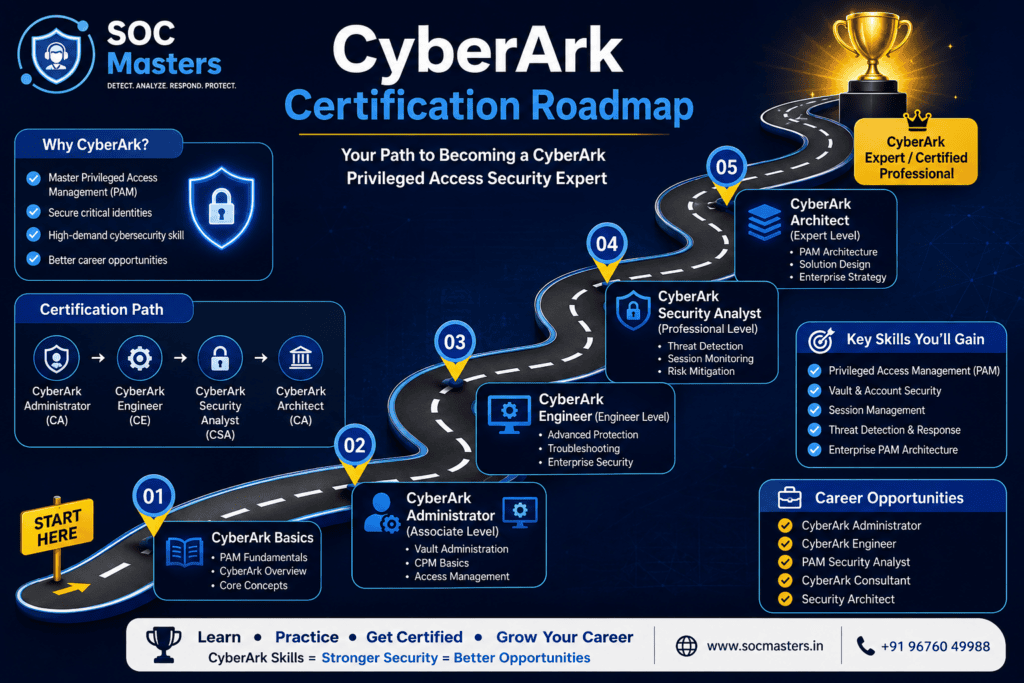
The CyberArk Certification Roadmap is a structured path from cybersecurity and IAM fundamentals to Privileged Access Management skills, then to CyberArk’s technical certification levels — Defender, Sentry and Guardian. CyberArk Training in Hyderabad helps professionals follow that path with instructor-led teaching, hands-on Vault, CPM and PSM labs, troubleshooting practice and exam guidance, so learning moves in the right order instead of randomly.
Table of Contents
Introduction
Almost every serious breach investigation ends at the same place: an account that had more privilege than it needed. That is the problem CyberArk was built to solve.
CyberArk is an identity security platform best known for Privileged Access Management (PAM) — the discipline of controlling, storing, rotating and monitoring the credentials that administrators, service accounts, applications and now AI agents use to reach critical systems. Where a firewall guards the perimeter, PAM guards the keys.
PAM skills have become valuable for a simple reason: attackers rarely break in anymore, they log in. Regulators noticed too. Banking, insurance, healthcare and shared-services firms now face audit requirements that ask specifically how privileged credentials are vaulted, rotated and recorded. Hyderabad, with its dense concentration of Global Capability Centres, feels that demand directly.
That is why searches for CyberArk Training in Hyderabad keep rising among system administrators, IAM engineers, SOC analysts and career switchers.
The difficulty is not motivation. It is sequence. CyberArk is a large platform, and learners routinely start in the wrong place — memorising screens before understanding why a credential needs rotating at all. A CyberArk Certification Roadmap fixes that by putting fundamentals, architecture, labs and certification in an order that actually builds skill. This guide lays out that roadmap for beginners and experienced IT professionals alike, whether you are comparing a CyberArk course in Hyderabad or studying independently.
What Is CyberArk?
CyberArk is an enterprise identity security platform whose core strength is protecting privileged accounts — the high-power accounts that can change configurations, access databases, run scripts and reach production infrastructure.
In plain terms, CyberArk does four things:
- Stores privileged credentials in an encrypted, tamper-resistant vault instead of spreadsheets, scripts or shared inboxes.
- Rotates those credentials automatically on a policy schedule, so a leaked password has a short useful life.
- Brokers privileged sessions so an administrator can connect to a server without ever seeing the password.
- Records and audits those sessions, producing the evidence auditors ask for.
Typical use cases include domain administrator protection, database and application credential management, vendor access, DevOps secrets handling and endpoint privilege control.
One important 2026 update: Palo Alto Networks completed its acquisition of CyberArk in February 2026 and, on 12 May 2026, launched Idira — a next-generation identity security platform built on CyberArk’s PAM heritage and extended to machine and AI-agent identities. The underlying engineering skills (Vault, PVWA, CPM, PSM) have not changed, but naming and packaging are shifting. Verify current product and certification branding on official sources before you enrol or sit an exam.
What Is a CyberArk Certification Roadmap?
A CyberArk Certification Roadmap is a staged learning plan that moves you from security fundamentals to validated, exam-level competence — in a deliberate order.
It usually has five layers:
- Foundation — cybersecurity, networking and operating system basics.
- Identity layer — IAM concepts, authentication, authorisation, Active Directory.
- PAM concepts — least privilege, credential rotation, session isolation, just-in-time access.
- CyberArk core skills — architecture, components, onboarding, policies, troubleshooting.
- Validation and progression — certification, projects and role specialisation.
Why not simply learn every feature at once? Because CyberArk configuration only makes sense once the security intent behind it is clear. A learner who understands why a credential is rotated will configure the Central Policy Manager correctly and debug it when it fails. A learner who memorised the screen will freeze the moment a rotation error appears in a real environment — which is exactly what interviews probe.
Structure also protects your time: you never end up studying advanced session management while still unsure what a service account is.
CyberArk Certification Roadmap for Beginners
Here is a practical eight-step beginner roadmap.
Step 1: Learn Cybersecurity Fundamentals
Start with the CIA triad, threat types, attack lifecycle basics, logging and least privilege. If you are entirely new, our guide to cybersecurity fundamentals is a reasonable starting point. Allow two to three weeks.
Step 2: Understand IAM Concepts
Learn identity lifecycle, authentication versus authorisation, role-based access control, single sign-on and multi-factor authentication. PAM sits on top of IAM, so this layer is not optional.
Step 3: Learn PAM Fundamentals
Understand what makes an account privileged, why standing privilege is risky, and what credential vaulting, rotation, session isolation and just-in-time access actually achieve. Map these ideas to the credential-access and privilege-escalation techniques catalogued in the MITRE ATT&CK Enterprise matrix — that connection is what turns configuration knowledge into security reasoning.
Step 4: Understand CyberArk Architecture
Learn how the components fit together: the Digital Vault as the secure store, PVWA as the web interface, CPM as the credential rotation engine, PSM as the session broker, and PTA for privileged threat analytics. Draw the data flow yourself before touching a lab.
Step 5: Learn Core CyberArk Components
Go component by component: safes and permissions, platforms, account onboarding, master policy versus exceptions, session recording and reporting.
Step 6: Practice with Real-Time Scenarios
Rotate a Windows local admin credential. Onboard a Linux root account. Break a rotation deliberately and fix it. Configure a PSM connection and review the recording. Scenario practice is where knowledge becomes skill.
Step 7: Prepare for CyberArk Certification
Once labs feel routine, align your study with the official exam objectives for the level you are targeting and close the gaps you find.
Step 8: Build Hands-On Experience
Document what you built, keep a lab journal and rebuild the environment from scratch at least once. Senior interviewers can hear that rebuild in your answers.
CyberArk Certification Levels and Learning Path
CyberArk’s technical certifications are administered through Pearson (formerly Pearson VUE). As listed on the official CyberArk certification exam page, the current technical levels are Defender, Sentry and Guardian.
Level | What it validates | Exams listed officially | Typical candidate |
Trustee | Foundational, awareness-level understanding of privileged access concepts (delivered through CyberArk’s own learning platform, not the proctored technical track) | — | Complete beginners, non-technical stakeholders |
Defender | Practical skills to maintain day-to-day operations and ongoing performance of the relevant CyberArk solution | CyberArk Defender PAM (PAM-DEF), Defender Access (ACC-DEF), Defender EPM (EPM-DEF) | Administrators and operators |
Sentry | Skills to deploy, install and configure the relevant CyberArk solution | CyberArk Sentry PAM (PAM-SEN), Sentry Privilege Cloud (CPC-SEN), Sentry Secrets Manager (SECRET-SEN) | Implementation and deployment engineers |
Guardian | Advanced technical skill across CyberArk solutions plus the ability to align enterprise architecture with privileged access strategy | CyberArk Guardian (GUARD) | Senior engineers, architects, consultants |
There is also a partner-only Certified Delivery Engineer (CDE) designation, available to personnel at organisations holding a current CyberArk partner agreement — it is not a route for individual learners.
Two practical points that change how you plan:
- Exams are in-person only. Online proctoring for CyberArk certification exams was discontinued from 1 November 2025, so you must book a physical Pearson test centre. For Hyderabad candidates this means planning a test-centre slot rather than assuming a from-home exam.
- Branding is in transition. With the Idira launch in May 2026, exam names, codes and packaging may evolve. Always confirm the current exam list, prerequisites and pricing on CyberArk’s official certification pages before paying for anything.
Skills Required Before Starting CyberArk Training
Not every prerequisite carries the same weight. Here is the honest split.
Required — you will struggle without these:
- Basic cybersecurity concepts (least privilege, authentication, common attack paths)
- Networking fundamentals (TCP/IP, ports, DNS, firewalls, RDP and SSH)
- Windows Server fundamentals and comfort with Linux command line
- Active Directory basics — users, groups, service accounts, group policy
- IAM concepts, including authentication versus authorisation
Helpful but optional — you can build these alongside:
- Scripting with PowerShell, Python or REST API basics for automation
- Cloud security fundamentals across Azure, AWS or GCP
- Database and application account familiarity
- Compliance awareness (audit evidence, access reviews, SOX-style controls)
A candidate who knows Active Directory well tends to learn CyberArk fastest, because most early onboarding work involves domain accounts.
CyberArk Skills You Learn During Training
Good CyberArk training should leave you able to operate, not just describe. Expect coverage of:
- Privileged account security — discovery, classification and onboarding of privileged accounts
- Digital Vault fundamentals — safes, safe permissions, access control and separation of duties
- Credential management and rotation — CPM platforms, rotation policies, verification and reconciliation
- Privileged session management — PSM connection components, session isolation, live monitoring and recording
- Policy design — master policy, exceptions and platform-level settings
- User provisioning and access control — LDAP and directory integration, group-based entitlements
- Reporting and auditing — producing the evidence auditors actually request
- Troubleshooting — failed rotations, connection component errors, service and log analysis
- Architecture reasoning — component placement, high availability and disaster recovery concepts
Troubleshooting and architecture matter most in interviews. Anyone can onboard an account on a good day; employers pay for the person who can explain why rotation failed on a bad one. Our CyberArk course syllabus breaks these modules down topic by topic.
Why CyberArk Training in Hyderabad Is Important for Career Growth
Technical skills
- CyberArk PAM fundamentals and privileged account lifecycle
- Enterprise Password Vault / Digital Vault administration
- Central Credential Provider for application credential retrieval
- Privileged Session Manager, including PSM for SSH
- CPM configuration, plugins and rotation troubleshooting
- LDAP and Active Directory — the single most valuable adjacent skill
- Windows Server and Linux administration
- Networking fundamentals: DNS, firewall rules, ports, certificates
- REST APIs plus PowerShell or Python scripting
- Cloud security concepts across AWS, Azure and GCP
Soft skills
- Structured problem-solving under production pressure
- Clear communication with teams who resist losing admin rights
- Documentation discipline — runbooks, design documents, handover notes
- Analytical thinking for root-cause investigation
- Methodical troubleshooting rather than trial and error
A candidate strong in Active Directory and Windows internals will learn CyberArk faster than one who memorised product screens without that foundation.
Why CyberArk Training in Hyderabad Is Important for Career Growth
Self-study can teach you concepts. It rarely gives you a working environment, a reviewer or a deadline. That is the practical case for structured CyberArk Training in Hyderabad.
What good instructor-led training adds:
- A lab you did not have to build — a functioning Vault, CPM and PSM setup takes real effort to assemble alone.
- Real-time scenarios — onboarding failures, policy conflicts and connection errors reproduced deliberately.
- Correction loops — someone experienced tells you when your safe permission design is wrong, before an interviewer does.
- Certification alignment — study mapped to current official exam objectives rather than outdated blogs.
- Interview and career guidance — help translating lab work into resume points and answers you can defend.
Hyderabad adds a location advantage. The city holds a significant share of India’s Global Capability Centre activity, and GCCs are precisely the organisations that run mature PAM programmes with audit obligations. Being trained where those employers hire — and being able to reach a Pearson test centre without travelling to another city — is a genuine practical benefit.
We should be clear about limits: no training institute, including SOC Masters, can guarantee placement or a specific salary. What training can do is make you employable faster than unstructured self-study.
CyberArk Certification Roadmap for Freshers
If you are starting from zero, follow this sequence without skipping:
Cybersecurity Basics → IAM Fundamentals → PAM Concepts → CyberArk Fundamentals → Hands-On Labs → Certification Preparation → Entry-Level Cybersecurity or PAM Roles
A realistic expectation: your first role may not carry a “CyberArk” title. Many entry paths run through IT support, identity operations, service desk or SOC roles handling access requests and account onboarding, then move into a dedicated PAM team within a year or two. Freshers who accept that stepping-stone route usually progress faster than those holding out for a CyberArk-titled first job.
Pair your labs with visible proof: a documented home lab, a clear project write-up and interview preparation. Our interview questions library is useful for the security fundamentals portion that almost every PAM interview still opens with.
CyberArk Certification Roadmap for IT Professionals
Experienced professionals should not restart from the beginning. Transfer what you already have.
System Administrators
You already understand Windows, Linux, service accounts and Active Directory — which is most of the hard part. Focus on PAM concepts, safe design and rotation policies. Usually the fastest transition of any background.
Network Engineers
Your strengths are connectivity, protocols and firewall rules. Concentrate on identity concepts and session management; PSM connection troubleshooting will feel familiar because so much of it is path and port reasoning.
Security Engineers
You have the threat model already. Spend your time on CyberArk architecture and component-level configuration, then move quickly toward Sentry-level deployment skills.
IAM Professionals
The shortest path of all. You know lifecycle, provisioning and directory integration. Add privileged-account specifics, vaulting and session isolation.
Cloud Professionals
Your advantage is cloud identity and secrets. Focus on classic on-premise PAM architecture — Vault, CPM, PSM — which is still the backbone of most enterprise deployments, then connect it to cloud and secrets management work.
SOC Analysts
You already read logs and investigate alerts. Learn how privileged session data and PAM telemetry feed detection, then build hands-on configuration skill. Analysts moving into PAM engineering is one of the more common upgrade paths in Hyderabad, and you can review typical SOC analyst roles in Hyderabad to see where those two career tracks meet.
CyberArk Career Opportunities After Certification
Roles commonly associated with CyberArk and PAM skills include:
- CyberArk Administrator
- CyberArk / PAM Engineer
- CyberArk Consultant
- IAM Engineer
- PAM Security Engineer
- Privileged Access Management Specialist
- Identity Security Engineer
- Cybersecurity Engineer
An honest caveat: certification does not guarantee employment. It validates knowledge and gets your resume read. What converts interviews is demonstrable hands-on capability — being able to describe an onboarding you performed, a rotation failure you diagnosed and a policy decision you defended. Our breakdown of CyberArk job roles and responsibilities shows what these positions involve day to day.
CyberArk Salary and Career Growth in Hyderabad
We deliberately do not publish a fixed salary table here, because compensation for PAM roles varies widely and any single number would mislead you. What we can explain is what actually moves the figure.
Compensation for CyberArk professionals is influenced by:
- Total years of IT experience and years specifically in identity or PAM work
- Depth of CyberArk skills — operations versus deployment versus architecture
- Broader PAM knowledge beyond a single vendor
- Certification level achieved and validated
- Cloud security skills, which consistently attract a premium
- IAM background, especially directory and provisioning experience
- Employer type — product companies, GCCs, consulting firms and service providers pay differently
- Role scope — support, engineering, consulting or architecture
- Project exposure, particularly migrations and audit remediation work
For current figures, check live aggregators such as Glassdoor, AmbitionBox or Naukri filtered to Hyderabad and your experience band, and treat them as estimates rather than promises. Our reference page on CyberArk salary in India explains the ranges and their caveats in more detail.
CyberArk Certification vs CyberArk Training
Factor | CyberArk Certification | CyberArk Training |
Purpose | Validates knowledge against a defined standard | Builds the knowledge and skill in the first place |
Learning | Structured around exam objectives | Structured around concepts, labs and real scenarios |
Hands-On Practice | Not directly assessed in a written exam | Central — Vault, CPM, PSM and troubleshooting practice |
Validation | Formal, recognised credential and digital badge | Informal, evidenced through projects and lab work |
Career Value | Gets the resume shortlisted | Gets the interview passed and the job done |
Neither replaces the other. Certification without hands-on skill produces candidates who fail technical rounds; hands-on skill without certification produces strong engineers whose resumes get filtered out before a human reads them. Training plus hands-on experience plus certification is the combination that survives both screens.
CyberArk Training in Hyderabad – What Should You Look For?
Use this checklist when comparing institutes:
- Updated curriculum — reflects current CyberArk versions and the Idira transition, not 2019 screenshots
- Experienced trainer — with real deployment or operations background, not only teaching experience
- Hands-on CyberArk labs — individual lab access, not a projected demo
- Real-time scenarios — including deliberate failures to diagnose
- PAM architecture coverage — component placement, high availability, disaster recovery
- Troubleshooting practice — treated as a module, not an afterthought
- Certification guidance — mapped to current official exam objectives
- Interview preparation — scenario-based, not question memorisation
- Career support — resume review and role targeting, without guarantees
- Flexible learning options — classroom, live online and self-paced formats
- Verifiable claims — ask directly about lab hours, batch size and trainer background
If an institute cannot answer the lab-access question specifically, treat that as your answer.
Common Mistakes While Following a CyberArk Certification Roadmap
- Learning only theory. You can describe vaulting perfectly and still be unable to onboard an account.
- Skipping PAM fundamentals. Jumping straight to CyberArk screens leaves you unable to reason about anything unexpected.
- Memorising exam dumps. It may pass a paper. It fails the technical interview immediately after.
- Avoiding hands-on labs. The single most common reason capable learners stall.
- Ignoring troubleshooting. Real PAM work is mostly things not working. Practice broken states deliberately.
- Not understanding architecture. Without the component map, every error looks random.
- Learning without projects. Nothing to document means nothing to discuss in an interview.
- Depending only on certification. The credential opens the door; skill keeps you in the room.
- Ignoring platform change. Content written before the Palo Alto Networks acquisition may describe outdated packaging.
CyberArk Certification Roadmap – 90-Day Learning Plan
Period | Focus | Skills | Practical Work |
Days 1–30 | Cybersecurity, IAM and PAM fundamentals | Least privilege, authentication and authorisation, Active Directory, networking basics, PAM principles | Build a small Windows and Linux lab; create and document service accounts |
Days 31–60 | CyberArk core concepts and hands-on labs | Vault, PVWA, CPM, PSM, safes, platforms, master policy, onboarding | Onboard Windows and Linux accounts; configure rotation; run and review a PSM session |
Days 61–90 | Advanced practice, projects and exam preparation | Troubleshooting, reporting, auditing, architecture reasoning, exam objectives | Break and fix rotation; produce an audit report; rebuild the lab from scratch; take practice assessments |
Ninety days assumes consistent daily study of roughly two hours plus lab time. Working professionals often need four to five months, and that is completely normal.
CyberArk Certification Roadmap – Career Path
Stage | Knowledge | Role Direction |
Beginner | Cybersecurity and IAM fundamentals | Entry-level security, identity operations or support |
Intermediate | PAM concepts and CyberArk operations | CyberArk Administrator or PAM Engineer |
Advanced | Architecture, deployment and troubleshooting | Senior PAM Engineer |
Expert | Design, strategy and enterprise integration | PAM Consultant or Identity Security Architect |
CyberArk vs Other Cybersecurity Career Paths
Career | Core Skills | Learning Focus | Career Direction |
CyberArk / PAM | Vaulting, credential rotation, session management, architecture | Deep platform and privileged-access engineering | PAM Engineer → Senior Engineer → PAM Architect or Consultant |
SOC Analyst | Log analysis, SIEM, alert triage, incident response | Detection and investigation breadth | L1 → L2 Analyst → Threat Hunter or Incident Responder |
IAM Engineer | Identity lifecycle, provisioning, SSO, MFA, governance | Identity administration across the enterprise | IAM Engineer → IAM Architect or IGA Specialist |
Cloud Security Engineer | Cloud IAM, workload security, secrets, posture management | Cloud-native security controls | Cloud Security Engineer → Cloud Security Architect |
These paths overlap more than they compete. PAM sits inside identity security, and SOC teams consume telemetry from all of it. Choosing CyberArk PAM training does not close the other doors — it usually opens them.
Key Takeaways
- Follow the sequence. Cybersecurity → IAM → PAM → CyberArk architecture → labs → certification. Skipping layers is the most common reason learners stall.
- Know the levels. The current technical certification levels are Defender (operations), Sentry (deployment) and Guardian (advanced and architectural) — verify exam names on official sources, as branding is shifting under Idira.
- Prioritise the right skills. Active Directory, Windows and Linux, networking and IAM are the prerequisites that matter most; scripting and cloud are strong accelerators.
- Certification opens doors; skill keeps them open. Roles from CyberArk Administrator to PAM Architect all depend on demonstrable hands-on capability.
- Hands-on training is the differentiator. Structured CyberArk Training in Hyderabad gives you labs, correction loops, troubleshooting practice and exam alignment that self-study rarely matches.
Conclusion
Privileged access is where modern attacks succeed or fail, and CyberArk remains the platform most enterprises trust to control it. The skills are learnable — but only in the right order.
A CyberArk Certification Roadmap gives you that order: fundamentals before features, architecture before configuration, labs before exams and evidence before interviews. Whether you are a fresher building a first security role or a system administrator converting a decade of Active Directory experience into a PAM career, the sequence is the same. Only your starting point changes.
If you want that sequence taught rather than self-assembled, structured CyberArk Training in Hyderabad is the fastest reliable route — with the caveat that no institute can promise placement, and any that does should be treated with suspicion.
Ready to Start Your CyberArk Journey?
At SOC Masters in Kukatpally, Hyderabad, our CyberArk and PAM programme is built around the roadmap in this article — fundamentals first, then architecture, then hands-on Vault, CPM and PSM labs, then troubleshooting scenarios and certification-aligned preparation.
You will learn to:
- Build genuine CyberArk fundamentals rather than surface familiarity
- Practise in real-time labs, including deliberate failure scenarios
- Follow a structured certification roadmap instead of guessing what to study next
- Develop practical PAM skills that hold up in technical interviews
- Prepare for CyberArk certification against current exam objectives
- Build a long-term cybersecurity career, not just a single credential
Classroom, live online and self-paced formats are available.
Talk to us: Call or WhatsApp +91 96760 49988, email socmasters.in@gmail.com, or get in touch through our contact page to discuss your background and the right starting point for you.
Frequently Asked Questions
1. What is the CyberArk Certification Roadmap?
It is a structured path from cybersecurity and IAM fundamentals, through PAM concepts and CyberArk architecture and labs, to the technical certification levels — Defender, Sentry and Guardian — followed by role specialisation.
2. Is CyberArk certification worth it?
Yes for most identity and infrastructure professionals, because it validates specific, in-demand skills and helps resumes pass screening. It is worth less if pursued without hands-on lab experience to support it.
3. What should I learn before CyberArk training?
Networking basics, Windows and Linux fundamentals, Active Directory, and core IAM concepts such as authentication, authorisation and least privilege. Scripting and cloud knowledge help but are not mandatory.
4. Is CyberArk suitable for freshers?
Yes, provided you build fundamentals first and accept that your first role may be in support, identity operations or a SOC before moving into a dedicated PAM team.
5. How long does it take to learn CyberArk?
Roughly 90 days of consistent daily study for job-ready fundamentals if you already work in IT. Complete beginners and busy working professionals commonly take four to six months.
6. What skills are required for CyberArk?
Active Directory, Windows and Linux administration, networking, IAM concepts, PAM principles, plus CyberArk-specific skills across Vault, PVWA, CPM and PSM, and troubleshooting ability.
7. What jobs can I get after CyberArk certification?
CyberArk Administrator, PAM Engineer, IAM Engineer, Identity Security Engineer, PAM Specialist and CyberArk Consultant roles, depending on your experience level.
8. Is CyberArk a good career in 2026?
Demand for privileged access skills remains strong, and the Palo Alto Networks acquisition has raised the profile of identity security further. As always, hiring varies by market and experience level, so treat demand as favourable rather than guaranteed.
9. Where can I get CyberArk Training in Hyderabad?
SOC Masters runs instructor-led CyberArk and PAM training in Kukatpally, Hyderabad, with classroom, live online and self-paced options. Compare any provider using the checklist in this article before enrolling.
10. Is hands-on experience necessary for CyberArk certification?
Yes. The exams test practical operational knowledge, and technical interviews test it harder. Lab work is not optional preparation — it is the preparation.
Are CyberArk exams available online?
No. Online proctoring for CyberArk certification exams was discontinued from 1 November 2025, so exams are taken in person at a Pearson test centre. Confirm current policy before booking.