
CyberArk Salary in India
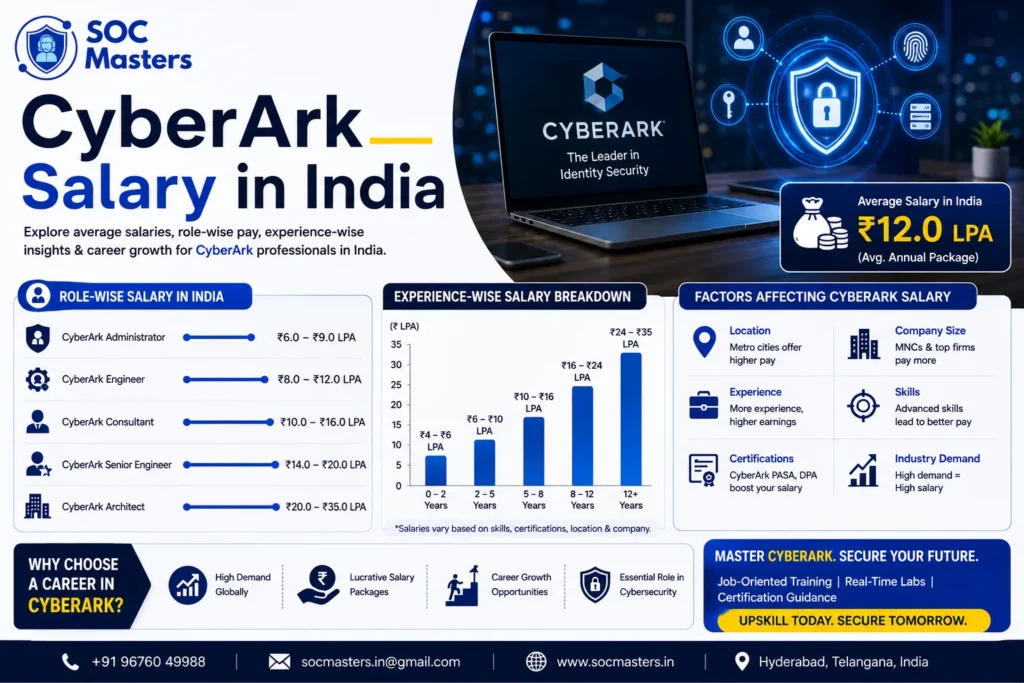
CyberArk salaries in India vary widely by experience, role and hands-on depth. Reported ranges begin near ₹4–7 LPA at entry level and reach ₹25–45+ LPA for architects. Salary follows demonstrated skill in Vault, CPM, PSM, PVWA and automation. Structured, lab-based CyberArk Training in Hyderabad helps learners build that practical ability and prepare for real privileged access management work.
Introduction
CyberArk is one of the best-known names in Privileged Access Management (PAM). Its job is simple to describe and hard to do well: keep administrator passwords, service accounts, SSH keys and API secrets out of human hands, and record every use.
That matters because attackers rarely break down the front door anymore. They log in. One stolen domain admin credential can undo years of firewall investment, which is why banks, hospitals and government departments now treat PAM as a board-level control rather than IT housekeeping.
Demand follows. Indian IT services firms, Global Capability Centres and MSSPs are staffing PAM teams, and CyberArk remains the platform most of them run. Palo Alto Networks completed its acquisition of CyberArk in February 2026 and, in May 2026, launched Idira, a rebranded identity security platform built on CyberArk's PAM foundation. The Vault, CPM, PSM and PVWA components engineers work with daily did not change.
What does this mean for pay? CyberArk skills sit in the upper half of the Indian cybersecurity salary band, but the numbers circulating online are often misleading. Many articles quote what CyberArk the company pays its own product engineers, then present that as what a PAM administrator at a services firm earns. Those are different markets.
This guide separates them, walks through salary drivers by experience, role and skill, and explains why practical ability — not just a certificate — is what employers price. It also explains why hands-on CyberArk Training in Hyderabad has become a practical starting point for learners here.
What Is CyberArk?
CyberArk is an identity security platform built around Privileged Access Management. Instead of letting administrators know and reuse high-power passwords, it stores those credentials in an encrypted vault, rotates them automatically, and brokers access through a controlled session.
The components are worth knowing by name, because interviews ask about them directly:
- Digital Vault — the hardened, encrypted store where privileged credentials live, isolated at the network level.
- PVWA (Password Vault Web Access) — the web interface users and administrators work through.
- CPM (Central Policy Manager) — rotates, verifies and reconciles passwords on target systems.
- PSM (Privileged Session Manager) — isolates and records sessions so the user never touches the credential.
- PTA (Privileged Threat Analytics) — flags suspicious privileged activity.
- Conjur / Secrets Manager — removes hardcoded secrets from code and CI/CD pipelines.
- EPM (Endpoint Privilege Manager) — removes standing local admin rights from endpoints.
Above these sits the wider idea: least privilege, just-in-time access, session isolation, and an audit trail regulators accept. That is the language enterprise security teams use, and a CyberArk professional is expected to speak it.
Chat on WhatsAppWhy CyberArk Professionals Are in Demand in India
Several forces are pushing demand at once.
Identity-based attacks dominate. Credential theft, session hijacking and abuse of over-privileged service accounts rank among the most common intrusion routes. PAM is the direct control for that risk.
Cloud adoption multiplied privileged accounts. Every subscription, cluster, database and pipeline creates new privileged identities, most of them non-human. Machine identities now far outnumber human ones.
Zero Trust made privilege a design question. "Never trust, always verify" cannot work without knowing who holds elevated rights, and under what conditions.
Regulators want evidence. RBI guidance, SEBI's framework, DPDP obligations, PCI DSS, ISO 27001 and SOX audits all expect auditable privileged access. Auditors want session recordings and rotation logs, not intent.
The result is steady, hard-to-outsource work: onboarding accounts, writing platform policies, integrating targets, troubleshooting CPM failures, supporting audits. That demand supports a career, and it is why enquiries for CyberArk Training in Hyderabad have grown alongside the city's enterprise security hiring.
CyberArk Salary in India
A caution most articles skip: there is no single authoritative salary source for CyberArk skills in India. Glassdoor, Indeed, AmbitionBox, Levels.fyi and 6figr collect self-reported data with different sample sizes and definitions, and ranges move month to month. Treat every figure below as an approximate market range, not a promise.
Note the earlier distinction too. Glassdoor data for CyberArk the employer covers engineers building the product; in April 2026 it showed a spread from roughly ₹10.5 lakh to ₹34 lakh by role. That is a product engineering band, not the band for a PAM administrator at a services company. Both are real; they answer different questions.
What actually moves an individual's number:
CyberArk Salary for Freshers in India
Honest framing first: very few companies hire a fresher into a pure CyberArk role. Most entry paths run through an IAM or infrastructure support position, with CyberArk work added during the first year.
Typical entry titles include Junior IAM Analyst, PAM Support Engineer, Identity Operations Analyst and Security Analyst (IAM). Public aggregator data places the entry band roughly around ₹4–7 LPA, with stronger offers going to candidates who already hold cloud or scripting skills.
Early responsibilities are narrower than beginners expect: onboarding accounts and safes against approved requests, handling reconciliation failures, running audit reports, first-level troubleshooting of session and rotation errors, and documenting changes.
To be considered at all, a fresher needs Windows and Linux fundamentals, Active Directory and LDAP concepts, basic networking (ports, DNS, certificates), and demonstrable time inside a CyberArk environment.
That last item is the barrier. It is hard to build alone, because CyberArk is licensed enterprise software rather than something downloadable for weekend practice. This is the specific gap a structured, lab-based CyberArk course in Hyderabad is designed to close — a working vault environment plus a trainer who has broken and fixed one before.
CyberArk Salary Based on Experience
The table below reflects commonly reported ranges across public salary aggregators and job postings as of mid-2026. Figures are directional and vary significantly by employer, city, domain and negotiation.
The table cannot capture two things. The same title pays very differently at a staffing firm and at a global bank's GCC, and a four-year engineer with real implementation scars can out-earn a seven-year engineer who only ran tickets.
Chat on WhatsAppCyberArk Roles and Responsibilities
Pay generally rises down this table, as the work shifts from executing defined tasks to making design decisions others depend on.
CyberArk Skills That Can Improve Career Growth
Employers screen for a recognisable cluster. The core stack comes first: PAS fundamentals, Vault administration, safes and object-level access control, master and platform policies, CPM, PSM, PVWA and PTA, extended by Conjur and secrets management for pipeline work.
Around it sits the supporting layer that separates strong candidates from average ones:
Compare these against the CyberArk course syllabus of any institute you shortlist — module lists reveal more than marketing pages do.
CyberArk Certification and Its Impact on Career Growth
CyberArk's certification programme is delivered through Pearson VUE and structured in levels. Current details are published on the official CyberArk certification page.
- Defender level (PAM-DEF) — day-to-day operational competence. Companion Defender exams exist for EPM and IAM.
- Sentry level (PAM-SEN) — deployment, installation and configuration, with variants for Privilege Cloud (CPC-SEN) and Secrets Manager (SECRET-SEN).
- Guardian (GUARD) — the advanced credential, combining enterprise architecture with privileged access strategy.
- CDE and recertification tracks — for certified delivery engineers maintaining currency.
After the Palo Alto Networks acquisition and the Idira launch, the Defender, Sentry and Guardian structure remains the recognised path for PAM professionals. Confirm current exam codes on the official site before booking, since details can change during a platform transition.
Does certification raise salary? It helps you get shortlisted, and partner organisations often need certified staff to hold partner status. But interviews are scenario-driven. Being asked why a CPM reports "password change failed" on a Unix target, and answering from memory of a lab you actually ran, is worth more than a badge. Build hands-on ability first, then certify to formalise it.
Why CyberArk Training in Hyderabad Matters for Career Growth
Self-study works well for many technologies. It works poorly for CyberArk, for one structural reason: you cannot download an enterprise vault and practise at home. Without an environment, learning stalls at theory — and theory is what interviewers screen out.
Quality CyberArk Training in Hyderabad addresses this by providing:
- Structured sequencing — concepts, components, installation, policy, troubleshooting
- A working lab environment — Vault, PVWA, CPM and PSM you can configure, break and repair
- Real-world scenarios — onboarding Windows, Unix, database and network device accounts as they appear in production
- Troubleshooting practice — encrypted credential files, account lockouts, failed reconciliations, session errors
- Implementation context — pre-requisites, port planning, AD integration, DR and vault backup
- Interview and certification preparation — scenario questions, mock interviews, Defender and Sentry practice
- Project exposure — capstone work you can describe on a resume without inventing anything
At SOC Masters, CyberArk sessions are led by Mr. Ranjeet, a practitioner with 10+ years in enterprise security, across instructor-led online and classroom batches near JNTU metro, Kukatpally, on a 30-day schedule. Free demo sessions let you assess the trainer before committing — the right way to evaluate any institute.
Chat on WhatsAppWhat Should You Look for in CyberArk Training in Hyderabad?
Use this checklist when comparing institutes:
- Updated syllabus covering PAS, Vault, CPM, PSM, PVWA, PTA, Conjur and EPM, plus current identity security concepts
- Experienced trainer with genuine implementation background — ask how many deployments they have led
- Hands-on CyberArk environment available for the full course, not a one-off demo
- Real-time projects simulating enterprise onboarding, session management and incident scenarios
- PAM troubleshooting built into the syllabus, not left as an afterthought
- Certification guidance mapped to Defender and Sentry objectives
- Interview preparation with scenario-based mock interviews
- Placement assistance described honestly — support and referrals, not promises
- Flexible modes across classroom, live online and self-paced, with weekend batches
- Student support including recordings, doubt clearing and an active batch group
One warning: be sceptical of any institute promising a specific salary or guaranteed placement. No institute controls hiring decisions at another company. What it can control is the quality of your skills, resume and interview readiness.
Enroll for Free DemoCyberArk Career Path in India
Beginner (IT / networking / security fundamentals)
↓
Junior IAM / PAM Professional — AD, LDAP, ticketing, account onboarding
↓
CyberArk Administrator — safes, policies, CPM/PSM operations, reporting
↓
CyberArk Engineer — installation, integration, automation, upgrades
↓
Senior CyberArk Engineer — HA/DR, multi-site design, Conjur, cloud PAM
↓
CyberArk Consultant — client delivery, solution design, stakeholder management
↓
CyberArk Architect — PAM strategy, governance, audit defence, leadership
At the beginner stage, focus on operating systems, directory services and networking. Through the administrator and engineer stages, depth in the CyberArk stack plus scripting earns promotions. From senior engineer onward, design judgement and the ability to explain a control to an auditor or CISO matter as much as technical depth.
CyberArk Salary in India vs Other Cybersecurity Roles
This is not a ranking. CyberArk and IAM roles benefit from scarcity and audit-driven demand. SOC roles offer the widest entry opportunities for freshers — if that route interests you, compare the SOC analyst salary in India alongside these figures, and treat SOC Masters analyst training as an alternative entry point. Cloud security has the steepest demand curve. The best choice depends on your existing background more than on any published average.
Hyderabad Cybersecurity Job Market for CyberArk Professionals
Hyderabad has become one of India's strongest markets for enterprise security hiring, for structural rather than seasonal reasons.
The city's Global Capability Centre ecosystem is expanding quickly. Telangana's IT department reported 43 new GCCs coming forward in the first half of 2026, after 84 began operations in 2025. According to the Nasscom GCC Landscape Report 2026, more than half of newly established BFSI GCCs in India have chosen Hyderabad.
That BFSI concentration matters directly for CyberArk careers. Banking, insurance and capital markets firms are the heaviest users of PAM, because their regulators demand demonstrable control over privileged access. A GCC serving a global bank almost always runs a PAM platform, and that platform needs a local operations and engineering team.
Beyond BFSI, the city hosts IT services delivery centres running PAM implementations for global clients, plus pharmaceutical, healthcare and engineering GCCs with strict data protection obligations. Most of this clusters around HITEC City, Gachibowli, Madhapur and the Financial District, and the same employers post SOC analyst jobs in Hyderabad alongside PAM roles.
CyberArk Salary by Skills and Certifications
Bands widen when you can do what most CyberArk administrators cannot, roughly in order of impact:
- CyberArk PAS depth — installation, upgrade, DR and complex troubleshooting, not daily operations
- Conjur and secrets management — securing CI/CD pipelines and machine identities; scarce and well paid
- Cloud security — extending PAM into AWS, Azure and GCP, including workload identity
- Automation and REST APIs — bulk onboarding, health checks, reporting, and integration with ITSM and SIEM
- IAM breadth — governance and provisioning knowledge alongside PAM, which opens architecture roles
The combination that consistently attracts the strongest offers is CyberArk depth plus automation plus cloud. Each alone is common. Together, they are not.
Enroll for Free DemoHow to Start a Career in CyberArk
Step 1: Learn the cybersecurity fundamentals. CIA triad, authentication versus authorisation, common attack paths, and why least privilege exists.
Step 2: Understand IAM and PAM. Identity lifecycle, provisioning, SSO, MFA, and how privileged access differs from standard access.
Step 3: Learn CyberArk fundamentals. Architecture, component roles, and how a credential request flows end to end.
Step 4: Practise Vault, PVWA, CPM and PSM. Onboard accounts, build safes, configure master and platform policies, run session recordings. This step cannot be read about — it must be done.
Step 5: Learn automation. PowerShell first, then the CyberArk REST API, then Python.
Step 6: Build real-time projects. A vault deployment, a CPM integration across Windows and Unix targets, a Conjur pipeline demo, an incident response walkthrough.
Step 7: Prepare for certification. Defender first, then Sentry once you have implementation exposure.
Step 8: Prepare for interviews. Scenario questions dominate. Work through interview questions in the same format and practise explaining your project decisions aloud.
Step 9: Apply for IAM, PAM and CyberArk roles. Include adjacent titles — many careers start as an IAM analyst and turn CyberArk-focused within a year.
Expect three to six months of consistent effort from a reasonable IT foundation to interview-ready. Faster claims usually mean shallower learning.
Common Mistakes Beginners Make
Learning only theory. Reading about PSM is not the same as configuring a connector that refuses to launch.
Ignoring IAM fundamentals. Candidates who cannot explain authentication versus authorisation, or how AD groups map to permissions, struggle regardless of their CyberArk knowledge.
Not practising in a real environment. Screenshots do not build muscle memory.
Skipping troubleshooting. Production CyberArk work is largely diagnosis. If your training never lets anything break, it never prepared you.
Ignoring automation. Manual-only administrators are capped in scope and pay.
Chasing certification before ability. A certificate without hands-on experience produces a difficult interview, an awkward first month, and a resume with no projects on it.
Choosing outdated training. Syllabi that ignore cloud, Conjur and secrets management leave you behind the market.
Future Scope of CyberArk Careers in India
Identity has become the primary control plane. As perimeter security matured, attackers moved to credentials, and investment follows the attack surface.
Machine and AI identities are expanding fast. Service accounts, workloads, containers and AI agents all hold privilege. Idira was positioned around governing human, machine and agentic identities together — an acknowledgement that traditional PAM scope was too narrow.
Zero standing privilege is the emerging standard. Moving from permanent admin rights to time-bound access is a multi-year programme at most enterprises, and programmes need engineers.
DevSecOps is normalising secrets management. Hardcoded credentials in pipelines remain widespread, and Conjur-class tooling exists to fix them.
Compliance pressure is not receding. DPDP, sectoral regulators and global frameworks keep privileged access on the audit agenda.
None of this guarantees any individual a job. It does mean the underlying skill is unlikely to become obsolete soon — a reasonable basis for choosing a specialisation.
Key Takeaways
- Salary follows demonstrated skill, not job title. Implementation and troubleshooting depth move numbers more than years served.
- The highest-value stack is CyberArk depth plus automation plus cloud. PowerShell, REST APIs, Conjur and cloud identity widen your range.
- Certification supports a career; it does not create one. Defender and Sentry help with shortlisting; scenario-based interviews decide outcomes.
- Lab access decides training quality. CyberArk cannot be self-taught at home, so environment access is the first thing to verify.
- Hyderabad's BFSI-heavy GCC growth makes it a practical place to learn and hire. Training and employers sit in the same city.
Conclusion
CyberArk sits at a useful intersection: a specialised skill, a small talent pool, and compliance-driven demand that does not disappear when budgets tighten. Salaries in India reflect that, rising steeply for professionals who move beyond operations into implementation, automation and architecture. But published figures should be read as approximate ranges shaped by employer, city, domain and, above all, proven ability.
The platform is entering a new phase under Palo Alto Networks, with Idira extending privileged access thinking to machine and AI agent identities. The fundamentals have not changed: vaulting, rotation, session isolation, least privilege and audit evidence remain the core of the job, and people who can implement and troubleshoot them remain in demand.
If you are starting out, the sequence is straightforward — build fundamentals, get real hands-on time in a working environment, produce projects you can talk about, then certify. Structured CyberArk Training in Hyderabad is a practical way to compress that path, particularly for the lab access and troubleshooting practice that are hard to arrange independently.
If PAM is not the right fit, SOC operations is the other main entry route into enterprise security — the SOC analyst career roadmap sets out that path.
Ready to Build Practical CyberArk Skills?
SOC Masters runs instructor-led online and classroom CyberArk batches in Hyderabad, with a live vault lab covering Vault, PVWA, CPM, PSM and Conjur, capstone projects, and PAM-DEF certification preparation.
Attend a free demo first, meet the trainer and see the lab environment before you decide.
Course page: CyberArk syllabus, fees and batch dates Call: +91 96760 49988 WhatsApp: Message SOC Masters Email: socmasters.in@gmail.com Classroom: JNTU Metro Pillar A689 and Manjeera Trinity Corporate, Kukatpally, Hyderabad Enquiries: Contact SOC Masters
Frequently Asked Questions
1. What is the average CyberArk salary in India?
There is no single reliable average, because published figures mix product-company engineers with PAM practitioners. Aggregator data suggests a range from roughly ₹4–7 LPA at entry level to ₹25–45+ LPA for architects — approximate market ranges that vary by employer, city and skill depth.
2. What is the CyberArk salary for freshers?
Entry-level IAM and PAM roles commonly report ranges near ₹4–7 LPA. Freshers with scripting, cloud or Windows/Linux administration skills tend to sit at the higher end.
3. Is CyberArk a good career in India?
For someone with an IT, networking or system administration background, yes — the talent pool is small relative to demand and the work is hard to automate away. It is narrower than general security, so it suits people who prefer depth over breadth.
4. Is CyberArk certification worth it?
As a supplement to hands-on experience, yes. Defender and Sentry help with shortlisting and matter to partner organisations, but interviews are scenario-based and certification alone does not carry them.
5. What skills are required to become a CyberArk Engineer?
CyberArk PAS components (Vault, CPM, PSM, PVWA), Active Directory and LDAP, Windows and Linux administration, networking fundamentals, PowerShell or Python, REST API usage, and a working understanding of cloud identity models.
6. How long does it take to learn CyberArk?
Core concepts and hands-on basics typically take one to two months of focused study. Interview readiness with projects usually takes three to six months from a reasonable IT foundation.
7. Is CyberArk difficult to learn?
The concepts are approachable. The difficulty is access — you need a real environment plus working knowledge of the systems CyberArk integrates with. Those with Windows, Linux or AD experience find it noticeably easier.
8. What is the demand for CyberArk professionals in India?
Demand is steady and concentrated in BFSI, GCCs, IT services and MSSPs, with Hyderabad, Bengaluru, Pune, Mumbai and NCR carrying most openings. Regulatory pressure keeps it consistent rather than cyclical.
9. What is the difference between CyberArk and IAM?
IAM manages identity and access for all users. CyberArk focuses on privileged access — the small set of high-power accounts that can cause the most damage. PAM is best understood as a specialised, higher-assurance layer within the broader IAM discipline.
10. Is CyberArk Training in Hyderabad useful for career growth?
It is useful when the training provides a real lab environment, an experienced trainer, troubleshooting practice and project work — the elements employers test. Purely theoretical training adds little, wherever it is delivered.