CyberArk Job Roles and Responsibilities
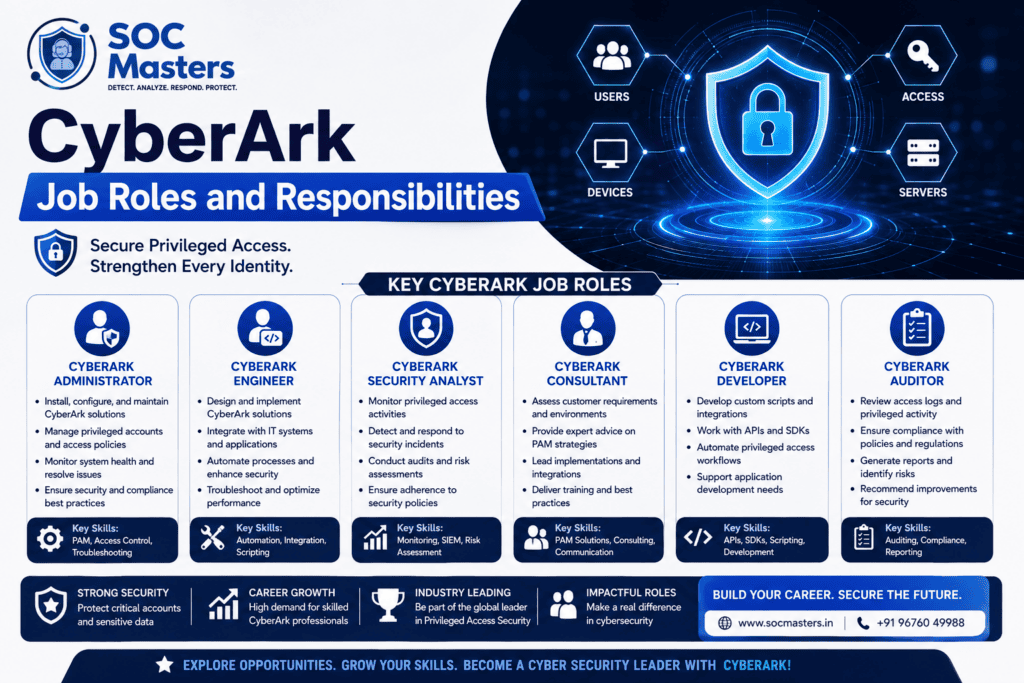
CyberArk professionals secure privileged accounts — the admin, root, service and application credentials that attackers target first. Common roles include CyberArk Administrator, Engineer, Consultant, PAM Specialist, Security Analyst and Architect. Responsibilities span Vault administration, safe and platform design, account onboarding, password rotation, session monitoring and audit reporting. Core skills are Windows, Linux, Active Directory, networking, PowerShell and REST APIs. Structured, lab-based training builds these skills faster than self-study alone.
Table of Contents
Introduction
Most serious breaches do not begin with a zero-day. They begin with a working password.
An attacker phishes one helpdesk account, finds a local admin credential reused across hundreds of servers, and moves laterally until they reach a domain controller. MITRE ATT&CK classifies this pattern as Valid Accounts (T1078) — legitimate credentials used illegitimately. It remains one of the hardest intrusion patterns to detect, because nothing technically “broke.”
Privileged Access Management (PAM) exists to close that gap. Instead of leaving privileged credentials scattered across scripts, spreadsheets and shared documents, PAM stores them in a hardened vault, rotates them automatically, and forces every privileged session through a monitored, recorded channel. CyberArk has been the market reference point for this discipline for over two decades.
The market moved in 2026. Palo Alto Networks completed its acquisition of CyberArk in February 2026 and, in May 2026, introduced Idira, the rebranded identity security platform built on CyberArk technology. For learners, one detail matters most: the component architecture, the module names and the engineering skills did not change. Vault, PVWA, CPM and PSM still work the way they always have, and job descriptions across India still say “CyberArk.”
That stability is why this is a good time to enter the field. Indian GCCs, banks, insurers and managed security providers are all under pressure to prove who accessed which system, when, and with whose approval — and they need people who can operate a PAM platform, not just describe it.
This guide breaks down every major CyberArk job role, what each does day to day, the skills each demands, and how CyberArk Training in Hyderabad helps you build those skills in a lab before you touch a production vault.
What Does a CyberArk Professional Do?
A CyberArk professional protects the credentials that open everything else.
In practice, the work covers seven areas:
Privileged Access Management. Identifying which accounts hold elevated rights — domain admins, root, database sysadmin, network device enable accounts, cloud root users — and bringing them under central control.
Credential security. Removing hardcoded passwords from scripts and application configuration files, replacing them with secure retrieval at runtime.
Vault management. Operating the hardened Digital Vault — safe structure, access permissions, backup, replication and disaster recovery readiness.
Access control. Enforcing least privilege through safe membership, dual control approvals, exclusive access and time-limited checkouts, so nobody holds standing admin rights they do not need.
Monitoring. Reviewing privileged session recordings, watching for risky commands and escalating anomalies to the security operations team.
Policy implementation. Configuring master policy and platform settings that decide how often a password rotates, whether a session is recorded and whether approval is required before checkout.
Security compliance. Producing the evidence auditors ask for under RBI, SEBI, PCI DSS, ISO 27001 and SOX — who accessed which privileged account, when, and under what justification.
The unifying idea: privileged credentials should be short-lived, accountable and observable.
Why CyberArk Skills Are in Demand
Several forces are pushing PAM hiring at once.
Credential abuse is the dominant attack path. Ransomware operators rarely need exotic exploits when a reused administrator password will do. Privileged accounts are the shortest route from foothold to full domain compromise.
Privileged accounts multiply quietly. Every new application brings service accounts, every automation script needs credentials, and every cloud subscription creates root-level identities. Machine identities now vastly outnumber human ones in most enterprises — a point Palo Alto Networks made central to its 2026 identity strategy.
Regulators now ask specific questions. Indian financial regulators expect demonstrable control over privileged access, not policy documents. Session recordings, approval trails and rotation evidence are now expected.
Enterprises are consolidating. PAM is no longer a niche project bolted on after an audit finding; it sits alongside IAM and identity governance in the core security stack.
Cloud and DevOps widened the scope. Secrets in CI/CD pipelines, Kubernetes service accounts and cloud console access all fall inside modern PAM programmes.
The result is steady demand for CyberArk skills. Because deployments are complex and long-lived, employers strongly prefer candidates with genuine hands-on exposure.
CyberArk Job Roles and Responsibilities
CyberArk careers are not one job with one title. Here are the six roles you will see most often in Indian job postings.
CyberArk Administrator
The operational backbone of a PAM programme.
- Vault administration and daily health checks
- User, group and role management, usually synced from Active Directory
- Safe creation, safe membership and permission assignment
- Privileged account onboarding, individually and in bulk
- Password policy configuration and rotation troubleshooting
- Access request handling and approval workflow support
- Session monitoring and basic incident triage
CyberArk Engineer
The build-and-integrate role.
- CyberArk component installation and deployment
- Platform, connection component and master policy configuration
- Integration with Active Directory, LDAP, SIEM, ITSM and cloud providers
- Automation using REST APIs, PowerShell and Python
- Level 2 and Level 3 troubleshooting
Support for PAM architecture decisions, upgrades and patching
CyberArk Consultant
The client-facing delivery role.
- Requirement gathering and current-state assessment
- PAM implementation planning and phased rollout design
- Solution design aligned to compliance obligations
- Stakeholder consulting across security, infrastructure and application teams
- Security assessments and privileged account discovery exercises
- Migration planning from legacy or competing PAM tools
CyberArk PAM Specialist
A focused operations role, common in large enterprises and managed service providers.
- End-to-end privileged account lifecycle management
- Access policy definition and periodic review
- Credential management for applications and service accounts
- Risk monitoring and exception handling
- Day-to-day PAM operations and SLA adherence
CyberArk Security Analyst
Where PAM meets the SOC.
- Privileged access monitoring and session review
- Triage of PAM-generated security alerts
- Investigation of suspicious privileged activity
- Risk analysis on standing privilege and dormant accounts
- Compliance and audit reporting
If this side of the work appeals to you, it is worth comparing it with SOC analyst roles and responsibilities, since many professionals move between the two.
CyberArk Architect
The most senior technical role.
- Enterprise PAM architecture and reference design
- High availability, disaster recovery and Vault replication planning
- Security strategy and roadmap ownership
- Integration architecture across identity, cloud and DevOps toolchains
- Capacity and scalability planning
- Design governance and technical review authority
CyberArk Administrator Roles and Responsibilities
The administrator role deserves a closer look, because it is where most people start.
A typical day begins with health checks: is the Vault reachable, are the CPM and PSM services running, did overnight password rotations succeed? Failed rotations are the single most common ticket. The cause is usually mundane — an account locked out, a changed AD policy, a target server offline, or a reconcile account without sufficient rights.
Safe creation follows a naming convention that mirrors the organisation’s structure, because safes are the unit of access control. Get the safe design wrong and you spend the next two years fixing permissions.
Account onboarding happens three ways: manually through PVWA for one-off accounts, through bulk upload for migrations, and through automated discovery scans that find unmanaged privileged accounts across the estate.
Password management means verifying that the CPM can change, verify and reconcile credentials against each target platform, and adjusting platform settings when it cannot.
User provisioning and access permissions run through LDAP-integrated groups rather than individual assignments, so access is revoked automatically when someone leaves.
Session monitoring means reviewing PSM recordings, especially for high-risk safes, and flagging anything unusual.
Reporting closes the loop: access reviews, onboarding status, rotation compliance and exception reports for audit.
CyberArk Engineer Roles and Responsibilities
Engineers own the platform rather than the queue.
Deployment covers installing Vault servers with vendor hardening applied, standing up PVWA, CPM and PSM servers, and configuring the network paths between them. Configuration work centres on platforms — the templates defining how each account type behaves — and on connection components determining how a user reaches a target system.
Integration is where engineers spend most of their time. Active Directory and LDAP for authentication. SIEM forwarding so privileged events reach the monitoring team. ITSM integration so approvals follow the existing change process. Cloud connectors for AWS, Azure and GCP privileged identities.
REST APIs and automation separate a good engineer from an average one. Onboarding thousands of accounts by hand is not viable, so engineers script it — usually in PowerShell or Python. API skills increasingly appear as mandatory in senior job descriptions.
Troubleshooting is diagnostic work: reading component logs, isolating whether a failure sits in the Vault, the CPM plugin, the target platform or the network path.
Upgrades round out the role — version planning, test-environment validation, and staged rollout without breaking existing integrations.
CyberArk Consultant Roles and Responsibilities
Consultants succeed on communication as much as configuration.
With security teams, they translate risk findings into PAM controls and agree what “least privilege” means in practice.
With IT infrastructure teams, they negotiate onboarding of domain admin, root and network device accounts — often the hardest part of any PAM project, because those teams lose direct password access.
With application teams, they replace hardcoded credentials with credential provider calls.
With compliance teams, they map controls to regulatory clauses and design reports auditors will accept.
With clients, they set realistic scope: a phased rollout securing the highest-risk accounts in three months beats a twelve-month plan that never reaches production.
Skills Required for CyberArk Job Roles
Technical skills
- CyberArk PAM fundamentals and privileged account lifecycle
- Enterprise Password Vault / Digital Vault administration
- Central Credential Provider for application credential retrieval
- Privileged Session Manager, including PSM for SSH
- CPM configuration, plugins and rotation troubleshooting
- LDAP and Active Directory — the single most valuable adjacent skill
- Windows Server and Linux administration
- Networking fundamentals: DNS, firewall rules, ports, certificates
- REST APIs plus PowerShell or Python scripting
- Cloud security concepts across AWS, Azure and GCP
Soft skills
- Structured problem-solving under production pressure
- Clear communication with teams who resist losing admin rights
- Documentation discipline — runbooks, design documents, handover notes
- Analytical thinking for root-cause investigation
- Methodical troubleshooting rather than trial and error
A candidate strong in Active Directory and Windows internals will learn CyberArk faster than one who memorised product screens without that foundation.
CyberArk Tools and Components Professionals Should Know
Component | What it does | Who works on it most |
Digital Vault (EPV) | Hardened encrypted store for all privileged credentials and session recordings | Administrator, Engineer |
PVWA | Web interface for requesting, checking out and managing accounts | All roles |
CPM | Central Policy Manager — automatically changes, verifies and reconciles passwords | Administrator, Engineer |
PSM | Isolates and records privileged sessions to Windows targets and applications | Administrator, Security Analyst |
PSM for SSH | Same isolation and recording for Linux and Unix targets | Administrator, Engineer |
Central Credential Provider | Supplies credentials to applications and scripts via API, removing hardcoded passwords | Engineer, Consultant |
Conjur / Secrets Manager | Secrets management for DevOps pipelines, containers and cloud workloads | Engineer, Architect |
PTA | Privileged Threat Analytics — detects anomalous privileged behaviour | Security Analyst |
REST API | Programmatic control over onboarding, reporting and administration | Engineer |
CyberArk Identity | SSO, MFA and workforce access alongside privileged access | Engineer, Architect |
Under the Idira branding introduced in May 2026, these component names remain unchanged — which is why existing skills and study material stay valid.
CyberArk Job Responsibilities by Experience Level
Experience | Typical Role | Key Responsibilities | Career Focus |
Fresher | Junior CyberArk Professional | Ticket handling, basic account onboarding, password reset support, shadowing rotations | Learn Vault and PVWA navigation; build AD and Windows fundamentals |
1–3 Years | CyberArk Administrator | Safe and user management, onboarding at scale, rotation troubleshooting, session review, reporting | Achieve Defender-level competence; own daily operations independently |
3–5 Years | CyberArk Engineer | Component deployment, platform and connection component configuration, AD/SIEM integrations, API automation | Build integration and scripting depth; move toward Sentry-level skills |
5–8 Years | Senior CyberArk Engineer | Upgrade planning, complex troubleshooting, DR testing, mentoring, design input | Lead technical delivery; specialise in cloud or secrets management |
8+ Years | CyberArk Architect / Consultant | Enterprise architecture, HA and DR design, roadmap ownership, client advisory | Strategy, governance and multi-platform identity design |
Progression is not automatic. Movement between levels depends on the complexity of the environments you have worked in and the problems you have solved yourself.
CyberArk Career Path
A realistic progression looks like this:
Cybersecurity Beginner → networking, Windows, Linux and core security concepts
PAM Fundamentals → least privilege, credential lifecycle, why standing access is risky
CyberArk Administrator → safes, accounts, policies and sessions, operated with confidence
CyberArk Engineer → deploy, integrate and automate the platform
Senior CyberArk Engineer → upgrades, complex integrations and design contributions
CyberArk Consultant → advise clients and lead implementations end to end
CyberArk Architect → design enterprise-scale identity security architecture
CyberArk certification training supports this learning path. The current programme runs Defender (PAM-DEF, ACC-DEF, EPM-DEF), Sentry (PAM-SEN, CPC-SEN, SECRET-SEN) and Guardian (GUARD). One practical detail many candidates miss: since November 2025, CyberArk certification exams are delivered in person at test centres only, and online proctoring is no longer available. Current exam details are published on the official CyberArk certification page at Pearson VUE.
CyberArk Job Roles vs Other Cybersecurity Roles
Role | Main Focus | Key Skills | Career Growth |
CyberArk Professional | Privileged Access Management | Vault, CPM, PSM, AD, scripting, REST API | Administrator → Engineer → Consultant → Architect |
SOC Analyst | Security monitoring and incident response | SIEM, EDR, log analysis, threat detection, triage | L1 → L2 → L3 → Threat Hunter / IR Lead |
IAM Engineer | Identity lifecycle and access governance | SSO, MFA, provisioning, access reviews, IGA tools | IAM Analyst → Engineer → IAM Architect |
Cloud Security Engineer | Securing cloud infrastructure | AWS/Azure/GCP security, IaC, CSPM, container security | Engineer → Senior → Cloud Security Architect |
The differences matter when choosing a path. A SOC analyst detects what already happened; a CyberArk professional reduces what an attacker can do in the first place. IAM governs identity broadly, while PAM goes deep on the small number of accounts carrying the most risk. Cloud security engineers own infrastructure posture and increasingly overlap with PAM through secrets management and cloud entitlements.
PAM suits people who like deterministic, systems-level work with clear evidence of risk reduction.
Why CyberArk Training in Hyderabad Helps Build Job-Ready Skills
CyberArk is difficult to self-study for one reason: you cannot easily obtain a lab. The software is enterprise-licensed, the architecture spans several servers, and a meaningful exercise needs a domain controller, target machines and a working Vault. Reading documentation without that environment produces theory that collapses in the first technical interview.
This is where structured, lab-based PAM training in Hyderabad earns its place:
- Sequenced learning from PAM concepts to architecture, rather than jumping between features
- Hands-on labs with a live Vault, PVWA, CPM and PSM stack
- Real-time PAM scenarios — failed rotations, locked accounts, broken connection components
- Vault administration practice including safe design and permission models
- Account onboarding through manual, bulk and discovery-based methods
- Policy configuration across master policy and platform settings
- Troubleshooting drills using component logs rather than guesswork
- Interview preparation focused on scenarios, not definitions
- Project experience you can describe specifically on a resume
Hyderabad is a practical place to do this: the city hosts a large concentration of global capability centres, IT services firms and BFSI technology operations — the organisations that run enterprise PAM programmes and hire for them locally.
If you want the module-level detail, the CyberArk course syllabus sets out what a complete programme should cover, and the CyberArk course in Hyderabad at SOC Masters page explains the classroom and online delivery options.
What Projects Can You Practice During CyberArk Training?
CyberArk projects are what turn a syllabus into interview answers. Practical exercises worth completing:
- Privileged account onboarding — onboard Windows domain, Linux root and database accounts, then verify rotation succeeds
- Safe creation and configuration — design a safe structure for a fictional organisation with three business units and assign least-privilege membership
- Password policy implementation — configure different rotation intervals and dual-control requirements per account type
- PSM session management — establish isolated sessions, record them, and locate a specific action in the playback
- Active Directory integration — configure LDAP authentication and map AD groups to safe permissions
- Application credential management — remove a hardcoded password from a sample script and retrieve it through a credential provider instead
- CyberArk monitoring and reporting — build access review and rotation compliance reports
- End-to-end PAM implementation scenario — take a discovery report of unmanaged accounts through to a phased onboarding plan
Document each one. A candidate who can explain a failed CPM rotation they personally diagnosed stands out immediately.
CyberArk Job Interview Preparation
CyberArk interview questions concentrate on architecture and scenarios, rarely on definitions.
Be ready to explain CyberArk architecture — how Vault, PVWA, CPM and PSM communicate, and why the Vault is isolated. Expect questions on safes and platforms: what a safe controls, what a platform defines, and how both interact with master policy.
Account onboarding and password rotation come up in almost every interview. Know the difference between change, verify and reconcile, and when a reconcile account is needed.
Troubleshooting questions are the real filter. “A password rotation is failing for a group of Linux servers — how do you investigate?” A strong answer walks through account status in PVWA, CPM logs, target connectivity, credential validity and platform configuration, in that order.
Active Directory integration questions test whether you understand authentication versus authorisation in a PAM context.
Practise explaining your lab projects out loud — structured, specific answers beat memorised lists. The same discipline applies across security roles, and the SOC analyst interview questions collection is a useful model for how scenario answers should be framed.
CyberArk Salary and Career Opportunities
Compensation for CyberArk roles varies widely, and any single figure quoted online should be treated as indicative rather than reliable. Reported ranges depend on:
- Years of hands-on PAM experience
- Depth of CyberArk expertise, especially integrations and automation
- Certification level achieved
- Location and cost-of-living band
- Employer type — product company, GCC, IT services or consulting firm
- Role seniority and project complexity
- Additional cloud, DevOps and scripting skills
Cloud and automation capability is the clearest differentiator at senior levels. Engineers who extend PAM into secrets management and cloud entitlements consistently command more than those limited to on-premises administration.
Hyderabad is one of India’s major cybersecurity employment markets, with substantial GCC and BFSI technology presence — which supports steady posting volumes for CyberArk jobs in Hyderabad. For aggregated market ranges with appropriate caveats, see the CyberArk salary trends in India overview.
No training provider, including us, can guarantee a salary or a placement. What structured training does is make you competitive for these roles.
How to Start a Career in CyberArk
- Learn cybersecurity fundamentals — networking, operating systems, authentication
- Understand IAM and PAM concepts — identity lifecycle, least privilege, just-in-time access
- Learn CyberArk architecture — components, data flow, why the Vault is isolated
- Practise core components — Vault, PVWA, CPM and PSM in a working lab
- Complete practical projects — onboarding, policy configuration, integration, troubleshooting
- Build a resume around evidence — what you configured and fixed, not what you attended
- Prepare for interviews — scenario rehearsal, architecture explanation, troubleshooting logic
- Apply for roles — junior PAM, IAM support and CyberArk administrator openings
- Keep learning — Conjur, cloud entitlements, machine identity security and automation
Steps 4 and 5 are where most self-taught candidates stall, and where guided CyberArk Training in Hyderabad makes the largest difference.
Who Should Learn CyberArk?
- Freshers with a CS or IT background, willing to build Windows and AD fundamentals first
- Cybersecurity professionals wanting a specialisation with clear enterprise demand
- SOC analysts moving from detection into preventive controls
- IAM professionals extending governance skills into privileged access
- System administrators — often the strongest candidates, since they already understand what privileged access means operationally
- Network professionals familiar with device credentials and access control
- Cloud professionals working on entitlements and secrets management
- Career switchers from non-security IT roles, provided they invest in fundamentals
The common requirement is comfort with operating systems and directory services. Without that, CyberArk feels like memorisation. With it, the platform makes sense quickly.
Key Takeaways
- Six core roles define CyberArk careers: Administrator, Engineer, Consultant, PAM Specialist, Security Analyst and Architect
- Responsibilities centre on Vault administration, safe and policy design, account onboarding, credential rotation, session monitoring and audit reporting
- The skills that matter most are Active Directory, Windows and Linux administration, networking, REST APIs and scripting — CyberArk sits on top of these, not instead of them
- Progression is evidence-based, moving from operations to engineering to architecture as the environments you handle grow more complex
- Lab practice is decisive, because interviews test troubleshooting reasoning that theory alone cannot produce
Conclusion
Privileged access is where security programmes succeed or fail. An organisation can run an excellent SOC and still be compromised in hours if a single admin credential is reused, unrotated and unmonitored. That is why CyberArk skills hold their value — including through the Palo Alto Networks acquisition and the Idira rebrand, which changed the branding while leaving the architecture and required skill set intact.
The roles are well defined. Administrators keep the platform running, engineers build and integrate it, consultants design and deliver programmes, and architects set direction. Each level rests on genuine hands-on capability rather than certification alone.
If you are starting out, focus on fundamentals first, then get into a real lab as early as possible. Structured CyberArk Training in Hyderabad shortens that path by giving you an environment where you can onboard accounts, break rotations and fix them — before you are responsible for a production vault.
Ready to build job-ready PAM skills? Explore the CyberArk programme at SOC Masters with hands-on labs, real-world scenarios and interview preparation, or contact our team to discuss which role best fits your background.
Call or WhatsApp: +91 96760 49988 | Email: socmasters.in@gmail.com
Frequently Asked Questions
1. What does a CyberArk professional do?
A CyberArk professional secures privileged accounts by storing credentials in a hardened vault, rotating them automatically, controlling who can check them out, and recording sessions for audit and investigation.
2. What are the main CyberArk job roles?
The main roles are CyberArk Administrator, CyberArk Engineer, CyberArk Consultant, CyberArk PAM Specialist, CyberArk Security Analyst and CyberArk Architect.
3. What are the responsibilities of a CyberArk Administrator?
Vault administration, safe creation and permissions, account onboarding, password policy configuration, rotation troubleshooting, user and group management, session monitoring and compliance reporting.
4. What skills are required for a CyberArk Engineer?
Component deployment, platform and connection component configuration, AD/LDAP and SIEM integration, REST API automation with PowerShell or Python, and Level 2/3 troubleshooting.
5. Is CyberArk a good career option?
Yes. PAM is a specialised discipline with sustained enterprise and regulatory demand, and fewer trained professionals than general security roles.
6. Is CyberArk difficult to learn?
The concepts are approachable, but the platform is architecturally complex and hard to practise without a lab. Candidates with Windows, Linux and Active Directory experience progress fastest.
7. What is the CyberArk career path?
Cybersecurity fundamentals → PAM fundamentals → CyberArk Administrator → CyberArk Engineer → Senior Engineer → Consultant → Architect.
8. Can freshers learn CyberArk?
Yes, provided they first build operating system, networking and Active Directory fundamentals. Freshers usually enter through junior PAM support or IAM operations roles.
9. What tools are used in CyberArk?
Digital Vault, PVWA, CPM, PSM, PSM for SSH, Central Credential Provider, Conjur / Secrets Manager, PTA, the REST API and CyberArk Identity.
10. Where can I learn CyberArk Training in Hyderabad?
Look for a programme with a live multi-component lab, real troubleshooting scenarios and project work. SOC Masters runs CyberArk Training in Hyderabad in both classroom and live online formats.