CyberArk Skills Required
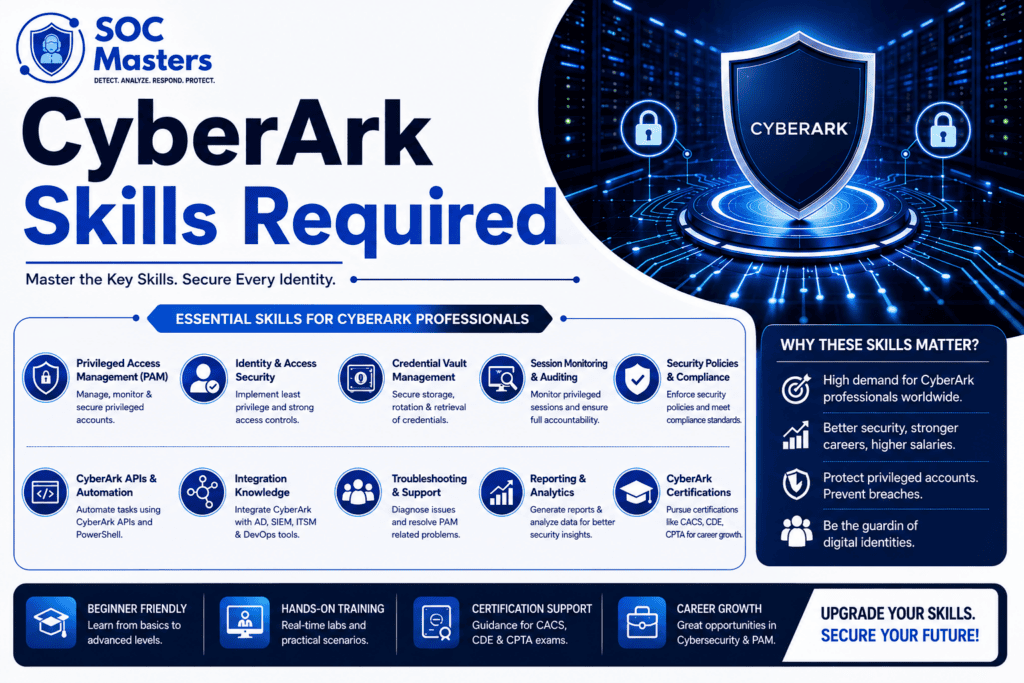
CyberArk skills required include cybersecurity fundamentals, networking, Windows/Linux administration, and Active Directory basics, followed by hands-on knowledge of the Digital Vault, CPM, PSM, and PVWA components. Intermediate professionals add safe management, account onboarding, and access policy configuration, while advanced roles require enterprise architecture, REST API automation, and SIEM integration skills for real-world PAM deployments.
Table of Contents
Introduction
CyberArk is one of the most widely deployed Privileged Access Management (PAM) platforms used by enterprises to secure administrator accounts, service credentials, and sensitive systems. CyberArk professionals are the people who configure, monitor, and troubleshoot this layer of identity security — vaulting privileged credentials, managing session recording, and enforcing least-privilege access across an organization.
Privileged accounts are the accounts attackers want most, because a single compromised admin credential can expose an entire network. That is why Privileged Access Management has become a core discipline inside every mature cybersecurity program, and why the CyberArk skills required to work in this space are in steady demand across IT services, banking, healthcare, and enterprise security teams in India.
This growing demand is a major reason professionals are actively searching for CyberArk Training in Hyderabad — the city’s large IT and GCC (Global Capability Center) base means PAM, IAM, and identity security roles are opening up consistently. But before enrolling in any program, it helps to understand exactly which technical and soft skills separate a job-ready CyberArk professional from someone who has only watched a few videos. The right combination of fundamentals, hands-on PAM component knowledge, and scripting ability is what actually improves interview outcomes and long-term career growth — which is also why exploring a structured CyberArk PAM training program in Hyderabad is worth doing early, not after you’re already stuck.
This guide walks through the complete CyberArk skills required at every stage — beginner, intermediate, and advanced — and explains what a well-structured CyberArk Training in Hyderabad program should include to build those skills properly.
What is CyberArk?
CyberArk is a Privileged Access Management platform designed to discover, secure, rotate, and monitor privileged accounts — the admin-level and service accounts that have elevated access to servers, databases, network devices, and applications.
At its core, CyberArk addresses four connected problems in enterprise security:
- Privileged Access Management — controlling who can use high-level accounts and when
- Identity Security — verifying that the person or process using a credential is who they claim to be
- Privileged Account Protection — vaulting credentials so they are never exposed in plain text
- Credential Security — automatically rotating passwords and secrets on a defined schedule
In 2026, CyberArk operates as part of Palo Alto Networks following the completed acquisition, and the platform is being progressively rebranded as Idira. The underlying architecture — Vault, Central Policy Manager (CPM), Privileged Session Manager (PSM), and Password Vault Web Access (PVWA) — and the engineering skill set required to work with it remain unchanged, along with the Defender, Sentry, and Guardian certification names.
Why CyberArk Skills Are in Demand
Privileged and identity-based attacks are now a leading cause of enterprise breaches. When attackers compromise even one privileged credential, they can move laterally across a network with minimal resistance — which is exactly what PAM controls are built to prevent.
Several factors are driving demand for CyberArk skills right now:
- Rising privileged account attacks targeting admin, service, and application credentials
- Identity-based attack techniques that bypass traditional perimeter defenses
- Stricter enterprise security requirements from regulators, auditors, and cyber-insurance providers
- Cloud adoption, which multiplies the number of privileged accounts across SaaS, IaaS, and hybrid environments
- Broader identity security transformation, as organizations extend PAM principles to machine identities and automated workloads
Because PAM sits at the intersection of security operations, IAM, and infrastructure administration, professionals who build genuine CyberArk skills required for real deployments — not just theoretical knowledge — tend to have more career flexibility than single-tool specialists.
CyberArk Skills Required to Build a Career
A strong CyberArk profile combines platform-specific knowledge with IT fundamentals. At a high level, the CyberArk skills required to build a career include:
- CyberArk PAM fundamentals and privileged account management concepts
- Working knowledge of the CyberArk Vault, CPM, PSM, and PVWA
- CyberArk authentication and access control concepts
- Core identity security and cybersecurity fundamentals
- Linux and Windows administration basics
- Networking fundamentals
- SQL basics for querying logs and reports
- Scripting with PowerShell and basic Python
- REST API familiarity for automation and integrations
- Troubleshooting and security monitoring skills
No single skill on this list is optional forever — but the order in which you learn them matters, which is why the next section breaks them into beginner, intermediate, and advanced levels.
Technical CyberArk Skills Required
Beginner CyberArk Skills
At the beginner stage, focus on the fundamentals that make PAM concepts make sense later:
Cybersecurity fundamentals (threats, controls, risk basics)
Networking basics (IP addressing, ports, protocols)
Windows administration basics
Linux basics (file system, permissions, commands)
Active Directory fundamentals (users, groups, OUs)
Authentication and authorization concepts
Basic scripting logic
Intermediate CyberArk Skills
Once the fundamentals are solid, intermediate learners should get hands-on with the core CyberArk components:
CyberArk Vault structure and safe design
Central Policy Manager (CPM) configuration
Privileged Session Manager (PSM) setup and session recording
Password Vault Web Access (PVWA) navigation and workflows
Safe management and permissions
Account onboarding and discovery
Password and secret management policies
Access policy configuration
Session monitoring and management
Advanced CyberArk Skills
Advanced professionals move into architecture, resilience, and automation:
CyberArk enterprise architecture design
High availability and clustering
Disaster recovery planning and failover testing
Advanced troubleshooting across components
REST API integration for automation
Scripted account onboarding and reporting
Enterprise-scale PAM implementation
SIEM integration for privileged activity monitoring
Cloud identity security concepts
CyberArk Tools and Components You Should Learn
Component | Purpose | Skill Level | Real-World Usage |
Digital Vault | Encrypted storage for privileged credentials | Beginner–Intermediate | Core repository every safe and account depends on |
Central Policy Manager (CPM) | Automates password rotation and policy enforcement | Intermediate | Keeps credentials compliant without manual resets |
Privileged Session Manager (PSM) | Isolates and records privileged sessions | Intermediate | Used during audits and incident investigations |
Password Vault Web Access (PVWA) | Web interface for requesting and managing access | Beginner–Intermediate | Daily interface for admins and end users |
Central Credential Provider (CCP) | Serves credentials to applications programmatically | Advanced | Removes hardcoded passwords from scripts and apps |
Application Identity Manager (AAM) | Secures application-to-application credentials | Advanced | Protects secrets in DevOps pipelines and services |
REST APIs | Programmatic access to CyberArk functions | Advanced | Automation, integrations, and custom reporting |
Cybersecurity Fundamentals Needed Before CyberArk Training
CyberArk concepts click faster when foundational security ideas are already familiar. Before diving into PAM-specific training, it helps to understand:
- The CIA Triad (Confidentiality, Integrity, Availability)
- Authentication vs authorization
- Least privilege as an operating principle
- Zero Trust concepts, where no user or device is trusted by default — formalized in <a href=”https://www.nist.gov/publications/zero-trust-architecture” target=”_blank” rel=”noopener”>NIST’s Zero Trust Architecture (SP 800-207)</a>
- What makes an account “privileged” versus a standard user account
- Access control models used in enterprise environments
- Credential management best practices
- Basic security monitoring and log review
Programming and Scripting Skills for CyberArk Professionals
Advanced programming is not mandatory to start a CyberArk career, but scripting and automation knowledge noticeably improves the roles you can qualify for. Useful skills include:
- PowerShell for Windows-side automation and CyberArk PSM/PVWA scripting
- Python for report generation and REST API scripting
- REST API concepts for integrating CyberArk with ticketing and SIEM tools
- JSON for reading and constructing API payloads
- General automation concepts (scheduling, error handling, logging)
- Basic scripting logic (loops, conditionals, variables)
Beginners can start without deep coding experience, but anyone aiming for engineer-level or automation-heavy roles should plan to build this skill set over time.
Networking Skills Required for CyberArk
Because PAM controls sit between users, applications, and network resources, networking fluency matters. Core areas include:
- TCP/IP fundamentals
- DNS resolution and troubleshooting
- Common ports and protocols used by CyberArk components
- Firewalls and how they affect PSM/PVWA connectivity
- Proxies and their role in session routing
- HTTP/HTTPS basics for PVWA and API traffic
- General network troubleshooting methodology
Windows and Linux Skills Required for CyberArk
Windows skills that support CyberArk administration include Active Directory management, Windows services, user and group administration, group policy basics, and PowerShell scripting.
Linux skills that matter equally include user and group management, file permissions, SSH access and key management, service management, and comfort with the command line — since many CyberArk components and target servers run on Linux.
Soft Skills Required for CyberArk Professionals
Technical depth alone doesn’t make someone effective in a PAM role. Employers consistently value:
- Problem-solving under time pressure
- Analytical thinking during incident investigation
- Clear communication with both technical and non-technical stakeholders
- Documentation discipline (runbooks, change records, safe designs)
- Structured troubleshooting habits
- Incident handling composure
- Team collaboration across security, IT ops, and application owners
- A continuous-learning mindset, since PAM platforms evolve constantly
CyberArk Skills Required for Freshers
Freshers benefit from following a sequence rather than jumping straight into PAM tools:
- Cybersecurity fundamentals
- Networking basics
- Windows and Linux fundamentals
- Identity and Access Management (IAM) concepts
- CyberArk fundamentals and terminology
- Core PAM components (Vault, CPM, PSM, PVWA)
- Hands-on labs with realistic scenarios
- Real-time projects that mirror enterprise onboarding and troubleshooting tasks
Skipping steps 1–4 is one of the most common reasons freshers struggle in interviews, because they can operate a screen but cannot explain why a control exists.
CyberArk Skills Required for Experienced IT Professionals
Professionals already working in adjacent IT roles often transition into CyberArk faster than expected, because much of their existing knowledge transfers directly:
- System Administrators already understand Windows/Linux internals and account management
- Network Administrators bring strong networking and troubleshooting instincts
- Cybersecurity professionals already understand threat models and access control
- IAM specialists understand identity lifecycle concepts that map closely to PAM
- DevOps engineers bring scripting and automation skills valuable for CCP/AAM work
- Cloud engineers understand the identity sprawl that CyberArk is often deployed to control
- IT support professionals bring troubleshooting discipline and ticketing-system familiarity
For all of these backgrounds, the gap to close is usually CyberArk-specific component knowledge and hands-on safe/policy configuration — not the underlying IT fundamentals.
CyberArk Training in Hyderabad: What Should You Learn?
Given the CyberArk skills required outlined above, a genuinely useful CyberArk Training in Hyderabad program should go well beyond slide-based theory. Look for a curriculum that includes:
- An updated curriculum reflecting current CyberArk/Idira component names and certification tracks
- Solid coverage of CyberArk PAM fundamentals before tool-specific training begins
- Hands-on labs on Vault, CPM, PSM, and PVWA — not just demonstrations
- Real-time scenarios such as account onboarding, safe design, and policy troubleshooting
- Exposure to enterprise architecture concepts, not just single-server setups
- Structured troubleshooting practice across common failure scenarios
- An introduction to automation using REST APIs and scripting
- Interview preparation aligned to real CyberArk administrator and engineer roles
- Practical, portfolio-worthy projects
- Honest career guidance based on your existing IT background
A program built around this structure builds the actual CyberArk skills required for day-one job readiness, rather than just certification-exam recall.
CyberArk Career Opportunities After Learning These Skills
Once these skills are in place, several role paths open up, including:
- CyberArk Administrator
- PAM Administrator
- CyberArk Engineer
- PAM Engineer
- Identity Security Engineer
- Cybersecurity Engineer
- IAM Engineer
- Privileged Access Management Consultant
You can explore how these roles differ in day-to-day responsibility in this breakdown of CyberArk job roles and responsibilities, and see how demand for these positions is evolving in our overview of CyberArk career opportunities in India.
CyberArk Skills and Salary Growth
Compensation in CyberArk and PAM roles tends to track technical depth rather than job title alone. Factors that typically influence salary growth include:
- Years of hands-on PAM experience
- Depth of CyberArk component expertise (beyond just PVWA navigation)
- Understanding of enterprise PAM architecture
- Automation and REST API scripting ability
- Cloud identity security knowledge
- Relevant certifications, combined with real project experience
- Exposure to large, complex enterprise implementations
There are no guaranteed salary outcomes tied to any single course or certification — actual figures vary by company, location, and experience. For current market-rate estimates and how they break down by experience level, see our detailed guide to CyberArk salary in India.
CyberArk Certification and Career Growth
CyberArk (Idira) certifications — Defender, Sentry, and Guardian — validate specific competencies: Defender for day-to-day operations, Sentry for deployment and configuration, and Guardian for advanced architecture-level PAM strategy. As of November 2025, these exams are administered exclusively at in-person <a href=”https://www.pearsonvue.com/us/en/cyberark.html” target=”_blank” rel=”noopener”>Pearson VUE testing centers</a>, with online proctoring granted only for qualifying accessibility exceptions.
Certification carries more weight when paired with:
- Hands-on practice in a lab environment
- Real safe design and account onboarding exercises
- Exposure to real-world enterprise scenarios
- Active troubleshooting experience
- A solid grounding in security fundamentals
A certificate alone rarely convinces a hiring panel — the ability to explain how you configured a safe or resolved a CPM failure does. For a level-by-level breakdown of what each exam covers, see our CyberArk certification roadmap.
CyberArk Skills Roadmap
Level | Skills | Tools/Technologies | Career Outcome |
Beginner | Cybersecurity basics, networking, Windows/Linux, AD fundamentals | OS command line, AD console, basic scripting | Foundation for PAM/IAM entry roles |
Intermediate | Vault, CPM, PSM, PVWA, safe management, account onboarding | CyberArk core components, PVWA console | CyberArk Administrator, PAM Support Engineer |
Advanced | Architecture, HA/DR, REST API automation, SIEM integration | REST APIs, scripting (PowerShell/Python), SIEM tools | CyberArk Engineer, PAM Engineer |
Expert | Enterprise PAM strategy, cloud identity security, consulting-level design | Multi-vault architecture, cloud IAM, automation frameworks | PAM Consultant, Identity Security Architect |
CyberArk Skills Checklist
Technical Skills
- Understand CyberArk PAM architecture end-to-end
- Comfortable navigating PVWA, PSM, CPM
Cybersecurity Skills
- Can explain CIA Triad, least privilege, and Zero Trust
- Understand privileged account attack patterns
Networking Skills
- Comfortable with TCP/IP, DNS, ports, firewalls
- Can troubleshoot connectivity issues affecting PSM/PVWA
OS Skills
- Windows administration and Active Directory basics
- Linux users, permissions, and SSH
Scripting Skills
- Basic PowerShell scripting
- Basic Python and REST API familiarity
CyberArk Skills
- Safe design and account onboarding
- Password policy and rotation configuration
- Troubleshooting common CPM/PSM failures
Soft Skills
- Documentation and change-record discipline
- Clear incident communication
Common Mistakes Beginners Make While Learning CyberArk
- Learning only theory without touching a real console
- Ignoring cybersecurity fundamentals before jumping into PAM tools
- Skipping networking basics, then struggling with connectivity troubleshooting
- Avoiding Linux because Windows feels more familiar
- Not practicing realistic PAM scenarios (only following guided demos)
- Focusing entirely on certification prep instead of hands-on skill
- Ignoring troubleshooting practice until it’s tested in an interview
- Not learning automation, which limits growth into engineer-level roles
Key Takeaways
- CyberArk skills required span IT fundamentals (networking, Windows/Linux, AD) through PAM-specific tools (Vault, CPM, PSM, PVWA)
- Scripting and REST API knowledge, while not mandatory for beginners, significantly expand career options
- Certifications (Defender, Sentry, Guardian) matter most when paired with real hands-on lab experience
- Freshers and experienced IT professionals both have viable paths into CyberArk careers, starting from different points
- A quality CyberArk Training in Hyderabad program should combine updated curriculum, hands-on labs, and real-world troubleshooting practice
Conclusion
Building genuine CyberArk skills required for real PAM roles takes more than memorizing screens — it means combining cybersecurity fundamentals, networking, OS administration, and hands-on component knowledge with steady, practical repetition. Whether you’re a fresher starting from scratch or an experienced IT professional transitioning into identity security, the skill sequence outlined here gives you a realistic map to follow.
If you’d like structured, hands-on guidance through this path, it’s worth exploring a well-rounded CyberArk Training in Hyderabad program that pairs updated PAM curriculum with real troubleshooting practice and honest career guidance — rather than choosing based on marketing claims alone. You can also check out SOC Masters’ training programs directly to see how the curriculum, fees, and centre details are laid out before deciding.
Frequently Asked Questions
1. What skills are required for CyberArk?
CyberArk skills required include networking, Windows/Linux administration, cybersecurity fundamentals, and hands-on knowledge of the Vault, CPM, PSM, and PVWA components, along with basic scripting for automation.
2. Is CyberArk difficult to learn?
CyberArk’s interface is approachable, but understanding why each control exists — safe design, policy logic, session isolation — takes structured practice rather than passive viewing.
3. Is coding required for CyberArk?
Basic coding is not required to start, but PowerShell, Python, and REST API skills significantly expand the roles available to you as you progress.
4. Is CyberArk good for freshers?
Yes, freshers can build a CyberArk career by first learning IT and security fundamentals, then progressing into PAM components through hands-on labs and real-time projects.
5. What should I learn before CyberArk?
Before CyberArk-specific training, build a foundation in networking, Windows/Linux, Active Directory, and core cybersecurity concepts like authentication and least privilege.
6. Is CyberArk a good career in 2026?
Demand for PAM and identity security skills remains strong in 2026, driven by rising privileged-account attacks and continued cloud and identity security investment across enterprises.
7. What does a CyberArk Administrator do?
A CyberArk Administrator manages safes, onboards accounts, configures password policies, monitors sessions, and troubleshoots issues across the Vault, CPM, PSM, and PVWA components.
8. Which CyberArk components should beginners learn?
Beginners should start with the Digital Vault, PVWA, and basic CPM concepts before moving into PSM session management and advanced components like CCP and AAM.
9. How long does it take to learn CyberArk?
Timelines vary by background, but someone with solid IT fundamentals can typically reach job-ready CyberArk administrator skills through consistent, hands-on training over a few months.
10. Is CyberArk certification necessary?
Certification is not strictly mandatory, but Defender, Sentry, and Guardian credentials — combined with real hands-on experience — strengthen a candidate’s profile for PAM roles.
11. What is the role of CyberArk in PAM?
CyberArk provides the core technology for vaulting, rotating, and monitoring privileged credentials, making it one of the most widely deployed platforms in enterprise Privileged Access Management.
12. Where can I learn CyberArk in Hyderabad?
Hyderabad has a growing number of cybersecurity and PAM training options; prioritize programs that combine updated curriculum with hands-on labs over ones offering theory-only sessions.