CyberArk Career Opportunities in India
CyberArk career opportunities in India span roles like CyberArk Administrator, Engineer, Consultant, and Architect, driven by rising Privileged Access Management (PAM) demand, cloud adoption, and Zero Trust adoption. Salaries scale from entry-level to architect-level with experience and certification. Structured CyberArk Training in Hyderabad helps beginners build the hands-on PAM skills employers actually test for.
Table of Contents
Introduction
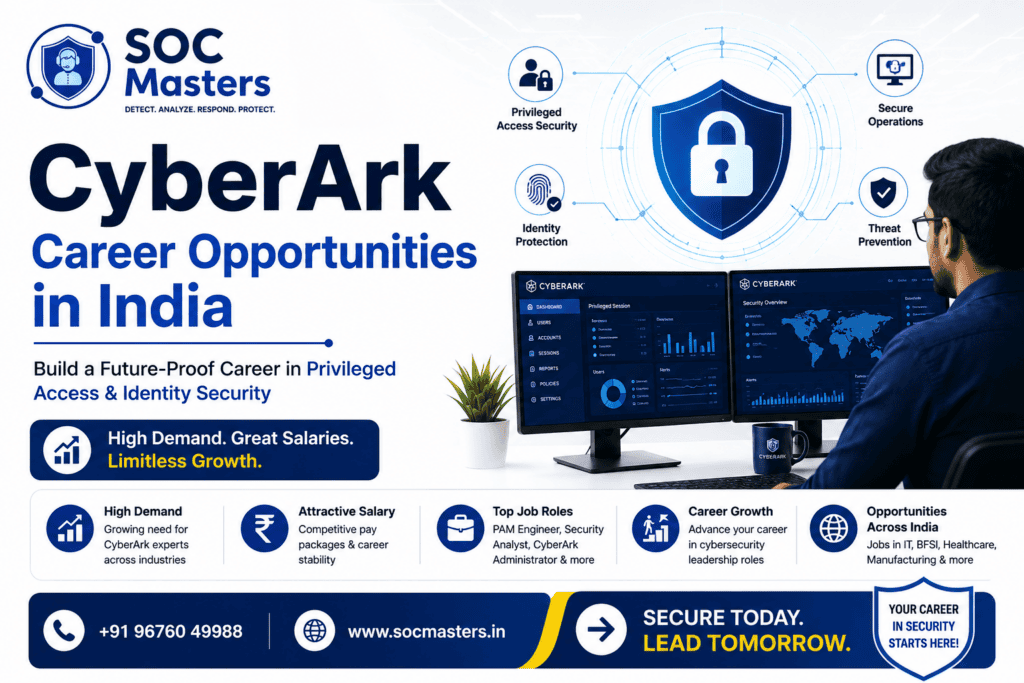
CyberArk is the platform enterprises rely on to protect their most sensitive accounts — the privileged credentials that, if compromised, give attackers the keys to an entire network. CyberArk professionals manage, monitor, and secure these accounts every day, which is why Privileged Access Management (PAM) has become one of the most closely watched disciplines inside enterprise cybersecurity teams.
As breaches increasingly trace back to compromised privileged credentials rather than perimeter failures, organizations across banking, IT services, healthcare, and global capability centers are building dedicated PAM teams. That shift is fueling CyberArk career opportunities in India at a pace few other identity security niches can match. Fresh graduates, system administrators, and IAM professionals are all finding a genuine entry point into cybersecurity through PAM — but only if they understand what the role actually demands. For beginners who want a structured path into this field, a CyberArk Training in Hyderabad program is one practical way to build the hands-on vault, credential, and access-control skills that hiring managers screen for in interviews.
This article walks through what CyberArk professionals do, why demand is rising in India, the specific career paths and salary ranges available, the skills and components you need to learn, and a realistic roadmap to get started.
What Is CyberArk?
CyberArk is an identity security platform built around Privileged Access Management — the discipline of controlling, monitoring, and securing accounts that have elevated access to systems, applications, and data. These are the accounts an attacker wants most: domain administrators, database service accounts, root logins, and application credentials that can move laterally across a network once compromised.
At its core, CyberArk provides:
- Credential protection — storing and rotating privileged passwords and SSH keys so they are never exposed in plaintext
- Privileged account security — isolating and recording sessions where administrators access sensitive systems
- Identity security — extending access governance beyond humans to service accounts, applications, and cloud workloads
For enterprise cybersecurity teams, CyberArk sits alongside broader Identity and Access Management (IAM) tooling but focuses specifically on the smaller, higher-risk population of privileged accounts — which is exactly why specialists in this space are valued differently from general IAM staff.
What Does a CyberArk Professional Do?
Day to day, a CyberArk professional’s work centers on keeping privileged access both usable and controlled. Typical responsibilities include:
- Privileged account management — onboarding accounts into the vault and defining ownership
- Vault management — maintaining the Digital Vault’s health, backups, and access policies
- Credential management and password rotation — ensuring credentials rotate on schedule without breaking dependent applications
- Access control and policy configuration — defining who can check out which credentials, for how long, and under what approval workflow
- Monitoring and auditing — reviewing session recordings and access logs for anomalies
- Security incident support — assisting investigations when privileged accounts are suspected of misuse
None of this is purely theoretical. A CyberArk administrator who can’t troubleshoot a failed password rotation against a legacy application, or explain why a session was blocked by policy, will struggle in a live enterprise environment — which is why hands-on practice matters more than memorized definitions in this field.
Why CyberArk Career Opportunities in India Are Growing
Several forces are converging to push PAM hiring upward in India:
- Rising privileged account attacks. Credential theft and lateral movement through privileged accounts remain among the most common paths attackers use once inside a network, making PAM a frontline control rather than a background one.
- Zero Trust adoption. As organizations move toward Zero Trust architectures, “never trust, always verify” applies most urgently to privileged accounts — pushing PAM tooling from optional to foundational.
- Cloud adoption. Enterprises running hybrid and multi-cloud environments now need to extend privileged access controls to cloud consoles, DevOps pipelines, and secrets used by automation — expanding the scope of PAM work well beyond on-premises servers.
- Regulatory and compliance pressure. Frameworks that require demonstrable control over privileged access — audit trails, access reviews, segregation of duties — make PAM implementation a compliance necessity, not just a security preference.
- Enterprise identity security requirements. As identity becomes the new security perimeter, enterprises are investing in dedicated PAM and identity security headcount rather than folding it into general IT administration.
Together, these factors mean CyberArk jobs in India are shifting from a niche specialization to a standard line item in enterprise cybersecurity budgets.
CyberArk Career Opportunities in India
CyberArk career opportunities in India span a range of roles, from hands-on administration to architecture-level design work:
- CyberArk Administrator — day-to-day vault and policy administration, account onboarding, password rotation troubleshooting
- CyberArk Engineer — implementation, configuration, and integration of CyberArk components across enterprise environments
- PAM Engineer — broader privileged access management work that may span multiple PAM tools, not CyberArk alone
- CyberArk Consultant — client-facing implementation and advisory work, often across multiple enterprise deployments
- IAM Engineer — identity and access management work where CyberArk is one component of a wider IAM stack
- Privileged Access Management Analyst — monitoring, reporting, and access-review-focused roles
- Cybersecurity Engineer — broader security engineering roles where PAM is one of several responsibilities
- Identity Security Specialist — roles focused on identity governance and privileged access policy design
- CyberArk Architect — designing enterprise-wide PAM architecture, integration strategy, and scaling plans
Each of these roles draws on the same foundational CyberArk skill set, but the seniority, client exposure, and architectural responsibility differ significantly. For a deeper, day-to-day breakdown of what each of these roles actually involves, see our guide to CyberArk Job Roles and Responsibilities.
CyberArk Jobs in Hyderabad
Hyderabad has grown into one of India’s major IT services and cybersecurity hubs, home to a dense concentration of MNC delivery centers, IT services companies, and Global Capability Centers (GCCs) that run security operations, cloud infrastructure, and identity programs for global clients. <cite index=”0-2″>Nasscom’s GCC Landscape Report noted 43 new GCCs committed to Hyderabad in the first half of 2026 alone</cite>, reflecting the city’s continued pull for enterprise technology and security teams.
That kind of GCC and IT-services density typically translates into steady demand for cloud security, IAM, and PAM implementation work — the categories CyberArk roles fall under. We won’t name specific employers currently hiring, since that changes constantly, but the underlying pattern is consistent: cybersecurity teams supporting cloud migrations, compliance programs, and identity consolidation projects are a recurring feature of Hyderabad’s IT and GCC ecosystem, and PAM skills are relevant across all three.
Skills Required for a CyberArk Career
A strong CyberArk foundation rests on cybersecurity fundamentals plus a set of adjacent technical skills:
- Cybersecurity fundamentals — understanding threats, attack paths, and why privileged accounts are targeted
- IAM and PAM concepts — the difference between general access management and privileged access controls
- Active Directory — since most enterprise privileged accounts are AD-integrated
- Windows and Linux fundamentals — the operating systems where privileged accounts actually live
- Networking basics — understanding how sessions, ports, and protocols factor into access policies
- Authentication and authorization — the mechanics behind how access is granted and verified
- Scripting fundamentals — useful for automation, custom connectors, and troubleshooting
- Cloud security concepts — extending PAM principles to cloud consoles and secrets management
- Troubleshooting and security monitoring — the day-to-day reality of keeping a PAM environment running
Employers consistently test for the combination of these fundamentals plus CyberArk-specific tool knowledge, not tool knowledge alone.
CyberArk Tools and Components You Should Learn
CyberArk’s platform is made up of distinct components, each solving a specific part of the privileged access problem:
Component | What It Does |
Digital Vault | The secure, encrypted repository where privileged credentials are stored |
PVWA (Password Vault Web Access) | The web interface administrators and end users use to request, check out, and manage credentials |
CPM (Central Policy Manager) | Automates password and credential rotation according to defined policies |
PSM (Privileged Session Manager) | Isolates and records privileged sessions so activity can be monitored and audited |
PTA (Privileged Threat Analytics) | Analyzes privileged session behavior to flag anomalies and potential misuse |
Conjur | Manages secrets for applications, containers, and DevOps pipelines |
CyberArk Identity | Extends identity and access management to SSO and workforce identity scenarios |
Understanding how these components interact — not just what each one is called — is what separates candidates who can pass an interview from those who can actually operate a production PAM environment. It’s also worth noting that CyberArk’s parent company completed its acquisition by Palo Alto Networks in February 2026, with the platform rebranded to Idira in May 2026 — a detail that matters for anyone reading older training material that still references the pre-acquisition branding.
CyberArk Career Path in India
Most CyberArk careers follow a recognizable progression, though the pace varies by individual and employer:
Stage | Typical Focus |
Beginner | Learning IAM/PAM fundamentals, Active Directory, and core CyberArk components through labs |
CyberArk Administrator | Day-to-day vault operations, account onboarding, password rotation support |
CyberArk Engineer | Implementation, configuration, and integration across enterprise environments |
Senior PAM Engineer | Leading complex implementations, mentoring junior engineers, handling escalations |
CyberArk Consultant | Client-facing advisory across multiple deployments, solution design input |
PAM Architect / Identity Security Architect | Enterprise-wide architecture, integration strategy, and long-term identity security roadmap |
Movement between stages typically depends on hands-on project exposure and depth of troubleshooting experience — not certification alone.
CyberArk Salary in India
CyberArk salaries in India vary meaningfully by experience, role, and employer type. The ranges below are directional estimates drawn from current job postings and industry salary trackers — not a guarantee of what any specific employer will offer.
Experience Level | Typical Experience | Salary Range (Annual) | Typical Job Role |
Fresher / Entry Level | 0–1 Years | ₹3–6 LPA | CyberArk Trainee / Junior Administrator |
1–3 Years | 1–3 Years | ₹6–10 LPA | CyberArk Administrator |
3–5 Years | 3–5 Years | ₹10–16 LPA | CyberArk Engineer |
5–8 Years | 5–8 Years | ₹16–25 LPA | Senior CyberArk Engineer / Consultant |
8+ Years | 8+ Years | ₹25–40+ LPA | PAM Architect / Identity Security Architect |
Salary always varies by:
- Experience and depth of hands-on project exposure
- Location (metro vs. tier-2 cities)
- Specific skills (multi-component implementation, cloud PAM, scripting)
- Certifications held
- Employer type (product company, IT services, GCC, consulting)
- Project complexity and client scale
One important caution: several publicly cited “CyberArk salary” figures online actually reflect what CyberArk-the-software-company pays its own software engineers — not what enterprises pay administrators and engineers who implement and operate CyberArk. These are two different labor markets, and conflating them inflates expectations. The ranges above are specific to practitioners who deploy and manage CyberArk inside client organizations. For a fuller, experience-wise breakdown, see our dedicated CyberArk Salary in India guide.
Within Hyderabad specifically, CyberArk salary outcomes are shaped by the same factors that apply nationally, with a few local nuances:
- Experience remains the single biggest driver of salary progression
- CyberArk implementation skills — hands-on vault, PVWA, CPM, and PSM configuration experience — command a premium over theoretical knowledge
- PAM and IAM expertise across multiple tools (not CyberArk alone) broadens the roles a candidate qualifies for
- Cloud security skills are increasingly expected as Hyderabad’s GCCs run hybrid and multi-cloud environments
- Certifications support salary negotiation but work best paired with demonstrable project exposure
- Enterprise project exposure, particularly on GCC or MNC delivery teams, tends to translate into faster progression than pure training-only backgrounds
Given Hyderabad’s density of GCCs and IT services delivery centers, candidates who combine core CyberArk skills with cloud security exposure are typically better positioned than those with CyberArk knowledge alone.
CyberArk Certification and Career Growth
CyberArk certifications — currently structured around the Defender, Sentry, and Guardian levels — validate specific skill tiers, from day-to-day operations through advanced deployment and design work. As of November 2025, CyberArk certification exams are administered exclusively in person through Pearson VUE testing centers, which is a meaningful shift from the earlier remote-proctoring option and something candidates should plan for well ahead of their exam date.
Certification carries real value, but it works best as one part of a broader preparation strategy:
- Certification value — signals baseline knowledge to recruiters and hiring managers
- Practical experience — the depth that actually gets tested in technical interviews
- Project exposure — real deployments, troubleshooting incidents, and policy design decisions
- Interview preparation — being able to explain “why,” not just “what”
- Continuous learning — PAM tooling and best practices evolve, and staying current matters
Certification alone does not guarantee employment; it’s most effective when paired with hands-on lab practice and project-level understanding. For a level-by-level breakdown of Defender, Sentry, and Guardian, see our CyberArk Certification Roadmap.
Why CyberArk Training in Hyderabad Can Help Beginners
For someone starting from IAM fundamentals or general IT administration, structured CyberArk Training in Hyderabad can compress the learning curve considerably — provided the training actually covers the right ground. You can review the CyberArk Course Syllabus to see exactly what’s covered module by module. Good training should provide:
- A structured curriculum that builds from IAM/PAM fundamentals up to CyberArk-specific components
- Hands-on labs covering vault setup, PVWA, CPM, and PSM configuration
- Real-world scenarios that mirror actual enterprise troubleshooting situations
- Coverage of core CyberArk components, not just a surface-level product tour
- Dedicated troubleshooting practice, since this is where interviews and real jobs diverge from theory
- Interview preparation grounded in real scenario questions
- Project exposure that gives candidates something concrete to discuss with interviewers
- Certification guidance for candidates who want to pursue Defender, Sentry, or Guardian credentials
None of this replaces sustained personal practice, but it gives beginners a faster, more structured path than self-study alone — without any placement guarantees attached.
What Should You Look for in CyberArk Training in Hyderabad?
Not all CyberArk training programs are built the same way. Before enrolling, it’s worth checking for:
- Trainer experience with real enterprise CyberArk deployments, not just product familiarity
- Updated syllabus that reflects current CyberArk components and certification structure
- Practical labs rather than slide-based walkthroughs
- Vault implementation practice covering onboarding, policy configuration, and rotation
- PVWA, CPM, and PSM training as dedicated modules, not a single combined overview
- Real-time scenarios that mirror actual troubleshooting and incident situations
- Interview preparation built around scenario-based questions
- Certification support for candidates pursuing Defender, Sentry, or Guardian
- Ongoing learning support after the core training ends
CyberArk Career Opportunities vs Other Cybersecurity Careers
CyberArk and PAM roles sit alongside several adjacent cybersecurity career paths. Here’s how they compare:
Role | Core Skills | Main Technologies | Career Growth | Typical Responsibilities |
CyberArk Engineer | PAM concepts, vault administration, credential lifecycle management | CyberArk Vault, PVWA, CPM, PSM, Conjur | Administrator → Engineer → Consultant → Architect | Implementing and maintaining privileged account security |
IAM Engineer | Identity governance, SSO, directory integration | Okta, Azure AD, SailPoint, CyberArk Identity | Analyst → Engineer → Architect | Managing broader identity lifecycle across users and applications |
SOC Analyst | Threat detection, log analysis, incident triage | SIEM platforms, EDR/XDR tools | L1 → L2 → L3 → Team Lead | Monitoring alerts and responding to active security incidents |
Cloud Security Engineer | Cloud architecture, IAM policies, workload protection | AWS/Azure/GCP security tooling, CSPM tools | Engineer → Senior Engineer → Architect | Securing cloud infrastructure, configurations, and access |
Each path overlaps with the others at the edges — a CyberArk Engineer who also understands cloud IAM, for instance, is unusually well positioned as enterprises extend PAM into cloud environments.
Future Scope of CyberArk and PAM Careers in India
Several structural trends point toward sustained demand for PAM and identity security skills:
- Zero Trust adoption continuing to push privileged access controls from optional to mandatory
- Identity security becoming the primary security perimeter as traditional network boundaries dissolve
- Cloud transformation extending PAM scope into multi-cloud and hybrid environments
- Hybrid environments requiring PAM strategies that span on-premises and cloud simultaneously
- Automation in credential rotation, onboarding, and policy enforcement reducing manual overhead but increasing demand for engineers who can build and maintain that automation
- AI-assisted security operations beginning to influence how anomalous privileged session behavior gets flagged and investigated
- Increasing enterprise security requirements driven by both threat activity and compliance pressure
None of these trends suggest PAM skills becoming less relevant — if anything, the scope of what “privileged access” covers keeps expanding.
Who Should Choose a CyberArk Career?
CyberArk and PAM roles suit a fairly wide range of backgrounds:
- Freshers with a genuine interest in cybersecurity and willingness to build IAM/AD fundamentals first
- System Administrators who already understand account management and want to specialize in security
- Network Professionals who understand infrastructure and want to move into access control
- IAM Professionals looking to specialize further into the higher-risk privileged access niche
- Cybersecurity Professionals seeking a technically deep specialization within security
- Cloud Professionals who want to extend their skills into privileged access for cloud workloads
- IT Professionals looking to transition from general IT support into a dedicated security career
Common Mistakes Beginners Make While Learning CyberArk
A few recurring mistakes slow down otherwise capable beginners:
- Learning tools without understanding PAM — memorizing component names without grasping why privileged access needs different controls than standard access
- Ignoring Active Directory — since most enterprise CyberArk deployments are deeply AD-integrated
- Avoiding hands-on labs — reading documentation is not the same as configuring a vault policy
- Memorizing interview questions — without being able to explain the reasoning behind an answer
- Ignoring troubleshooting — real jobs are mostly troubleshooting, not clean installs
- Focusing only on certification — at the expense of practical, scenario-based understanding
- Not understanding enterprise security workflows — how PAM fits into the broader security operation, not just as a standalone tool
How to Start a CyberArk Career in India
A realistic, step-by-step starting point looks like this:
- Learn cybersecurity fundamentals — threats, attack paths, and core security concepts
- Understand IAM and PAM — how privileged access differs from general access management
- Learn CyberArk architecture — how the Vault, PVWA, CPM, and PSM fit together
- Practice core CyberArk components — hands-on labs, not just documentation reading
- Build hands-on projects — simulate onboarding, rotation, and troubleshooting scenarios
- Prepare for interviews — focus on scenario-based and “why” questions, not just definitions
- Consider relevant certification — Defender, Sentry, or Guardian, based on career stage
- Apply for entry-level PAM roles — administrator or trainee-level positions to gain real project exposure
- Continue learning advanced identity security — cloud PAM, automation, and broader IAM concepts as you progress
Key Takeaways
- CyberArk career demand in India is rising, driven by Zero Trust adoption, cloud transformation, and compliance pressure around privileged access
- Required skills combine cybersecurity fundamentals, Active Directory, and hands-on CyberArk component knowledge
- Career opportunities range from Administrator to Architect, with distinct responsibilities at each stage
- Salary depends heavily on experience, certifications, employer type, and depth of hands-on project exposure
- Practical, lab-based training matters more than certification or theory alone for building real job readiness
Conclusion
CyberArk career opportunities in India are expanding because privileged access has moved from a background IT concern to a frontline security priority. The roles span from hands-on administration to enterprise architecture, and salary progression tracks closely with hands-on experience, certification, and genuine implementation exposure rather than theoretical knowledge alone. For beginners building toward this career, understanding the fundamentals — Active Directory, IAM/PAM concepts, and the core CyberArk components — matters more than any single credential.
CTA
If you’re serious about building job-ready CyberArk skills — hands-on vault configuration, real troubleshooting scenarios, and structured interview preparation — explore a CyberArk Training in Hyderabad program built around practical labs rather than slide decks alone. You can also visit the SOC Masters training programme to see the full range of cybersecurity courses on offer.
Frequently Asked Questions
1. Is CyberArk a good career in India?
Yes — PAM demand is rising as enterprises prioritize identity security, making CyberArk a genuinely growing specialization within cybersecurity in India.
2. Is CyberArk in demand in India?
Demand is rising steadily, driven by Zero Trust adoption, cloud transformation, and compliance requirements around privileged access.
3. What does a CyberArk engineer do?
A CyberArk engineer implements, configures, and maintains privileged access management components, including vault setup, credential rotation, and session monitoring.
4. What skills are required for CyberArk?
Core requirements include IAM/PAM concepts, Active Directory, Windows and Linux fundamentals, networking basics, and hands-on CyberArk component knowledge.
5. Is CyberArk suitable for freshers?
Yes, with the right foundational knowledge in IAM, Active Directory, and cybersecurity basics before diving into CyberArk-specific components.
6. What is the salary of a CyberArk engineer in India?
Salaries vary by experience and employer, typically ranging from entry-level administrator pay up to significantly higher compensation at the architect level; exact figures depend on location, skills, and certifications.
7. Is CyberArk difficult to learn?
It has a learning curve, particularly around understanding why PAM controls differ from general access management, but structured, hands-on learning makes it manageable.
8. How long does it take to learn CyberArk?
Timelines vary by prior IT background, but building working proficiency across core components typically takes a few months of consistent, hands-on practice.
9. Which certification is useful for CyberArk?
CyberArk’s Defender, Sentry, and Guardian certifications map to increasing levels of operational and architectural expertise.
10. Is CyberArk Training in Hyderabad worth it?
For beginners without direct enterprise PAM exposure, structured CyberArk Training in Hyderabad can meaningfully shorten the learning curve — provided the program includes genuine hands-on labs and real-world scenarios rather than a surface-level product overview.