
Security Operations Center Analyst Job Description
A Security Operations Center Analyst monitors an organisation's networks, endpoints and cloud systems for signs of attack. Working from a SIEM platform, the analyst triages security alerts, separates false positives from real threats, investigates suspicious logins and malware activity, escalates confirmed incidents to senior responders, and documents every finding. SOC Analysts work in shifts so monitoring continues twenty-four hours a day.
Introduction
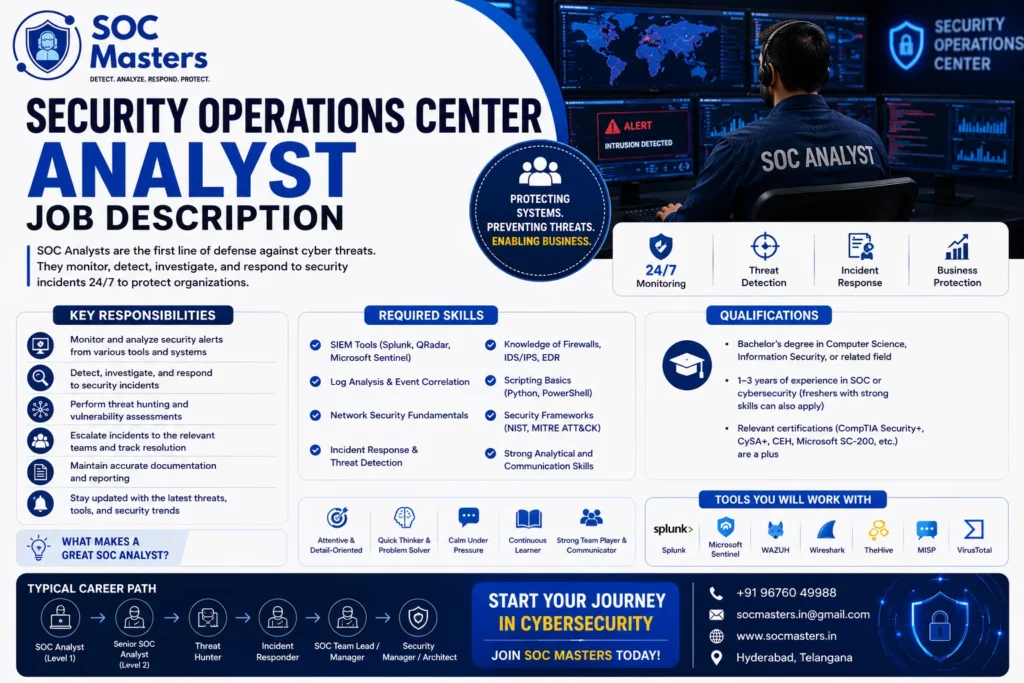
Every organisation running email, cloud apps and internet-facing servers is generating security signals right now — failed logins, blocked connections, unusual file transfers, suspicious PowerShell commands. Somebody has to decide which ones matter. That job belongs to the Security Operations Center: the team responsible for continuous monitoring, threat detection and incident response. Some SOCs sit inside a single company; others are run by Managed Security Service Providers covering dozens of clients.
A SOC Analyst watches those alerts and works out what is actually happening. If a finance user logs in from Hyderabad at 9 a.m. and from a foreign IP twenty minutes later, an alert fires. The analyst decides whether it was a VPN, a shared account or a real takeover.
The role keeps growing for regulatory reasons as much as technical ones. India's CERT-In directions require organisations to report specified cybersecurity incidents within six hours — not long if nobody is watching the console at 3 a.m.
Hyderabad matters because of where the hiring is. Nasscom's GCC Landscape Report 2026 recorded 43 new Global Capability Centres committed to the city in H1 2026 alone, and GCCs staff L1 and L2 monitoring roles locally. Add the MSSP presence, Big 4 cyber practices and banking back offices, and entry-level demand stays consistent.
Reading a job description is easy; performing the job on day one is not. Lab-based SOC Analyst Training in Hyderabad exists to close that gap. This guide covers the job description, then the skills, tools, salary bands and career path behind it.
What Is a Security Operations Center Analyst?
A Security Operations Center Analyst is a cybersecurity professional who continuously monitors an organisation's IT environment for threats, investigates the alerts security tools generate, and escalates confirmed incidents so they are contained before damage spreads.
The SOC splits into tiers. L1 handles the front of the alert queue — high volume, fast decisions, strict escalation rules. L2 takes the escalations and runs deeper investigation. L3 analysts and threat hunters look for activity that never triggered an alert. Detection engineers, threat intelligence specialists and a SOC Manager sit alongside them.
Monitoring vs incident response
Monitoring is continuous and mostly proactive: watching dashboards, tuning detection rules, reviewing telemetry. Incident response starts once something confirmed is found — time-bound, procedural, covering containment, eradication and recovery.
A SOC Analyst does both, unequally. Most of the day is monitoring and triage. Incident response participation is real but supporting: supplying evidence, timelines and scope to the responders leading the case. Adverts promising a fresher will "lead incident response" describe a role that does not exist.
Attackers do not work Indian business hours — ransomware operators deliberately detonate on Friday nights and public holidays. Hence 24×7 shift rotations, and hence shift work being a real part of this job description. Our explainer on what a Security Operations Center actually is covers SOC models in more depth.
Security Operations Center Analyst Job Description
Core purpose: detect, analyse and escalate security threats, and keep accurate records of every event handled.
Day-to-day responsibilities:
- Monitor security alerts across SIEM, EDR, email and cloud consoles during a shift
- Perform alert triage — assess severity, credibility and business impact within defined SLAs
- Investigate suspicious activity — anomalous logins, privilege changes, odd outbound traffic
- Detect incidents by correlating signals from multiple log sources, not one alert alone
- Analyse incidents — what happened, which assets are affected, whether it is ongoing
- Perform log analysis across Windows, Linux, firewall, proxy, identity and cloud logs
- Apply threat detection knowledge by mapping behaviour to known attacker techniques
- Escalate critical incidents per the escalation matrix
- Document security incidents with timelines, evidence, indicators and actions taken
- Produce security reports — shift handovers, alert and trend summaries
- Maintain monitoring coverage so no gap opens between shifts
- Support incident response with forensic evidence and log extracts
- Contribute to detection tuning by flagging noisy rules and repeat false positives
Employers typically ask for a graduate degree in any stream (CS/IT preferred, not mandatory), networking fundamentals, familiarity with one SIEM, willingness to work rotational shifts, and clear written English.
SOC Analyst Roles and Responsibilities
Two are chronically underrated: documentation makes an investigation defensible in an audit, and shift handover is where most SOC failures happen.
What Does a SOC Analyst Do on a Typical Day?
The workflow is consistent enough to use as a mental model: Monitor → Detect → Triage → Investigate → Contain/Escalate → Document → Report.
Monitor. The shift opens with a handover briefing and a dashboard health check — is every log source still reporting? A silent firewall is more dangerous than a noisy one.
Detect. Correlation rules and analytics fire — some threshold-based, others comparing activity to a learned baseline.
Triage. The analyst reads the rule logic and asks: is this technically possible, is it business-normal, what is the impact if real? Most alerts close here.
Investigate. Survivors get real work — raw logs, hashes checked against threat intelligence, the endpoint process tree, a reconstructed timeline.
Contain or escalate. L1 containment authority is limited; isolating a host may be allowed under a runbook or need L2 approval. Anything ambiguous escalates.
Document. Every step goes into the ticket while it is fresh, including what was ruled out and why.
Report. The shift closes with a handover note listing open investigations and what to watch next.
Skills Required to Become a SOC Analyst
Technical skills
- Networking fundamentals — the biggest single predictor of surviving L1
- TCP/IP — ports, protocols, the three-way handshake, reading a connection record
- DNS — resolution flow, and why DNS logs expose command-and-control and exfiltration
- HTTP/HTTPS — methods, status codes, headers, and what TLS hides
- Firewalls — rule logic and how to read firewall logs
- Windows security — Event IDs, Active Directory authentication, Kerberos, PowerShell logging
- Linux fundamentals — permissions, processes, cron, reading /var/log
- SIEM — ingestion, correlation, and writing your own search queries
- EDR — endpoint telemetry, process trees, isolation and rollback
- Threat intelligence — IOCs, reputation lookups, knowing when intel is stale
- Incident response — the phases, and where an analyst fits into each
- Log analysis — the craft underneath every other skill here
- Vulnerability management — CVEs, CVSS, and why exploitation changes priority
- MITRE ATT&CK fundamentals — mapping behaviour to documented techniques
- Security monitoring — dashboards, baselining, detection coverage
On ATT&CK: MITRE released ATT&CK v19 in April 2026, and the Enterprise matrix now carries 15 tactics, 222 techniques and 475 sub-techniques. Defense Evasion was split into Stealth (TA0005) and Defense Impairment (TA0112) — hiding from your tools versus sabotaging them. A syllabus still teaching 14 tactics has not been refreshed this year.
Soft skills
- Analytical thinking — reasoning from partial evidence to a defensible conclusion
- Problem-solving — knowing which log source answers the question in front of you
- Communication — explaining an incident to a non-technical stakeholder
- Attention to detail — one transposed character in an IP invalidates an investigation
- Decision-making — closing or escalating under pressure with incomplete information
- Documentation — writing so the next analyst can follow your reasoning at 3 a.m.
- Team collaboration — SOC work is a relay, not a solo sprint
See our guide to cybersecurity fundamentals for the SOC role.
Chat on WhatsAppSOC Analyst Tools You Should Learn
No organisation uses every tool below; most run one SIEM, one EDR and a few supporting platforms. Learn the categories, then go deep on your target employers' stack.
Three platform changes worth knowing in 2026. IBM ended support for QRadar's SaaS and cloud offering in April 2026, while the on-premises product continues separately — so a syllabus advertising "QRadar cloud" needs scrutiny. Sentinel is moving into the Defender portal, with the Azure portal retiring in March 2027. And Chronicle was rebranded Google SecOps. Our comparison of current SIEM platforms for security operations goes tool by tool.
SIEM and SOC Analyst Job Responsibilities
SIEM — Security Information and Event Management — is the platform that collects logs across the environment, normalises them, correlates them against detection rules, and raises alerts.
It matters because attacks are rarely visible in one log. A phishing click shows in email logs, payload execution in endpoint telemetry, the callback in firewall and DNS logs. Only a system holding all three connects them.
- Log collection — connectors pull events from servers, endpoints, network devices and cloud
- Normalisation — raw logs become structured fields analysts query against
- Correlation — rules and analytics evaluate events against detection logic
- Alert generation — matches produce alerts with an assigned severity
- Dashboard monitoring — analysts watch the queue and overall posture
- Investigation — analysts query the SIEM in KQL or SPL for evidence the alert omitted
- Escalation — confirmed or unclear high-severity findings move up the tiers
SIEM query skill is the practical dividing line. Anyone can click an alert; writing a query that answers "did this account authenticate anywhere else in the last 24 hours" is what gets people hired. See our breakdown of SIEM architecture and data flow covers the layers in detail.
SOC Analyst Alert Triage Process
Triage exists because alert volume always exceeds analyst capacity. The goal is not to investigate everything, but to decide quickly what deserves it.
The most common beginner mistake is closing an alert as a false positive because it looks familiar. State the evidence instead: "Closed — expected admin activity" is weak; "Closed — matches patch window, verified against change ticket CHG-4471" is defensible.
SOC Analyst Incident Response Responsibilities
- Detection — the analyst identifies and declares the incident. Fully SOC-owned.
- Investigation — establishing scope, entry point and affected assets. Shared with responders.
- Containment support — L1 may isolate a host under an approved runbook; larger containment decisions belong to the incident commander.
- Eradication support — analysts supply indicators and asset lists; removal is engineering or IR work.
- Recovery support — monitoring restored systems for reinfection.
- Post-incident documentation — timelines and evidence for the report.
The honest framing for an interview: a SOC Analyst detects, investigates and documents; a dedicated responder leads containment and eradication. Claiming otherwise as a fresher will not survive a technical panel. Our walkthrough of the SOC incident response process maps each phase end to end.
Chat on WhatsAppSOC Analyst Log Analysis and Threat Detection
Detection comes from noticing what does not fit the baseline. A service account that authenticated only from two servers for eight months, suddenly logging in interactively from a laptop, is worth investigating whether or not a rule fired. That instinct comes from studying normal traffic repeatedly — which is why lab time beats lecture time.
Enroll for Free DemoSOC Analyst Salary in Hyderabad
Pay here is driven by demonstrable skill more than years alone. The factors that move the number: the tier you can operate at; provable SIEM query ability; the platform your employer runs; certifications, which mainly clear HR filters; organisation type, since GCCs typically pay above service-based MSSPs; shift allowances; and specialisation.
Important: these are directional market estimates from public job listings and salary aggregators as of 2026 — not offers or promises. Glassdoor and Indeed report India-wide SOC Analyst averages of roughly ₹5.1–5.3 LPA, and Hyderabad packages typically sit 10–15% below equivalent Bengaluru roles. Our detailed salary breakdown for security operations roles in India covers the tier-by-tier picture.
SOC Analyst Career Path
SOC Analyst L1 → L2 → L3 → Senior SOC Analyst → SOC Lead → Security Engineer / Incident Responder / Threat Hunter
Most people move L1 to L2 in 18–30 months, faster if they build detection or automation skills alongside monitoring.
Certifications for SOC Analysts
Certifications open interview doors, but they do not close job offers — practical skill does, and no certification guarantees employment.
- CompTIA Security+ — the standard vendor-neutral entry credential; baseline literacy.
- CompTIA CySA+ — analyst-focused, covering detection, triage and response. CS0-004 launched 23 June 2026 with added AI, cloud and automation coverage; check CompTIA's page for whether CS0-003 is still bookable.
- Microsoft SC-200 (Security Operations Analyst) — aligned to Sentinel and Defender work, the dominant stack across many Hyderabad GCCs. Microsoft refreshed the SC-200 objectives twice during 2026, so older study material is partly stale.
- Splunk certifications — Core User and Power User tracks prove SPL ability.
- Google Cybersecurity Certificate — a broad beginner foundation, useful for orientation rather than as a hiring signal.
- EC-Council Certified SOC Analyst (CSA) — SOC-workflow specific: log management, SIEM use cases, triage; now on a V2 syllabus.
- CEH — widely recognised by Indian HR filters, though offensive rather than defensive in focus.
If you are combining cloud and security credentials, AZ-500 retires end of August 2026, replaced by SC-500 with no automatic conversion. Our guide to choosing certifications for security operations roles compares cost, difficulty and hiring relevance.
Why SOC Analyst Training in Hyderabad Is Important
You cannot learn triage from a slide deck. The gap between reading about a SIEM and querying one under pressure is large, and hiring panels are built to find it. Good SOC Analyst Training in Hyderabad closes that gap through practice, not promises. A serious programme gives you:
- SIEM hands-on practice on a live console with real query syntax, not screenshots
- Real-time scenarios replicating phishing, credential compromise and malware execution
- Alert investigation practice across a realistic queue, false positives included
- Log analysis exercises on Windows, Linux, firewall and cloud data
- Incident response simulations so escalation becomes muscle memory
- Threat detection labs mapped to current ATT&CK techniques
- Interview preparation covering the scenario questions panels actually ask
- Resume guidance that turns lab work into credible experience statements
- Practical projects you can walk a hiring manager through
Local relevance is genuine: Hyderabad's GCC and MSSP employers run identifiable stacks — Microsoft-centric in many GCCs, Splunk-heavy in several MSSPs. Training on what they run shortens the ramp-up, which is the model the SOC Masters course programme is built around.
Enroll for Free DemoWhat to Look for in SOC Analyst Training in Hyderabad
- Updated syllabus — ask which ATT&CK version and SIEM portal the labs use
- Experienced trainers — practitioners who have worked shifts, not only taught them
- SIEM labs — individual console access, not a shared demo screen
- Real-time scenarios built from actual attack patterns
- Hands-on projects you can describe end to end in an interview
- Incident response exercises with defined escalation paths
- Threat intelligence practice with IOC enrichment
- Mock technical interview panels
- Certification guidance aligned to current exam versions
- Placement assistance — resume support, referrals and interview scheduling, which is not the same as a guaranteed job. Be sceptical of institutes promising the latter.
Red flag: a 2026 syllabus advertising QRadar cloud training without acknowledging the April 2026 end of support.
SOC Analyst Job Opportunities in Hyderabad
- IT services companies — the largest volume of L1 openings, usually rotational shifts
- Banking — high compliance rigour, strong documentation expectations
- Financial services and fintech — fraud-adjacent monitoring alongside SOC work
- Healthcare and pharma — sensitive data under regulatory pressure
- E-commerce — high volumes, account-takeover-heavy alerts
- SaaS and product companies — cloud-native security, modern tooling
- Consulting and Big 4 — advisory roles with client exposure
- MSSPs — multi-client monitoring, steep curve, excellent early experience
- Global Capability Centres — often the best-paying entry roles, typically Microsoft-stack
Most of this sits across HITEC City, Gachibowli, Madhapur and the Financial District — openings are tracked in our roundup of security operations openings across the city.
SOC Analyst vs Cybersecurity Analyst
The practical difference: a SOC Analyst answers "is something happening right now?" A Cybersecurity Analyst answers "how exposed are we?" The titles overlap heavily in Indian job adverts, so read the responsibilities rather than the heading — our side-by-side comparison of the two roles covers the overlap.
SOC Analyst vs Security Engineer
- Responsibilities — the analyst detects and investigates; the engineer builds the controls
- Skills — investigation and log fluency versus configuration and automation
- Tools — analysts live in SIEM and EDR consoles; engineers work the layer beneath
- Experience — analyst roles are a common entry point; engineering expects two to four years first
- Career progression — many engineers start as analysts, moving across when they stop consuming detections and start writing them
Common Mistakes Beginners Make While Becoming SOC Analysts
- Learning tools before fundamentals. Splunk is easy; knowing what to ask it is not.
- Ignoring networking. Most failed technical interviews trace back to weak TCP/IP and DNS.
- Skipping Linux. Much of production infrastructure and security tooling runs on it.
- Not practising on a SIEM. Query fluency does not come from watching videos.
- Studying only theory. Definitions do not survive a scenario question.
- Avoiding hands-on labs. Free options exist; zero lab hours has no excuse.
- Ignoring log analysis. Reading raw logs is the differentiator, not tool navigation.
- Not learning incident response. Detection without response context produces weak escalations.
- Collecting certifications without skill. Four certificates and no lab work is a visible pattern.
- Underestimating documentation. Poor writing limits promotion in this field.
How to Start a SOC Analyst Career in Hyderabad
Step 1 — Networking fundamentals. TCP/IP, DNS, HTTP/HTTPS, ports, firewalls, packet flow.
Step 2 — Windows and Linux security basics. Windows Event IDs and Active Directory authentication; Linux permissions, processes and log locations.
Step 3 — Cybersecurity fundamentals. CIA triad, attack types, kill chain, defence in depth.
Step 4 — Learn a SIEM. Pick one and go deep: ingestion, correlation, writing your own queries.
Step 5 — Practise alert triage. Work a realistic queue; justify every close in writing.
Step 6 — Learn incident response. The phases, escalation matrices, what responders need.
Step 7 — Practise real scenarios. Phishing with credential harvest, malware execution, insider data movement, cloud misconfiguration.
Step 8 — Build a portfolio. A home lab with an open-source SIEM and documented cases.
Step 9 — Prepare for interviews. Practise explaining an investigation aloud, alert to closure — our interview questions for security operations roles and resume guidance for SOC candidates both help.
Step 10 — Apply. Target GCCs, MSSPs and IT services firms. Expect rotational shifts first; treat that as training.
Key Takeaways
- A SOC Analyst monitors, triages, investigates, escalates and documents security events; incident response is a supporting contribution.
- The skills that matter most are networking fundamentals, Windows and Linux basics, SIEM query fluency and log analysis.
- Tool knowledge should follow your target employers' stack — Sentinel and Defender in many GCCs, Splunk across several MSSPs.
- GCC expansion, MSSP presence and regulatory reporting pressure keep entry-level hiring active in Hyderabad.
- Lab time is decisive. Certifications open doors; investigation ability converts interviews.
Conclusion
Security Operations Center Analysts are the reason attacks get caught early rather than discovered months later in a forensic report. Every hour a compromise goes unnoticed increases its cost, and in India that clock carries a regulatory dimension.
For anyone entering cybersecurity, the SOC is the most reliable front door. The role is structured, the learning curve is steep in a useful way, and the exit paths — detection engineering, threat hunting, incident response, cloud security — are varied. Long-term growth depends on staying current: frameworks change, portals move, certification versions retire.
What separates candidates who get hired from those who keep applying is hands-on exposure. Practical, lab-driven SOC Analyst Training in Hyderabad is built for exactly that — live SIEM consoles, realistic alert queues, incident simulations and interview preparation shaped around what local employers run. It prepares learners for entry-level roles; it does not replace effort, and no honest institute will promise a job.
If you are planning your move into security operations, explore the SOC Masters training programme or message us on WhatsApp at +91 96760 49988 to discuss the right starting point for your background.
Frequently Asked Questions
1. What does a SOC Analyst do?
A SOC Analyst monitors security tools for signs of attack, triages the alerts they generate, investigates suspicious activity across logs, escalates confirmed incidents, and documents findings. The role runs in shifts so monitoring stays continuous.
2. What are the responsibilities of a SOC Analyst?
Monitoring SIEM dashboards, alert triage, investigating suspicious events, log analysis, threat detection, incident escalation, documentation, supporting incident response, and shift reporting.
3. What skills are required to become a SOC Analyst?
Networking fundamentals, Windows and Linux basics, SIEM querying, log analysis, EDR familiarity and MITRE ATT&CK awareness — plus analytical thinking, clear writing and attention to detail.
4. Is SOC Analyst a good career for freshers?
It is one of the more accessible entry points into cybersecurity: L1 roles are structured, hire in volume and teach on the job. The trade-offs are rotational shifts and repetitive work in year one.
5. What tools do SOC Analysts use?
Usually a SIEM (Microsoft Sentinel, Splunk, IBM QRadar or Elastic Security) and an EDR (CrowdStrike Falcon or Microsoft Defender), plus Wireshark, VirusTotal, threat intelligence platforms and a ticketing system like ServiceNow.
6. How much does a SOC Analyst earn in Hyderabad?
Market estimates place entry-level roles at roughly ₹3–6 LPA, mid-level at ₹6–10 LPA and senior roles at ₹10–18 LPA — directional ranges from public listings and aggregators, not guaranteed figures.
7. How can I become a SOC Analyst in Hyderabad?
Build networking and OS fundamentals, learn one SIEM properly, practise triage and log analysis in labs, certify, document projects, then apply to GCCs, MSSPs and IT services firms.
8. Is SIEM important for SOC Analysts?
Yes — it is the primary working environment. Writing your own queries, rather than reading pre-built alerts, is the clearest differentiator in interviews.
9. Which certification is best for a SOC Analyst?
There is no single best one. Security+ suits absolute beginners; CySA+ and Microsoft SC-200 map most directly to analyst work, and SC-200 matters most where Sentinel and Defender dominate.
10. How long does it take to become a SOC Analyst?
With consistent study, most beginners reach interview readiness in four to eight months: about two on fundamentals, two to three on SIEM and log analysis, the rest on scenarios and interviews.