How to Become a CyberArk Engineer
A CyberArk Engineer secures privileged accounts using Privileged Access Management. To become one, learn security fundamentals, IAM, Active Directory, Windows and Linux, then CyberArk’s Vault, PVWA, CPM, PSM and Secrets Manager, plus REST API and PowerShell automation. Certification such as Defender (PAM-DEF) validates skill. Structured CyberArk Training in Hyderabad shortens this path with live labs for beginners and working IT professionals.
Table of Contents
Introduction
Every enterprise has a handful of accounts that can do almost anything — domain admins, Linux root, database service accounts, cloud root credentials, secrets hardcoded in application code. They are exactly what attackers want. CyberArk is the platform enterprises use to lock them down: vault them, rotate them, record every session, and prove to an auditor that nobody touched production without leaving a trail.
A CyberArk Engineer designs, builds and runs that control. It pays well because the skill is narrow, operationally demanding and impossible to fake in an interview. That is why so many IT professionals in Telangana search for CyberArk Training in Hyderabad — the city’s banking back-offices, global capability centres and IT services firms all run privileged access programmes and are short of people who can administer one.
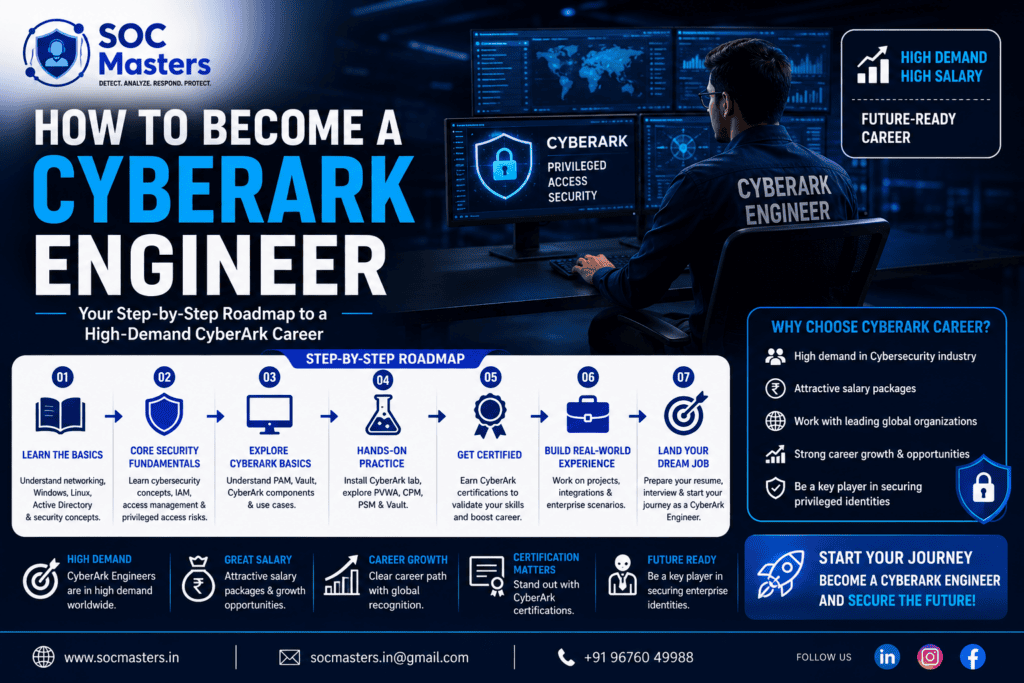
So, how do you become a CyberArk Engineer? There is no shortcut through a vault. Build security fundamentals, then identity and access management, then Privileged Access Management as a discipline, and only then CyberArk as a product. Practise until troubleshooting a broken PSM connection stops being frightening, automate the repetitive parts, then certify.
One thing worth knowing first, because much course material has not caught up: Palo Alto Networks completed its acquisition of CyberArk in February 2026 and on 12 May 2026 launched Idira, an identity security platform built on CyberArk’s technology. Existing CyberArk products continue to run and CyberArk PAM skills remain in demand, but the direction of travel has shifted.
What Is a CyberArk Engineer?
A CyberArk Engineer is an identity security specialist who implements and operates CyberArk’s Privileged Access Management platform. The job sits where security policy meets running infrastructure: you take a rule like “no human should ever know the production database password” and turn it into a working configuration of safes, platforms, policies and connectors.
Three ideas define the role. Privileged Access Management (PAM) is the practice of controlling, monitoring and auditing accounts with elevated rights — not every account, only the dangerous ones. Credential protection means passwords and keys sit in an encrypted vault, rotate automatically, and are never handed to a human in plain text if it can be avoided. Session isolation and monitoring means that when an administrator does log into a server, the connection is brokered through CyberArk, recorded, and can be terminated mid-session.
How the CyberArk Engineer differs from adjacent roles
The titles overlap in job ads, so precision helps:
- Cybersecurity Analyst (SOC Analyst) — detects and responds to threats. They consume logs; the CyberArk Engineer produces some of the most valuable ones.
- IAM Engineer — workforce identity: joiner-mover-leaver, SSO, MFA, provisioning. Scope is every employee.
- PAM Engineer — privileged identity specifically. That is the discipline; CyberArk is one product within it, alongside BeyondTrust and Delinea.
- CyberArk Engineer — a PAM Engineer with depth in the CyberArk stack: vault architecture, CPM plugins, PSM connectors, Secrets Manager.
- Security Engineer — broadest: firewalls, endpoint, cloud posture, sometimes PAM as one duty among many.
Our guide to CyberArk job roles and responsibilities maps each title to real job descriptions.
What Does a CyberArk Engineer Do?
Here is the roadmap, in the order that actually works.
Step 1: Learn Cybersecurity Fundamentals
Before CyberArk means anything, you need the vocabulary of security: the CIA triad, authentication versus authorisation, access control models, encryption at rest and in transit, hashing, certificates, and how policy becomes technical control. Our primer on cybersecurity fundamentals is a reasonable start from a non-security IT background. Skip this and every CyberArk configuration screen looks like arbitrary settings rather than enforcement of a policy.
Step 2: Learn Identity and Access Management
PAM is a subset of IAM, so IAM comes first: role-based access control, multi-factor authentication, single sign-on, federation, and the identity lifecycle. Then learn what makes a privileged identity different — it often belongs to no person, has no lifecycle, and outlives the project that created it.
Step 3: Understand Privileged Access Management as a Discipline
Learn PAM before CyberArk: why standing privilege is dangerous, what least privilege and just-in-time access mean in practice, and the account categories you will meet:
- Administrative accounts — domain admin, local admin, root
- Service accounts — non-human accounts running applications and scheduled tasks, usually with passwords nobody has changed in years
- Application accounts — credentials hardcoded in scripts, config files and CI/CD pipelines
- Break-glass accounts — rarely used, catastrophic if compromised
This grounding lets you design a PAM programme rather than click through a product.
Step 4: Learn the CyberArk Core Components
Now the product: the Digital Vault (encrypted store and hardened server), PVWA (the web interface), CPM (rotates and verifies credentials), PSM (session isolation and recording), PrivateArk (thick admin client), PTA (Privileged Threat Analytics), and secrets management for applications and DevOps.
A 2026 note: Conjur has been renamed. After the Palo Alto Networks acquisition the hosted product is Secrets Manager SaaS and the self-hosted product Secrets Manager Self-Hosted, while open-source Conjur has stopped receiving meaningful updates. Much training material still teaches “Conjur” as current — know both names, because interviewers use them interchangeably.
Step 5: Practise CyberArk Administration
Reading about safes teaches you nothing. You need an environment where you can create a safe, set its permissions, onboard a Windows domain account, attach it to a platform, force a password change, watch the CPM verify it — then break something deliberately and diagnose the failure. Minimum hands-on set: safe creation and permission design, onboarding (manual and bulk), password policy configuration, platform customisation, rotation and reconciliation, PSM session launch and playback.
Step 6: Learn Automation
At enterprise scale nobody onboards ten thousand accounts through a web form. Learn the CyberArk REST API for safe and account management, PowerShell for Active Directory and bulk operations, and Python for API scripting and integrations, plus basic Bash for Linux estates. Automation is the clearest dividing line between a CyberArk administrator and a CyberArk Engineer, and it shows up in salary.
Step 7: Work on Real-Time Projects
Projects turn abstract knowledge into something you can talk about under pressure: resume content that survives questioning, interview stories with detail, and troubleshooting reflexes. Ideas are listed below.
Step 8: Prepare for CyberArk Certification
Certification is the last step, not the first. It validates what you have built and gives hiring managers a defensible signal, but it does not substitute for lab time.
CyberArk Skills Required to Become a CyberArk Engineer
Foundation technical skills
Active Directory — non-negotiable. Most accounts you manage are AD accounts, and most integration problems are AD problems.
Windows Server — services, permissions, GPOs, event logs, certificate stores
Linux/Unix — SSH, sudo, PAM modules, key management
Networking — ports, firewalls, DNS, load balancing, TLS
Databases — enough SQL to pull audit data and understand database privileged accounts
CyberArk-specific skills
Digital Vault architecture, hardening, DR and replication; PVWA administration; CPM plugin behaviour, rotation, verification and reconciliation; PSM connector configuration and session playback; safe design, platform customisation and policy modelling; Secrets Manager (formerly Conjur); and Application Access Manager / Credential Provider patterns.
Automation and engineering skills
CyberArk REST API, PowerShell, Python, PACLI for legacy automation, and log analysis with SIEM integration (Splunk, QRadar, Microsoft Sentinel).
Professional skills that quietly decide promotions
Documentation, change management discipline, explaining privileged access risk to non-technical stakeholders, and the patience to run an onboarding campaign across a resistant application team. See our CyberArk skills required breakdown.
CyberArk Tools and Components You Should Learn
CyberArk Component | Purpose | Importance | Skill Level |
Digital Vault | Encrypted store for all privileged credentials; the hardened core of the platform | Critical — everything depends on it | Beginner to Advanced |
PVWA (Password Vault Web Access) | Web interface for users to request access and for admins to configure the platform | Critical — your daily working surface | Beginner |
CPM (Central Policy Manager) | Automatically changes, verifies and reconciles credentials per policy | Critical — most operational tickets originate here | Intermediate |
PSM (Privileged Session Manager) | Brokers, isolates and records privileged sessions without exposing credentials | High — the main audit and containment control | Intermediate to Advanced |
PTA (Privileged Threat Analytics) | Detects anomalous privileged behaviour and raises risk-based alerts | Medium — valuable in mature deployments | Advanced |
AAM / Credential Provider | Removes hardcoded credentials from applications and scripts | High — the classic application-security use case | Advanced |
Secrets Manager (formerly Conjur) | Secrets management for DevOps pipelines, containers and machine identities | Growing fast — the future of the platform | Advanced |
PrivateArk Client | Thick client for low-level vault administration | Medium — needed for certain admin tasks | Intermediate |
CyberArk Engineer Learning Roadmap
Stage | What to Learn | Tools / Technologies | Outcome |
Beginner | Security fundamentals, IAM concepts, OS and directory basics | Active Directory, Windows Server, Linux, networking | Able to understand what a privileged account is and why it matters |
Intermediate | PAM discipline plus core CyberArk administration | Digital Vault, PVWA, CPM, safes, platforms, policies | Able to onboard accounts and run day-to-day PAM operations |
Advanced | Session management, integrations and automation | PSM, PTA, REST API, PowerShell, Python, SIEM integration | Able to engineer, integrate and troubleshoot a deployment |
Expert | Enterprise architecture and machine identity | Secrets Manager, DR design, zero standing privilege, multi-site architecture | Able to design and lead an enterprise PAM programme |
Our full CyberArk course syllabus maps these stages to specific modules if you want to see the detail.
CyberArk Training in Hyderabad: What Good Looks Like
Hyderabad is a good place to learn this. Banking operations, insurance back-offices, healthcare IT and a fast-growing global capability centre base all run privileged access programmes, and they hire people who can operate one rather than describe one.
PAM training is easy to fake, though — a slide deck and a recorded product tour can be sold as “CyberArk training”. What quality CyberArk Training in Hyderabad should include:
- A syllabus published up front, module by module — not a vague outline sent after you share your phone number
- Live instructor-led sessions with someone who has run CyberArk in production
- A real vault lab, not screenshots — you should be creating safes and breaking things yourself
- Enterprise scenarios: bulk onboarding, failed rotations, AD integration issues, PSM connector faults
- Automation taught, not mentioned — REST API and PowerShell
- Troubleshooting practice, because that is what interviews test
- Interview preparation with technical mock rounds and honest feedback
- Certification guidance aligned to current exam objectives and policy
- Placement support stated precisely, with no guarantee attached
- Published fees, so you can compare providers on the same basis
The SOC Masters CyberArk course in Hyderabad runs in classroom and live online modes from Kukatpally, with fees, trainer, duration, batch dates and the full module list published on the course page.
One caution: if a provider will not quote a fee without your number, states a confident exam price with no source, or promises a guaranteed job, treat all three as warnings.
Who Should Learn CyberArk?
- Freshers and graduates — viable, but only with serious lab discipline, since you compete against people with production experience.
- Cybersecurity professionals — SOC analysts moving from detection into control implementation often find PAM a natural, better-paid step.
- IAM professionals — the shortest path: you already understand identity and are adding privileged identity.
- System and Windows administrators — you already know AD, GPO and service accounts, which is most of the prerequisite knowledge.
- Network professionals — device credential management is a large PAM use case and your troubleshooting instincts transfer.
- Cloud and DevOps engineers — secrets management and machine identity are the platform’s fastest-growing area.
- Career changers — support, testing and infrastructure backgrounds all work, provided you invest in Steps 1 to 3.
CyberArk Engineer Career Path
Cybersecurity Beginner → IAM/PAM Analyst → CyberArk Engineer → Senior CyberArk Engineer → PAM Consultant → Cybersecurity Architect
- IAM/PAM Analyst. Access requests, onboarding, rotation failures, reporting — inside a design someone else made.
- CyberArk Engineer. You configure platforms and policies, build PSM connectors, integrate with AD and SIEM, and automate onboarding within a defined architecture.
- Senior CyberArk Engineer. You own the deployment: upgrades, DR testing, complex integrations, and the troubleshooting nobody else can close.
- PAM Consultant. You assess PAM maturity, design programmes and lead implementations. Client-facing skill matters as much as technical depth.
- Identity Security Architect. You design identity security across the enterprise — PAM, IAM, IGA, machine identity, cloud entitlements — and set the standards others implement.
Our overview of CyberArk career opportunities in India covers the hiring picture.
CyberArk Engineer Salary in Hyderabad
Pay is driven by hands-on production experience, depth in CyberArk components (particularly PSM and Secrets Manager), automation ability, certification level, exposure to regulated environments, and whether you sit in a product company, a GCC or an IT services firm.
Experience | Role | Expected Salary Range | Key Skills |
0–2 Years | PAM Administrator / CyberArk Support Analyst | ₹4 – ₹7 LPA | Vault basics, PVWA, account onboarding, ticket handling, AD fundamentals |
2–5 Years | CyberArk Engineer / PAM Engineer | ₹7 – ₹14 LPA | CPM policies, platform configuration, PSM connectors, scripting, AD integration |
5–8 Years | Senior CyberArk Engineer / IAM Consultant | ₹14 – ₹24 LPA | Architecture, DR, upgrades, REST API automation, SIEM integration, Secrets Manager |
8+ Years | PAM Lead / CyberArk Architect | ₹25 – ₹45+ LPA | Programme design, multi-site architecture, zero standing privilege strategy, stakeholder leadership |
These are market estimates, not promises. Offers vary by employer type, notice period, negotiation and skill mix — two people with the same title and experience routinely sit at opposite ends of a band. Our CyberArk salary in India analysis breaks this down further.
One trap worth naming: aggregator pages titled “CyberArk salaries” often report what the vendor pays its own engineers, which has little to do with what an Indian enterprise pays a PAM administrator.
CyberArk Certification and Career Growth
CyberArk’s certification programme is tiered: Defender (day-to-day operations), Sentry (deployment and configuration) and Guardian (expert-level architecture and strategy). For most entrants, CyberArk Defender – PAM (PAM-DEF) is the right first target. Two current facts that much published material gets wrong:
Exams are in-person only. Since 1 November 2025, all CyberArk certification examinations have been administered exclusively at physical test centres through <a href=”https://www.pearsonvue.com/us/en/cyberark.html” target=”_blank” rel=”noopener”>Pearson VUE</a>. Online proctored delivery is no longer available, so any course page telling you that you can sit PAM-DEF from home is out of date.
Exam fees are set by CyberArk, not your institute, and they change. Ask any institute quoting a precise exam fee where the number came from.
Certification helps at screening and is sometimes a partner or procurement requirement, but it does not survive a technical interview on its own. A candidate who can explain why a CPM reconciliation failed will beat a certified candidate who cannot. Certify after the lab work, not instead of it — our CyberArk certification roadmap sets out the full sequence.
CyberArk Engineer vs IAM Engineer vs SOC Analyst
Role | Main Focus | Key Tools | Career Path |
CyberArk Engineer | Privileged Access Management — vaulting, rotation, session control for high-risk accounts | CyberArk Vault, PVWA, CPM, PSM, Secrets Manager, REST API, PowerShell | Senior CyberArk Engineer → PAM Consultant → Identity Security Architect |
IAM Engineer | Workforce identity — provisioning, SSO, MFA, joiner-mover-leaver lifecycle | Okta, Entra ID, SailPoint, Ping, LDAP, SCIM | Senior IAM Engineer → IAM Architect → Identity Governance Lead |
SOC Analyst | Threat detection, alert triage and incident response | SIEM (Splunk, Sentinel, QRadar), EDR, SOAR, threat intel | Senior Analyst → Incident Responder → Threat Hunter → SOC Lead |
The three converge at senior level — an identity security architect draws on all of it, which is why lateral moves between these tracks are common and valuable. If detection work interests you more than access control, the SOC Masters security operations programme covers that side of the discipline.
Real-Time CyberArk Projects to Practise
- Vault setup and hardening. Install the Digital Vault, harden it, configure the DR vault and test failover. Outcome: you understand the platform’s foundation, not just its interface.
- Privileged account onboarding. Onboard a mixed set of Windows, Linux and database accounts, including a bulk import. Outcome: the most common task in the job, at realistic volume.
- Password rotation. Configure rotation policies, then deliberately break a rotation and reconcile it. Outcome: CPM troubleshooting, which interviewers probe hardest.
- PSM session management. Configure RDP and SSH connectors, launch isolated sessions, review recordings. Outcome: you can speak to PAM’s audit value, not only vaulting.
- Active Directory integration. Integrate with AD for authentication and group-based safe permissions. Outcome: the integration that fails most often in production.
- REST API automation. Script bulk safe creation, onboarding and a reporting job. Outcome: the evidence that separates engineer-level candidates from administrator-level ones.
- Privileged access audit. Produce an access review pack — safe access, session activity, rotation compliance. Outcome: you can answer the questions PAM exists to answer.
Document each one. A single page per project — objective, environment, what you configured, what broke, how you fixed it — is worth more in an interview than any certificate.
Common Mistakes Beginners Make While Learning CyberArk
- Learning only theory. You cannot talk your way through a PSM connector fault.
- Skipping IAM fundamentals. PAM sits on top of IAM; without it, safe permission models never quite make sense.
- Ignoring Active Directory. Most of your accounts and most of your integration problems live in AD.
- Neglecting Windows and Linux basics. Every CPM plugin and PSM connector touches an operating system.
- Avoiding automation. Refusing to script caps your ceiling at administrator level.
- Memorising interview questions. Rehearsed answers collapse at the first follow-up. Use banks such as our CyberArk interview questions as a self-test, not a script.
- Chasing certification first. Certification with no lab time produces candidates who fail technical rounds.
- Learning outdated brand names only. Know that Conjur is now Secrets Manager and that Idira is the platform direction.
How Long Does It Take to Become a CyberArk Engineer?
Timelines depend on your starting point and on hours of genuine lab practice, not months elapsed.
- Complete beginner (no IT background): roughly 8–12 months to job-ready. Most of that is fundamentals, Windows, Linux and AD — CyberArk itself is the shorter part.
- IT professional (support, infrastructure, testing): roughly 5–8 months, since OS and troubleshooting instincts already exist.
- System or network administrator: roughly 4–6 months; AD and OS knowledge transfer directly.
- IAM or cybersecurity professional: roughly 3–5 months to working competence.
Instructor-led training compresses the CyberArk-specific portion, but no course removes the need for repeated practice. Be sceptical of any timeline expressed as a promised time-to-job: skills have timelines, hiring markets do not.
CyberArk Career Opportunities in Hyderabad
Timelines depend on your starting point and on hours of genuine lab practice, not months elapsed.
- Complete beginner (no IT background): roughly 8–12 months to job-ready. Most of that is fundamentals, Windows, Linux and AD — CyberArk itself is the shorter part.
- IT professional (support, infrastructure, testing): roughly 5–8 months, since OS and troubleshooting instincts already exist.
- System or network administrator: roughly 4–6 months; AD and OS knowledge transfer directly.
- IAM or cybersecurity professional: roughly 3–5 months to working competence.
Instructor-led training compresses the CyberArk-specific portion, but no course removes the need for repeated practice. Be sceptical of any timeline expressed as a promised time-to-job: skills have timelines, hiring markets do not.
Future Scope of CyberArk Engineering
The direction of this field is expanding rather than narrowing.
- Identity is now the primary attack surface. Attackers increasingly log in rather than break in, putting privileged credentials at the centre of enterprise defence.
- Zero Trust is driving PAM adoption. The NIST <a href=”https://csrc.nist.gov/pubs/sp/800/207/final” target=”_blank” rel=”noopener”>Zero Trust Architecture (SP 800-207)</a> model assumes no implicit trust and requires per-request access decisions — an argument for exactly the controls PAM provides.
- Zero standing privilege is the new target state. Rather than vaulting permanent admin accounts, the emerging model grants privilege dynamically and removes it afterwards. This was central to the Idira launch.
- Machine and AI agent identities are multiplying. Service accounts, containers, pipeline credentials and AI agents all hold privilege, so secrets management is no longer niche.
- Cloud and hybrid estates complicate everything. Privileged access must work consistently across on-premises and cloud.
The practical implication: keep building core CyberArk PAM skills, because that is what employers hire for today — and add secrets management and cloud identity, because that is where the next five years of demand sits.
Key Takeaways
- A CyberArk Engineer secures privileged accounts — vaulting, rotation, session isolation, audit — and is distinct from IAM Engineers and SOC Analysts.
- The path runs in order: fundamentals → IAM → PAM → CyberArk components → labs → automation → projects → certification.
- Active Directory, Windows and Linux are prerequisites. Most CyberArk problems are really OS or directory problems.
- Automation is the clearest dividing line between administrator-level and engineer-level pay.
- Certification (starting with PAM-DEF) validates skill but does not replace lab time; all exams have been in-person only since November 2025.
- Hyderabad bands run roughly ₹4 LPA at entry to ₹25 LPA and above at architect level — estimates, not guarantees.
- The field is moving toward zero standing privilege, machine identity and secrets management.
Conclusion
Becoming a CyberArk Engineer is realistic for anyone with an IT foundation and the discipline to spend real hours in a lab. The role rewards depth over breadth: you are not expected to know every security tool, but you are expected to know exactly what happens when a privileged credential is requested, rotated, used and audited — and to fix it quickly when it breaks.
The sequence matters more than the pace: fundamentals, identity, PAM, CyberArk, automation, certification, in that order. Skip a step and you will feel the gap in your first technical interview. Build the Active Directory, Windows and Linux base first, then the Vault, PVWA, CPM and PSM stack, then automate with the REST API and PowerShell. Prove it with documented projects. Certify last, with Defender (PAM-DEF) as the sensible first target — remembering that those exams have been in-person only since November 2025.
Keep one eye on where the platform is going. Following the Palo Alto Networks acquisition and the Idira launch, the growth is in zero standing privilege, machine identity and secrets management — so keep core PAM skills current, and add the secrets side as you go. That combination is what will still be hiring in five years.
For professionals in Telangana, well-structured CyberArk Training in Hyderabad shortens the product-specific part of that journey — provided it gives you a live vault, a trainer who has run one in production, and honest answers about what training can and cannot do for your career. Start with the CyberArk course syllabus if you want to see exactly what that covers.
Start Your CyberArk Journey with SOC Masters
If you are ready to move from reading about Privileged Access Management to configuring it, SOC Masters runs instructor-led CyberArk Training in Hyderabad in classroom and live online formats from our Kukatpally centre.
What the programme is built to give you:
- PAM and identity security fundamentals before the product
- Hands-on practice on a real CyberArk vault — safes, onboarding, rotation, PSM sessions
- Enterprise scenarios and troubleshooting drills
- REST API, PowerShell and Python automation
- Capstone projects you can defend in an interview
- Preparation aligned to CyberArk Defender (PAM-DEF) objectives
- Interview preparation, resume review and honestly stated placement support
We publish our fees, we tell you who is teaching, and we make no placement or salary guarantees.
Talk to a mentor: +91 96760 49988 Email: socmasters.in@gmail.com Centre: Kukatpally, Hyderabad
Frequently Asked Questions
1. What does a CyberArk Engineer do?
A CyberArk Engineer implements and operates Privileged Access Management: administering the Digital Vault, onboarding privileged accounts, configuring password rotation, setting up recorded sessions, integrating with Active Directory and SIEM, and producing audit evidence.
2. How do I become a CyberArk Engineer?
Learn security fundamentals, then IAM, then PAM. Learn the CyberArk components — Vault, PVWA, CPM, PSM and Secrets Manager. Practise in a live lab, add REST API and PowerShell automation, complete projects, then take Defender (PAM-DEF) certification.
3. What skills are required for CyberArk?
Active Directory, Windows Server, Linux, networking and security fundamentals as a base. On top: Vault administration, PVWA, CPM policies, PSM connectors, safe and platform design, plus REST API, PowerShell and Python.
4. Is CyberArk a good career?
Yes, for people who enjoy operational depth. Privileged access is a regulatory requirement across banking, healthcare and enterprise IT, the specialist pool is small, and salaries reflect that scarcity.
5. Is CyberArk difficult to learn?
The concepts are moderate; the difficulty is operational. If you already know Active Directory, Windows and Linux, CyberArk is manageable. If not, the prerequisites are the hard part.
6. What is CyberArk PAM?
CyberArk PAM is a platform that stores privileged credentials in an encrypted vault, rotates them automatically, brokers and records privileged sessions, and evidences who used which account and when.
7. Which CyberArk components should beginners learn first?
Start with the Digital Vault and PVWA, then CPM for rotation, then PSM for session management. Leave PTA, Secrets Manager and Application Access Manager until the core is comfortable.
8. Is CyberArk certification worth it?
As validation after hands-on practice, yes. Defender (PAM-DEF) helps at screening, but does not replace lab experience or guarantee a job. All CyberArk exams have been in-person only since 1 November 2025.
9. What is the salary of a CyberArk Engineer in Hyderabad?
Market estimates run roughly ₹4–7 LPA at entry, ₹7–14 LPA at two to five years, ₹14–24 LPA at senior level and ₹25 LPA upwards for leads and architects. Figures vary by employer and skill mix.
10. Where can I learn CyberArk Training in Hyderabad?
Look for published fees, a real vault lab, a practitioner trainer, a published syllabus and honestly stated placement support. SOC Masters runs classroom and live online CyberArk training from Kukatpally, Hyderabad.